


Inside
Is the title of the thesis in Economy of the Job introduced near the University of the Studies of Rome with the best note. The Thesis in Italian language is available in zip format in the download area
Speaker
Prof Marina CAPPARUCCI
Graduating student
Valeria Maria POZZI
DEGREE THESIS IN LABOR ECONOMICS ICT AND EMPLOYMENT (REAL OR VIRTUAL?):
THE UNITEC CASE
UNIVERSITY OF ROMA TRE: Excellent Students source: Faculty of Political Sciences Roma Tre
Summary
1st: Technical progress and employment: summary of theoretical contributions
1.0. Introduction
1.0. Introduction
The greatest economists, from the pre-classical to the contemporary, have examined the conditions and growth factors of individual and national income in various development models, considering technological progress as the key instrument for the dynamic development of individual and collective wealth. In this sense, it is necessary to retrace the positions of the most important schools of thought on the relationship between technical progress and employment to understand its origins and study its various angles. It is appropriate to use this type of approach, not because it concerns the history of economic thought, but because it is the most suitable for proposing theories and notions (both the simplest ones and the more complex and realistic ones) relating to the link between technological innovation and the number of jobs.
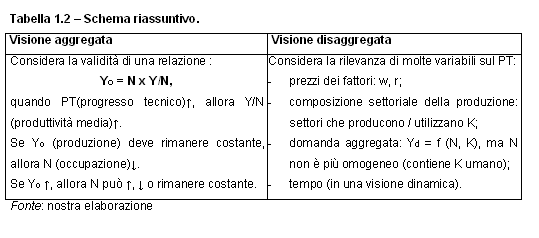
We will begin by introducing our topic, briefly illustrating the theories, dominant in the 17th and 18th centuries, proposed by the mercantilists and, subsequently, we will discuss those offered by the classics, primarily the theory of compensation. In the second paragraph we will study neoclassical thought, in the third that of Keynes and Schumpeter, in the fourth we will refer to more recent theoretical studies. To conclude, in the last paragraph, we will attempt to give an overall comparative vision of the thought of the main authors of the various schools cited by us here. Furthermore, we will propose a general summary scheme that allows us to compare the trend of the different variables which, according to the various economic theories, influence the link between technical progress and employment.
1.1. The hypothesis of ``compensation`` of effects: from mercantilists to classics
1.1. The hypothesis of "compensation" of effects: from mercantilists to classics
The mercantilists already addressed the relationship between employment and technical change: the latter was then defined as "Simplifications of the Arts". These were generally viewed favorably since, as Sir William Petty argued², they allowed "one man to do the work of five men" (Petty, 1690). However, as soon as negative consequences on employment became apparent, it was decided to introduce restrictive legislation on the use of machinery. Colbert³ himself opposed the introduction of machines (which he defined as "enemies of work") in private companies and, in this sense, developed so-called legislation. anti-machines. Conversely, he advocated their adoption in public companies "to shorten time and save costs". Mercantilists noted the advantages of technological superiority in international trade, but at the same time feared social disturbances due to the replacement of labor. Their contribution, in some ways, laid the foundations for the subsequent and more complex thought of the classics. In 1767 James Steuart, for example, anticipated Ricardo's thinking by half a century, explaining how sudden mechanization could lead to temporary unemployment. He realized that the use of machines could reduce costs and, therefore, prices, but that an explicit connection with the demand for labor was rarely detected, thus being able to unequivocally predict the sign and extent of the final variation. On the one hand, the advantage in terms of price competitiveness of the goods obtained through the use of machines was not denied, on the other, the uncertainties regarding the final outcomes on the employment front that they could entail were intuited: "If these have the effect of taking away bread from hundreds, previously employed to carry out simple operations, they also have the effect of giving bread to thousands" (Steuart, 1767, book I, page 256). In fact, in the long run there would have been compensatory effects (thanks to the increase in employment in companies producing machinery and thanks to the reduction in prices, which would have increased demand), but, contrary to what supporters of Say's law of outlets would later assume5, Steuart doubted that markets would always balance. Indeed, aware that the problem of re-employment of workers unemployed due to machines could not be resolved automatically, he argued that the government should address and resolve the issue. It was up to the statesman "to prevent the vicissitudes of processes and products from damaging common interests due to their... natural consequences" (ibidem, page 120). Steuart argued that it should be looked at as a question of reallocation of workers between the different productive sectors; since "a machine introduced into an industry made arms superfluous in that sector, which could quickly be used in another" (ibidem, page 120). He neither explained the reason nor clarified how mobility between the various sectors should be promoted, but it was this author who was the first to intuit that an obstacle to the re-employment of the unemployed can arise from the different skills required by the various occupations, reiterating that the State must alleviate the inconveniences of these transformations. Classical economists supported the validity of the theory of compensation6, i.e. the temporary nature of the sacrifices that must be borne by workers due to the direct effects that technical progress brings on the employed workforce. They believed that the introduction of machines reduced employment in the short term, but that in the long term the loss of jobs did not remain permanent, because the workers expelled from the machines would re-enter the production process to produce them and to respond to the increase in demand, determined by the decrease in prices caused by the new technologies. From this perspective, the compensation of the effects was an endogenous mechanism and did not require particular behaviors of the various classes. Basically, technological unemployment for the classics could therefore occur when there is no increase in production capable of reabsorbing it (since there is an insufficient increase in global demand), or because there is an insufficient supply of capital for this purpose. In 1776 the work of Adam Smith7 marked the birth of modern economic thought. The industrial revolution, which began in England in the second half of the eighteenth century, rapidly transformed industrial relations and methods of production, sanctioning the transition from an exchange economy to one based on the factory system. Regarding the relationship between the introduction of machines and employment, Smith did not see the hypothesis of technological unemployment as inevitable. He essentially believed that increases in productivity8, by increasing production, could have left the number of employed people unchanged, if the greater product obtained had been entirely placed on the market: "This great increase in the quantity of the product, given by the division of labour, is generated by the same volume of employed people for three reasons:
- for increasing the dexterity of each individual worker;
- for saving time, which is normally lost in moving from one type of operation to another;
- for the invention of a great number of machines which facilitate and reduce the time of labour" (Smith, 1776, p. 6).
According to this reasoning, technological unemployment could only exist if the market was incapable of entirely absorbing the increased production resulting from technological change. In Smithian thought, the division of labor is placed at the center of inventive activity because it allows attention to be focused on a single task or occupation, so as to increase returns. It is essentially seen as specialization, through which the link between the different levels of production and the various types of workers' abilities is better explained. In his theoretical scheme of the industrial structure, which he examined in the division between sectors and branches, Smith considers different groups of workers, whose specific skills intervene usefully in production. In conclusion, the author sees the labor factor as a heterogeneous whole, since those who participate in the production process have different skills and a different level of qualification. Smith's thinking significantly influenced the debate that arose shortly thereafter on technological unemployment, also due to the various historical events of the period. In March 1812, the first organized social uprising against the use of machines took place in a township in Nottingham, England. This movement, which was called "Luddism" after its legendary leader, the factory worker Ned Ludd, opposed the introduction of a new large sock loom (the Spinning Jenny) into home knitting. It was a revolt against job losses and poor product quality, made by highly skilled independent workers. They defended themselves from the extension of machinery, which allowed the massive recruitment of women and children to replace the qualified workforce. "General Ludd" argued that the deterioration of quality would lead to the loss of many markets and a further decline in employment. The movement was well organized and achieved some success, which brought great alarm: the doctrine of classical economics was increasingly invoked to justify repressive actions against the Luddites (who were punished by death) and against the trade unions. This was the background that gave life to the thought and work of David Ricardo9, a classical economist who was the first to express a change of opinion, compared to previous theories, on the question of the employment impact of innovation. In 1821, Ricardo, in the third edition of his Principles10, clearly stated that the introduction of technological innovations could harm workers, since the high cost of machinery, by reducing the wage fund, could create unemployment. Ricardo argued, more precisely, that the substitution of machines for human labor was generally harmful to the interests of the working class, while it was normally advantageous for capitalists and landowners. In this regard he unleashed a bitter diatribe by stating: "The opinion, specific to the working class, that the use of machinery is often harmful to its interests, is not based on prejudices or errors, but is aligned with the correct principles of political economy" (Ricardo, 1817, page 392). The reasoning is based on the assumption that the increase in net product, generated by technical change (from which only landowners and capitalists benefit) is not necessarily accompanied by an increase in gross product (on which, however, overall income and the level of global employment depend): on the contrary, this can even decrease. Ricardo demonstrates that the introduction of machines leads to a change in the composition of capital, transforming a part of it from circulating to fixed. If the total capital is given, the increase in the fixed capital reduces the share of working capital allocated to the maintenance of workers (wage fund), therefore leading to a reduction in employment. If the use of new technologies (and therefore of a new production technique) ensures the same profits as the previous technique, even if with lower production, then the capitalist can be satisfied, while the workers are damaged by what Ricardo calls "unemployment from mechanization". To increase circulating capital, however, there is the possibility of increasing global capital: it depends on the capitalist's positive propensity to save on his own income and on the decrease in prices11. But, if these two conditions were not met, unemployment would be generated due to time lags and the inflexibility of work mechanisms, directly resulting from supply limitations. At that time, in any case, Ricardo felt obliged to modify his rather severe formulation and to note the long-term compensatory effects. The introduction of machines favors the decrease in the prices of goods, as it lowers the cost of production; thus, given the same nominal incomes and needs, the capitalist will be able to save more. The capital increase allows for an increase in employment. Indeed, if production increased, thanks to machines, so much as to provide in the form of net product the same volume of goods previously had as gross product, there would not necessarily even be unemployment. Fundamentally, Ricardo believes that machines and labor are in constant competition with each other and that the introduction of machines into the production of goods depends on the price of labor. In conclusion, in the Ricardian scheme, technical progress saves work for the productions affected by technological change. The possibility of reabsorbing "freed" workers depends on the size of the net product which determines the level of capital accumulation, on the share of this allocated to working capital and on the level of demand for goods and services. In some cases, all these elements could favor the reabsorption of "unemployment from mechanization" through the growth of overall employment.
Another of the fundamental authors of economic thought included within the classical trend was Karl Marx12. He believed that technical progress was a fundamental variable of the entire economic system. In this sense, capitalism was characterized by a continuous search for new products and industrial processes. He especially emphasized the importance of the social transformations caused by "technological revolutions". Marx highlighted that bitter conflicts in the labor market can lead to an acceleration of mechanization processes, with a consequent expulsion of numerous workers from the production process (Marx, 1952, I, chapter XIII, 5). According to his vision, competition between entrepreneurs causes them to adopt increasingly capital-intensive techniques, indirectly causing downward pressure on wages: "The more productive capital grows, the more the division of labor and the use of machines extend. The more the division of labor and the use of machines extend, the more the competition of the workers extends, the more their wages contract" (Marx, 1849). Marx also underlined that the accumulation of capital, the basis of economic development, causes an increase in the organic composition of capital, i.e. the ratio between fixed and variable capital. This translates into a relative decrease in the demand for labor force and, therefore, an increase in unemployment. This creates an industrial reserve army, the size of which varies in the various phases of the economic cycle. In conclusion, for Marx technological unemployment is caused by a progressive substitution of machines for work.
Note 1: The expression "mercantilist" was used for the first time by Adam Smith to indicate the protectionist policy of the European states of 1700. The mercantilists were a heterogeneous group of authors who lived between the 16th and 18th centuries; many of them held roles in the public life of their respective countries. Note 2: Sir William Petty (1623 - 1687) worked in political economy and was a pioneer of statistics. He affirmed the importance of observation and numerical measurement of economic aggregates. He was part of Oliver Cromwell's army and took part in the expedition that suppressed the Irish revolt. Note 3: Jean Baptiste Colbert (1619 - 1683) was King Louis XIV's finance minister for 22 years. He was among the greatest exponents of mercantilist thought Note 4: James Steuart accepted a government responsibility to keep employment stable, through a series of interventionist measures. Note 5: Say's law of outlets states that supply generates its own demand. In this case, there could be no imbalance situations. Note 6: This theory expresses the central thesis of neoclassical thought regarding the effects of technical progress on employment. The exponents of this line of thought will treat and develop it fully. We therefore believe it is more appropriate to postpone the discussion in subparagraph 1.2.1. Note 7: Adam Smith (1723 - 1790) was the founder of modern economics. He wrote Inquiry into the Nature and Causes of the Wealth of Nations as a cornerstone of economic theory. Note 8: Productivity means the quantity of product obtained for each unit of work entered into the production process. Note 9: David Ricardo (1772 - 1823) was an English economist and politician, advocate of liberalism. He dealt with issues concerning income, agricultural duties and international trade. It influenced Marx's political thought. Note 10: In his most important work, On the Principles of Political Economy and Taxation, Ricardo dealt with the topic of the introduction of machines into production processes in chapter XXXI (on Machinery). Note 11: For Ricardo, it is real wages that must increase and, since monetary incomes are assumed constant, the price level must decrease. Note 12: Karl Marx (1818 - 1883) was an economist and philosopher. He developed an overall philosophy, "materialism
1.2. Compensation in the flexibility of prices and wages: the neoclassicals
1.2. Compensation in the flexibility of prices and wages: the neoclassicals
The theory of compensation, formulated by the neoclassicals, is based on some fundamental assumptions which mainly hinge on Say's law of outlets: in particular, the flexibility of prices and wages is postulated as an adjustment mechanism capable of reabsorbing the unemployment initially created by the introduction of machines. Other important hypotheses underlying neoclassical reasoning are those of the perfect competition of all markets and the tendency of these to always achieve equilibrium, unless the existence of "frictions". Furthermore, perfect substitutability between production factors is assumed. Charles Babbage¹ should certainly be counted among the supporters of compensation. His treatise On the Economy of Machinery and Production (1832) is the apotheosis of the application of the scientific system to economic life. He had an in-depth knowledge of many industrial processes and addressed with originality the theme of the displacement of labor due to mechanization: for him, introducing machinery was, in fact, only an incomplete way to increase labor productivity. The first edition of his work was so successful that after a few months a second was published, in which he added a chapter on the effect of machines in reducing the demand for labour. At the beginning of this chapter, he gives full credence to the compensation theory by arguing: "In countries where occupations are divided and the division of labor is carried on, the ultimate consequence of improvements in machinery is almost invariably the cause of an increased demand for labour" (Babbage, 1835, p. 335). According to him, this positive effect resulted from the increase in demand linked to the reduction in prices. He was a forerunner of profit-sharing and the participation of labor in decisions regarding production to avoid the danger of unemployment.
Knut Wicksell, a great Swedish economist, also a supporter of the compensation theory, argued that it was wages (and not prices) that set it in motion. He based himself on the law of marginal productivity of production factors². Due to the expulsion of workers for the implementation of technical innovations, the supply of labor increases compared to the demand: this leads to a decrease in wages. This variation in the remuneration of labor compared to that of capital stimulates the demand for labour, the use of which is now more convenient precisely in productions that still employ less innovative production methods: the unemployment generated by technological change is to a certain extent reabsorbed by the hiring of workers at reduced wages. Furthermore, the lowering of prices leads to a further expansion, first of global demand, then of production and, finally, of employment. However, if there were any downward rigidity of wages, due to union or legislative policies or the refusal of individuals to work for a wage deemed inadequate, then unemployment would be generated, which therefore cannot in itself be attributed to technological progress.
Note 1: Charles Babbage, Newton's successor in the Cambridge chair of mathematics, was an excellent mathematician and economist. He invented the first mechanical calculator. Note 2: The law of marginal productivity, as we will see later, hypothesizes, given all the prices of the factors of production, their "minimum cost" combination will be given by the condition that the marginal products of the factors are proportional to their prices.
1.2.1. The various mechanisms of compensation
From its first inception, the theory has revealed the existence of economic forces that can spontaneously compensate for the initial decrease in employment due to technical progress. Six types of compensation mechanisms have been identified (Vivarelli - Pianta, 2000), of which we have already analyzed two. The first compensation mechanism seen is the one that is achieved "via a decrease in prices": this is the general position of neoclassical theory. It is argued that, on the one hand, innovations displace workers and that, on the other, they lead to a decrease in unit costs and prices and, subsequently, an increase in demand, production and employment. The second compensation mechanism is the one proposed by Wicksell "via a decrease in wages": the direct negative effect of labor-saving technologies on employment can be positively compensated by a decrease in wages, which induces the adoption of labor-intensive production techniques. A third compensation mechanism is the one known as "via new machines": the same innovations that displace workers in the industries that introduce them create new jobs in the primary sectors in which these machines are produced. The fourth mechanism that allows compensation is known to us as "via reinvestment of profits" or "via new investments": if the reduction in costs due to technical progress is not completely transferred to prices, innovative companies accumulate extra profits, which if reinvested lead to an increase in production and generate new jobs. The fifth way to compensate for the employment lost with progress is called "via increase in incomes": the increase in productivity, linked to the introduction of new technologies, is transferred to higher wages, stimulates consumption, production and employment, so much so that it can also compensate for the initial job losses. The sixth and final compensation mechanism evident to us is the "via new products" one: technological change does not always equate to process innovations, it can also take the form of the creation and marketing of new products, in which case new economic sectors and new jobs develop. Of course, all these mechanisms can function in whole or in part, depending on different circumstances. From this perspective, neither the pessimistic trend, based on the fear that current forms of compensation have weakened the positive correlation between growth and employment, nor the optimistic trend, according to which there really is a long-term compensation for jobs that have been lost due to technical progress in the short term, no longer makes sense. Indeed, the lasting effects of technological change cannot be deduced either from the initial dismissal of workers due to labor-saving innovation of the pessimistic tradition, nor from the acute observations based on aggregate or microeconomic evidence of the optimistic one. In conclusion, an open attitude is an essential starting point for studying the relationship between technological change and employment.
1.2.2. Marginal productivity and production techniques
Hicks writes that an entrepreneur who has to choose between two production techniques will choose the least expensive one and, later, he also adds "the law of marginal productivity tells us that, assuming all the prices of the factors of production are given, their "minimum cost" combination will be given by the condition that the marginal products of the factors are proportional to their prices" (Hicks, 1936).
Table 1.1 - The mechanism of choice of the production technique according to the neoclassicals.
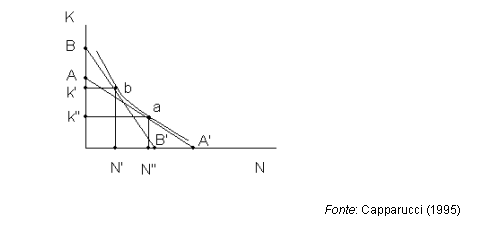 Table 1.1 describes the mechanism of choosing a production technique supported by the neoclassicals.
The entrepreneur will evaluate the relationship between marginal productivity and the price of labor compared to that of capital.
Therefore, we will move from technique a to technique b, when we have a situation where:
Table 1.1 describes the mechanism of choosing a production technique supported by the neoclassicals.
The entrepreneur will evaluate the relationship between marginal productivity and the price of labor compared to that of capital.
Therefore, we will move from technique a to technique b, when we have a situation where:

Note 1: This mechanism, in contrast to the one via decreasing wages, was proposed by Keynes and Kaldor.
1.3. From Keynes' brief period to Schumpeterian theories of innovation
1.3. From Keynes' brief period to Schumpeterian theories of innovation
In the General Theory of Employment, Interest and Money (1936) John Maynard Keynes¹ did not directly examine the problem of investments aimed at introducing new technologies. He did not grasp the role they played in increasing the marginal efficiency of capital. This is especially surprising because six years earlier in the Treatise on Money (1930) Keynes had unequivocally accepted the explanation given by Schumpeter on the main origins of investments in capitalist societies. It is in this work that Keynes argues that "entrepreneurs are induced or dissuaded from embarking on the production of fixed capital by expectations of the profit which will result from it." What is surprising is that neither Keynes nor the Keynesians followed up on recognizing the decisive role of technical innovation. In the Theory he regressed to a position in which he neglected technology, considered it as given, even as he presented a very artificial concept such as that of the secular decline of the marginal efficiency of capital, completely detaching it from real technical changes or the composition of capital. In accordance with this statement, it became indifferent to Keynesians what the new technologies and fastest-growing industries were. This is where the main point of Schumpeter's objection came from.
Contrary to Keynes and the neoclassicals, but in accordance with what Marx stated, technological progress is in Schumpeter's thought at the center of the dynamics of our economic system. While for the former, growth is limited to accompanying the emergence of new industries and technologies, for this author the system is driven by such innovations and their diffusion. The relevance of Schumpeter's work lies in having proposed a theory of economic change over time. Starting from the behavior of each producer, innovator or not, he developed a theory of innovation at the company level. By innovation the economist means multiple forms of change: the introduction of new products, process innovation (changes in technology to produce already commercialized goods), the opening of new markets or new sources of supply, the Taylorization³ of work, a better use of raw materials or even new forms of commercial organization (Schumpeter, 1939). By technological innovation Schumpeter refers directly to changes in production techniques. Schumpeter considers innovation to be the distinctive feature of capitalist society, what differentiates it from a situation of "stationary equilibrium". In his theoretical scheme, the author introduces four important hypotheses: in the first, innovations involve the construction of new plants and equipment and require a considerable expenditure of time and money. In the second hypothesis, Schumpeter claims that before introducing innovations there is no concretely unused resource from the production process. The third hypothesis is that according to which innovations are incorporated into "new" companies, which place themselves alongside the "old", generating a competitive struggle within the industry, due to the lowering of the total unit cost curves, given precisely by technological progress. More precisely, they are the innovations that lower the average cost curves and provoke the struggle between companies and the upheaval of the existing industrial structure. In Capitalism, Socialism and Democracy (1943) the author says that "the competition created by the new commodity, the new technique, the new source of supply, the new organizational type... conditions a decisive advantage in cost and quality" (p. 80). In his fourth hypothesis, Schumpeter claims that entrepreneurs are "new men"4 who actually implement innovations. In The Theory of Economic Development (1912) he defines an entrepreneur as anyone who "introduces a new combination". Entrepreneurs do not form a social class, theirs is not a profession or even a lasting condition. Their identity is closely linked to innovative action and ceases when this form of action runs out. The entrepreneur's ability to innovate is rewarded by profit, which he is entitled to since it is the fruit of his creative action. It "is the expression of the value of the entrepreneur's contribution to production" (Schumpeter, 1912). The "new men" hypothesis explains why innovations are not introduced at the same time by all companies, but only by some (the "new" companies) and then subsequently, passing through a phase of imitation, they spread throughout the entire production structure. This happens because innovating is not easy, as the surrounding environment poses a certain resistance to novelties, while it accepts the repetition of usual acts with neutral benevolence. Hence the genius and relevance of the innovative entrepreneur's contribution. In conclusion, Schumpeter places entrepreneurship as the only active element of the development process; it is embodied by the figure of the innovative entrepreneur and reduces every other social figure to a subordinate role in the process of evolution of the system. Having established the hypotheses, let us therefore examine the theory of economic change. To build the new plant and introduce modern machinery (which he orders from existing companies), the entrepreneur borrows the necessary funds from the capitalists. The path to innovation is simpler, other entrepreneurs decide to adopt more capital intensive production techniques. Since there are initially no unused resources, the prices of the factors of production (nominal wage and interest rate) increase due to the increase in demand. When the first company's new goods enter the market, they are purchased at precisely the price the entrepreneur hoped to sell them: profits begin to appear. The new enterprises come into operation one after the other and increase the total production of consumer goods, which had previously been decreased to produce the plants and machinery. Thus we have that imbalance which stimulates the reorganization process of the entire industry: existing companies begin a painful process of modernization and rationalisation. However, as long as new businesses arise and pour their spending flow into the system, the negative effects of innovation (i.e. unemployment from restructuring) are offset. In conclusion, Schumpeter states that the main means of reabsorbing this type of unemployment is the entrepreneur's spending, which is reduced as new products enter the market and the repayments of initially contracted debts increase. This leads to a "zone of equilibrium" from which entrepreneurial activity will restart. Throughout the theory of economic change, it is clear that Schumpeter saw the innovative process as an unbalancing force in the economic system, rather than as a type of uniform and incessant transformation. He formally justified this vision on three levels. First of all, innovations tend to be concentrated almost exclusively in a few key sectors and their surroundings. The result is asymmetry and disharmony, which causes structural adjustment problems between the different sectors of each growing economy. Secondly, the diffusion process represents the means through which innovations generate the greatest sources of investment and product growth. Its trend is intrinsically irregular with cyclical characteristics. In fact, generally the launch of a new product is often characterized by a slow start, but usually followed by rapid growth, due to a certain "carry-over effect" on imitators. Finally, profit expectations change during the growth period, as the process of imitation erodes innovators' profit margins. Market saturation reduces production, profitability and the attractiveness of other investments. Fundamentally, innovations constitute the element of organic transformation of the industry. They incessantly overturn economic structures from within, destroying the old and creating the new. Innovation generates greater social production, the same total sum of nominal incomes, a lower price level (economic change is triggered by the change in prices, not by that of nominal wages). It is clear that the long-term results of the innovative effort have been passed on to consumers in the form of an increase in real income. In short, innovating has a net positive effect on the economic system in terms of greater well-being. In this regard, in Capitalism, Socialism, Democracy he states that: "The capitalist process, ...by virtue of its very mechanism, determines a progressive increase in the standard of living of the masses...in any case" (Schumpeter, 1943). Schumpeter highlighted the fact that technical progress consists in the creation of new products and industries, that is, in what he properly defined as "creative destruction". It eliminates jobs in old industries and creates jobs in new ones. “This mechanism of creative destruction is the essential fact of capitalism, what capitalism consists of” (Schumpeter, 1977, p. 79). For Schumpeter, the process of economic change in the system consists in the systematic reiteration of two phases of considerable weight: the first, the prosperity phase, sees the move away from a position of equilibrium due to the solicitation of the innovative activity of the entrepreneur, while the second, which is known as the recession phase, consists in the system moving closer to another position of equilibrium. Both stages are the result of two opposing tendencies inherent in capitalism, which are competitive struggle and perfect competition. In the first phase, competition, generated by innovative action, unbalances the system and generates profits, producing a phase of cyclical prosperity, characterized at an employment level by almost full employment. Instead, in the second phase, competition is perfect and is based on rational imitative action. It opens a phase of statization, which tends to bring the system back towards stationary equilibrium, through the equalization of profits and their progressive elimination. In this second phase, even if there is perfect competition, even if at the beginning of the process of economic change all the productive resources were used, there is unemployment. A similar phenomenon of imbalance in the labor market is expressed by Schumpeter in this way: "Our company is almost necessarily in an imperfect position, even if the system in other respects is perfectly competitive" (Schumpeter, 1939, page 135). He states that the behavior of economic subjects is characterized by uncertainty even in a regime of perfect competition, since reality changes incessantly and this constitutes an internal element of indeterminacy. A direct consequence of this is that paradoxically the system is closer to equilibrium, where it is strongly unbalanced by the effects of technological progress, rather than in the depression phase, when there is perfect competition and unemployment. Clearly, Schumpeter attributed the emergence of unemployment to technological transformations. However, since relevant inventions occur at cyclical intervals, the growth phases of investments will also occur at periodic time intervals: this results in cyclical fluctuations in the trend of economic development and, therefore, in "cyclical" employment. At this point it is clear that, for Schumpeter, cyclical and technological unemployment coincide. Precisely in this regard, he was able to authoritatively maintain: "Technological unemployment..., linking...with innovation, is by its nature cyclical. In our historical analyses, ...prolonged periods of above-average unemployment coincide with the periods in which the results of inventions spread throughout the system...as in the 1820s and 1980s" (Schumpeter, 1939)5. Schumpeter refers to those years, since he looked at the employment phenomenon with reference to long cycles (of half a century), which he cites as "Kondrat'ev cycles". Schumpeter links them with technical change, given that the process of diffusion of every important new technology even takes a few decades to take place. According to Schumpeter, long cycles were a succession of technological transformations7 of the economic system, which required that profound structural change that was given by creative destruction, through what he defines as "successive industrial revolutions". The diffusion of new technologies could explain the long waves of economic development, if such innovations had a shocking impact on the entire system. Kondratiev suggested that they had to be massive and require extensive diffusion time (like electricity or railways) in order to give the economy an upward boost. Of course, in addition to their direct effects, innovations would influence expectations and opportunities in almost all industries. Finally, the question that Schumpeter asks is whether economic policy can solve the system's employment problems. He believes that cyclical unemployment is an unavoidable constitutive element of the development process and that, therefore, it can only be considered as a social cost that the entire society must bear. A high unemployment rate follows phases of prosperity in periods of adaptation, so it is essentially a passing event. However, temporary or permanent, unemployment is experienced as a scourge in any case. The gravity of the phenomenon is given by the impossibility of adequately providing for the unemployed, without damaging the conditions for further economic development. The solutions proposed by Schumpeter to the problem are in favor of facilitating professional and territorial mobility (which, if absent, can generate unemployment, at least in the short term), and of an intervention plan to support the unemployed, through an adequate use of the surplus resources that capitalist development frees.
According to what was highlighted in the various Schumpeterian works, the belief was gradually becoming established that the transformations linked to new technologies, by generating an increase in labor productivity, tended to reduce the quantity of work necessary to produce a unit of output. Gregory, in a 1930 article, also argued that market "imperfections" and technological conditions resulted in a certain amount of permanent unemployment. Therefore, in the analysis of technological unemployment, alongside the traditional hypothesis of compensation, a new path was opened which contemplated the idea of structural unemployment. Emil Lederer8 (1931) developed Schumpeter's ideas, showing a firm desire to close with the theory of compensation, considered of a certain importance only from a static perspective, to address a dynamic analysis of the relationship between technical progress and employment. He particularly explored the concept of structural unemployment due to its strong links with the trend of technical progress, placing specific emphasis on the distinction between static companies and innovative companies. The waves of technical progress determine different effects on them: in static companies, there is a slowdown in the growth of production, employment and capital, at the same time in innovative companies (which replace capital with labour), there is a reduction in employment: this is why unemployment is created in the production system (Palmerio, 1987). Hansen9 in 1932 ideally closed the debate of the 1930s on technological unemployment. He reiterated in the context of neoclassical theory, centered on the substitutability of production factors and the importance of market mechanisms, that "technological innovations disturb the correct mechanism for determining the prices of production factors. ...A flexible system between wages and interest rates and an increase in new investments are the main instruments through which work, displaced by technological innovations, is...reabsorbed" (Hansen, 1932, pp. 27-29). Seen from this perspective, the problem of technological unemployment no longer makes any sense: it is replaced by a concept of frictional unemployment. Indeed, Hansen concedes much to the interference of institutional impediments and the malfunctioning of markets.
Note 1: John Maynard Keynes (1883 - 1946) was one of the most influential economists of all time. He was one of the first authors who supported the need for state intervention through specific measures to combat depression, contrary to what had been affirmed by the laissez-faire theory until then. Note 2: Joseph Alois Schumpeter (1883 - 1950) was a well-known Austrian economist of the first half of the 1900s. He argued that growth in a private business economy was due to the profits expected by entrepreneurs. Note 3: Taylorism was a movement for the scientific organization of work (scientific management) born at the end of the 19th century thanks to Frederick Winslow Taylor. It was based on three key principles: the first involved the systematic observation of the workers' movements, the chronometric detection and the statistical classification of the times used, in order to be able to establish the one best way (the only best way) to carry out a work operation and the optimal time necessary for it. The second principle supported the intervention of management in the worker's work activity to dictate its methods. The third principle saw the systematic expropriation of workers' knowledge in order to transfer it to the management and planning offices. Taylor's proposal presented itself as an initiative aimed at making manpower, recalcitrant to the introduction of machines, compatible with the new technologies necessary for mass production. It did not succeed and a bitter trade union struggle arose. The Taylorization of work paved the way for the assembly line and the Fordism of Henry Ford, the "king of the car". Note 4: With this expression Schumpeter was probably referring to the homines novi of ancient Roman society. These were not born into families known for having held particular positions, they did not have an illustrious family tree to show as credentials, but they stood out for their particular gifts of eloquence and political ability. They were men like Cato the Censor, Gaius Marius and Cicero, who were personally architects of their own destiny. For Schumpeter, the entrepreneur is a true homo novo, who created an invention by himself and developed it in his company. Only later was he imitated by other companies. Note 5: Cited in Freeman - Soete, 1994, pag. 36. Note 6: Kondrat'ev was a Russian economist, director of the Moscow Economic Research Institute. In the 1920s, he described the occupational cycles that bear his name. Previously, van Gelderen had already spoken about it in 1913 in a work written only in Dutch and, therefore, unknown to both Schumpeter and Kondrat'ev. Note 7: As claimed by Rosenberg (1976), the diffusion process does not allow the new product to be replicated in the same way, but implies (in addition to its improvement) improvements in processes, components, subsystems, raw materials and management methods. Note 8: Emil Lederer was a German economist, known for the publication of the work Technical Progress and Unemployment. The book had a fair response in the academic world, but was harshly panned by Kaldor in 1932. Note 9: Alvin Harvey Hansen (1887 - 1975), American economist, who believed that an economic depression like that of the 1930s could only be prevented with public intervention in favor of full employment. His proposals also included increased government spending on schools, hospitals and roads. His suggestions were implemented in the Employment Act of 1946.
1.4. Recent theoretical studies
1.4. Recent theoretical studies
In more recent times, Carlota Perez (1983) assumed that the "phases of prosperity" take place when a "happy meeting" occurs between the new technologies of a long wave and the institutional framework. Conversely, according to his thinking, depressions represent periods of disconnect between emerging production techniques and institutions. The widespread generalization of new technologies is only possible following a period of adaptation of social institutions to the characteristics and potential of the new techniques. Perez notes that Schumpeter belatedly recognized the need for government policies that addressed depressions, and in very general terms at that. Indeed, he took a mostly hostile position towards Keynesian theory. According to Perez, the failure to match the institutional framework with the exceptional cost and productivity advantages provides the impetus to seek social and political reforms to overcome the crisis. In any case, the time required will be long, because it is necessary to change the education and training system, the administrative and business structures, the capital markets, the financial systems, the type of investments, the laws, politics and trade at a national and international level. Public intervention is therefore essential. The French school of interventionist economists has also highlighted the relevance of periods of institutional change for alignment with structural changes. In particular, Boyer (1989) insisted on the institutional innovation capacity of each country. There is a need to change management methods, industrial relations and labor policies to obtain a sufficient degree of investment for a new level of economic and technical development.
In 1981 Pasinetti published his Structural Change and Economic Growth, an essay on economic theory on the long-term evolution of the industrial system, building a dynamic multi-sectoral model. Let us analyze the implications, in the presence of technical progress, on the structural change in production and employment, on the change in the composition of demand (given by the change in consumer tastes and preferences) and on a growing population. Let's see what the three new features of the model proposed here are. First, Pasinetti builds a disaggregated multi-sector model, which considers the different variations in productivity in different branches of the economy. This analytical approach is very different from traditional ones, whether classical or Keynesian. Secondly, it defines the concept of vertical integration of the production process, as the phenomenon by which each factor is made into an input of work or service rendered by stocks of capital goods, without transitional phases. In this way, Pasinetti allows the carrying out of a dynamic analysis, starting from an input-output scheme, also considering technical progress. Finally, he develops his study according to that type of investigation that the classics defined as "natural", because it is so fundamental as to be detached from the institutional situation of society. For the author, the neoclassical scheme (based on the principle of maximization under given constraints) is inadequate to depict a modern industrial society, in which technological progress continually changes all data. The concept of industry is at the center of the work, it is dynamic and implies production and, therefore, an incessant learning process (which causes economic quantities to vary over time): this is precisely what technical progress consists of for Pasinetti. This continuous acquisition of know-how is the foundation of the entire system, as it aims to improve both processes and products. In essence, human work is the main creator of production, from which all possible goods can be produced. Before describing his model, Pasinetti considers some hypotheses. First of all, he defines his analytical scheme of pure production, on which he mainly focuses. The model is dominated by the learning process of individuals, both as regards improvements in production techniques and as regards the evolution of consumption preferences. In this regard, the second hypothesis sees the economic system represented by an autarchic model, in which only two activities are recognised: one of production and one of consumption. Thirdly, only the final produced goods are considered in the model: thus all production processes are represented as vertically integrated, that is to say that all factors are reduced to labor inputs or services provided by stocks of capital goods, without intermediate stages. The fourth hypothesis ensures that technical progress is such as to require the division of labor and marked specialization in every production process. At any time, the system has its own technical structure, represented by a series of production functions, each of which expresses the manufacture of each single good as a technical function of the various physical inputs (labour, capital goods, intermediate goods...). Fifthly, it should be noted that the single technique currently in operation is the only important one, it cannot be changed at a given moment. Only in the long term is it possible to change the technological structure, when new production methods are chosen with the replacement of worn-out capital goods. Sixth, the model assumes that in each period and in each sector a constant proportion of productive capacity vanishes as a result of its utilization. Finally, the study in question is aimed at the analysis of production and employment, which change structure as demand varies, which is endogenous, while population, technological knowledge and consumption models are exogenous. In particular, the population of the system provides the work flows to the various production processes and holds the stocks of capital goods. Furthermore, it expresses the demand for final goods, both consumption and investment.
After considering the hypotheses, let's now analyze the model. Pasinetti assumes that the economic system is initially in equilibrium: global demand generates exactly that volume of production that requires full employment of the existing workforce and the production capacity of the various sectors is fully utilised. It then maintains that as time passes the productivities¹ of the different sectors change (due to the introduction of technical progress), that per capita demand varies (due to a change in consumer preferences, resulting from the existence of new products) and that the population increases: therefore, to maintain the system in full employment equilibrium over time, two conditions must be satisfied. First, as population and technology change, the system must continually expand its production to keep pace with increases in per capita demand and increases in the workforce. Secondly, the macroeconomic condition of effective demand must be satisfied, which requires that demand increases in exactly proportion to productivity growth. If this were not the case, the system would generate unemployment. The model shows that maintaining full employment over time is not an endogenous fact and does not occur automatically. On the contrary, the economic system tends towards technological unemployment, because demand generally varies less than proportionally to income growth and cannot grow incessantly, since each good has a degree of saturation in consumption. However, there are two factors that operate in the long term and that manage to offset the negative effects of the dynamics of the economic system on employment. The first factor is precisely technical progress which, by increasing the sectors producing new goods, stimulates the growth of effective demand. The second factor is linked to the use of the workforce, with the decrease in the number of workers in the total population and/or with the reduction in the duration of the working week. Yet, even if the macroeconomic demand condition were always satisfied, on average half of the sectors would generate technological unemployment over time, while the other half would reabsorb the unemployment created by sectors in which the growth of per capita demand is lower than that of productivity. Therefore, if macroeconomic balance is to be maintained, employment requires strong intersectoral mobility of the workforce. If the population grew, the equilibrium could be favored by the early retirement of some of the older workers in declining sectors, if demand was stagnant or contracting, and also by the entry of young people into expanding sectors. Furthermore, the increase in inhabitants brings with it an expansion in demand for all goods. On the other hand, it is productivity growth that generates technological unemployment. The overall effect of these variables is to vary the entire structure of employment, in other words the proportions in which workers are distributed among the different sectors of the economy. Three final considerations can be proposed regarding the structural dynamics of production and employment in the presence of technical progress. The first is that operators are forced to make ever new decisions to direct the system towards equilibrium: they cannot rely on the system's self-regulation mechanisms, because these mechanisms do not operate in the desired direction. There is an industrial policy problem of technological innovation. The second consideration is that satisfying the macroeconomic equilibrium condition of full employment does not serve to maintain the dynamic equilibrium. An employment policy problem therefore arises, given that the dynamics of the system requires a redistribution of employment between the various sectors based on the evolution of technology and demand. The last consideration concerns the implicit assumption of a given price structure and a given income distribution, to whose variations demand is sensitive. Furthermore, in the model the rate of profit influences the choice of technique and the wage rate influences the degree of mechanization of the production processes, i.e. the capital/labour ratio. In conclusion, Pasinetti suggests that technical progress is of a labour-saving type and that, therefore, its effects consist both in an increase in real wages in the long term and in a necessary redistribution of employment towards new and traditional productions, which have an expanding demand and/or result in a different distribution of working time across the entire workforce (Schilirò, 1984). According to Sylos Labini, inventions depend on many factors, some exogenous (as supported by most economists), others endogenous to the economic system (Sylos Labini, 1991).
The author defines endogenous as those inventions that are generated by purely economic motivations. We know that to translate into innovation, an invention must pass the economic test (in practice it must be profitable), but this does not mean that all inventions should be defined as endogenous. However, it defines as exogenous those inventions, great ideas, strokes of genius that come from intellectual progress, disinterested scientific progress and/or public pressures (for example, military or civil). These may also be potential inventions from the past, now implemented. In particular, the author notes that sometimes small innovations, often adaptations and improvements of large ones, advance economic development, even more than the latter. Sylos Labini also notes how certain elements stimulate the introduction of innovations into processes, first and foremost, the growth of real demand. The faster it is, the more likely it is that the latest innovations (both technical and organizational) offered on the market will be introduced into production. Another stimulus to the introduction of innovations is cost trends. When costs increase, it is necessary to compensate for this increase by increasing the efficiency of the production factors used, reorganizing industries with technical or management innovations. In this sense, industrial capitalism is in a continuous process of restructuring. Lastly, the presence of strong social conflicts can also push for an increase in the use of machines in production. Public research policy can unify the three thrusts; it is carried out by all governments, even those critical of public interventions in the economy, which rather than acting directly through public laboratories, give fiscal and credit incentives, help with contracts, orders and a legislative policy of patents and licenses. In conclusion, for Sylos Labini the links between innovation and employment appear quite complex: what matters is the speed of the increase in the supply of labour, in national income (from which the demand for labor originates) and in productivity (which depends precisely on technological and organizational innovations). Therefore, on the one hand, innovations can generate unemployment, depending on the speed of the increase in income. On the other hand, the increase in the workforce can increase unemployment, even if workers are not expelled either as a result of innovations or for other reasons.
Naturally, numerous authors have participated in the debate on the relationship between technical progress and employment, but it was decided here to propose only the thoughts of the most significant ones on the matter.
Note 1: For Pasinetti, technical progress manifests itself not only through increases in productivity, but also through the increase in the number of sectors.
1.5. Comparisons and debates
1.5. Comparisons and debates
From this brief review of the preclassical, classical, neoclassical, Keynesian, Schumpeterian and current theories on technical change and employment, it is clear to everyone that the adaptation of employment to technical change does not occur instantaneously and automatically. In any case, there are considerably acute difficulties in adjustment and structural unemployment. The differences between these schools lie in the estimation of the speed and regularity of adjustments and in the relative importance of each compensation mechanism. On the one hand, there is the self-regulating endogenous model, balancing the market, based on Say's law. In an intermediate position, Keynesian theory states that, however, the presence of "creaks and squeaks" must be recognized in this model. At the other extreme are the theories of Perez and Boyer. They believe that adjustments are achieved only thanks to social and political changes, suited to the characteristics of new technologies. In any case, these theories may be compatible in a certain way. Many neoclassicals recognize the importance of institutional and technical change, such as Olson (1982), who developed a theory of institutional rigidities. Furthermore, everyone would admit the existence of territorial disparities and other factors (such as competition and international trade), which could increase the severity of structural problems. The real discriminating factor between the various schools of economic thought is the uncertainty about the speed of adjustments. There is, therefore, enormous variability in forecasts on future employment levels, depending on whether these are Keynesian, neoclassical or other types of calculations. Separate cases are Pasinetti's model and Sylos Labini's theory. Pasinetti builds a multi-sectoral disaggregated dynamic model, considering the variations in productivity in the various branches of the economy. His analytical approach is different from traditional ones. Furthermore, it defines that new concept which is the vertical integration of the production process. Sylos Labini focuses on different, original themes, the endogenous or exogenous nature of innovations with respect to the economic system. In particular, it also analyzes the factors that stimulate the use of machinery in the production process. During the twentieth century, there have been two broad swings in conventional wisdom about unemployment. We went from the relatively optimistic vision of the beginning of the century to a profoundly pessimistic one in the 1930s, returning to great optimism in the 1950s and again to profound pessimism in the last two decades of the century. It seems that economists' thinking on the possibility of achieving reduced unemployment rates is significantly influenced by the growth trend of the decade preceding the one taken into consideration. Samuelson (1981) wrote bitterly: "My considered conjecture is that the final quarter of the twentieth century will lag far behind the third quarter in the real rate of economic progress. The gloomy horoscope of my old teacher Joseph Schumpeter may have particular relevance here¹". The reference to Schumpeter reminds us that it is better to try to explain the fluctuations in the trend of the economic cycle in the long term, rather than in the short term. In the following, to understand the long-term fluctuations in unemployment (which have affected all industrialized countries in the past century), we will consider the rise of new technologies, the decline or development of entire sectors, new infrastructure investments, shifts in the international location of industries and technological leadership, elements which were introduced into the debate for the first time by Schumpeter and Kondrat'ev.
Note 1: Cited in Freeman and Soete (1994).
2nd: ICT and Employment
2.0. Introduction
2.0. Introduction
In this second chapter, we intend to define the new paradigm linked to information and communication technologies (ICT) and the employment phenomenon in the three large Western blocs, with particular regard to that part of it linked to the introduction of new machinery in the production process. In the first paragraph, the advantages and characteristics of the new ICT paradigm will be defined and studied, also comparing it with the previous Fordist model. Furthermore, a chronology of its diffusion will be briefly presented. In the second paragraph, the current situation will be analyzed, evaluating the main trends and uncertainty regarding both the general economic situation and specifically the events relating to the ICT sector. In the third paragraph, the topic of the international relocalization of traditional manufacturing activities and productivity growth (towards developing countries), linked to ICT, will be explored as an element that can cause technological unemployment. Furthermore, we will see how foreign trade and international competition change depending on the diffusion of new technologies. In the fourth paragraph, we will discuss the various types of flexibility: salary, organizational and professional and in the fifth we will introduce the new most requested professional figures on the web. Finally, in the sixth we will address the employment situation in the sector and formulate hypotheses on the prospects for next year.
2.1. The characteristics of the new technoeconomic paradigm
2.1. The characteristics of the new technoeconomic paradigm
According to the definition of Freeman and Soete (1994), ICT (Information Communication Technology) is "a new technoeconomic paradigm concerning the design, management and control of systems of production of goods and services throughout the economy, based on an interconnected set of radical innovations in computers, software, control systems, integrated circuits and telecommunications, which have allowed a drastic reduction in the costs of storing, processing, transmitting and distributing information" (Freeman and Soete, 1994, page 47). The ICT paradigm is defined as technoeconomic, as the innovative technology at its disposal manages to spread throughout the market economy, providing both technical and economic benefits. Introducing an innovative technoeconomic paradigm means using a new production and design philosophy. The full enjoyment of its economic and social benefits, including the development of employment, depends on a process of social experimentation and learning, still in its infancy. The penetration of ICT concerns all sectors and services, their links and the characteristics of different industrial societies. The introduction of completely new technologies brings with it many social and institutional changes, including those of the employment model and professional qualifications. At the extreme, George Gilder (1993) in an article in the Economist claims that technical changes will stimulate institutional changes. The socio-institutional framework inherited from the past has sometimes not been correctly adapted to the potential of new technologies, hindering the process of job creation and increased productivity. For example, fifty years ago, one would have hardly imagined the spread of household appliances in all Italian homes and, even more so, the increase in employment that occurred in the industries that produced them. Likewise, it is currently difficult to predict future production and service delivery models in half a century. Nonetheless, only a long-term perspective can avoid that lack of imagination, which sees technical progress only as a reduction in the volume of employed people.
The choice of development, definition and application of information and communication technologies was strongly influenced by the advantages they allow to derive from competition, their expected profitability and the potential time savings they allow. The main types of advantages that the use of ICT brings with it can be divided into five categories: the first concerns the speed and precision with which information is processed and transmitted. Precisely this advantage was the central reason that led to the development of calculators. The second affects the storage capacity of an enormous amount of data. The third category refers to flexibility in the organization of production, design, marketing and administration. The fourth tells us about networking with and between businesses, individuals and organizations. Finally, the last one concerns the retrieval of information. In 1840, when the economist Charles Babbage created the first calculator, he did not have a valid technology available that would allow its commercial success, as it lacked the speed and precision of processing and transmitting information. Only in the 1940s was he able to realize his dream with the creation of electronic machines with great speed and memory capacity. The remaining advantages that computerized systems currently offer manifested themselves only during the diffusion process, revealing the birth of a model of new entrepreneurial development, in conflict with the old paradigm of Fordism. Below is a simplified comparison scheme between the two paradigms.
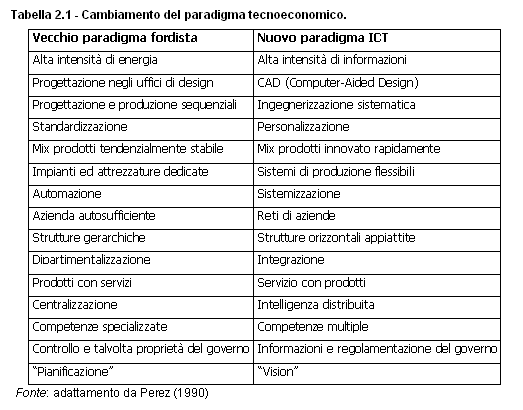
Initially, the computer was not a dominant technology, to survive it had to fight against profoundly different technologies and systems. It was believed that there would never be a high level of demand for such machines: their future was only for state, military and scientific applications. The difficulties were high, but already then, computers demonstrated all their technical advantages. In the 1950s, computers became part of the hierarchical structures of large companies, above all due to the time savings in storing and processing information in standardized applications that they allowed. Saving time is the key element, it has played a decisive role in the diffusion of ICT: the speed of data processing has grown exponentially. Its applications concern many aspects: the integration (via internal telematic networks of the company) of production programs and stock management with purchases and suppliers, the use of electronics in design with the use of CAD (which brought with it prompt processing of work in the "design offices"), the introduction of computerized warehouses and inventory control systems, capable of quickly dealing with even daily variations in demand. All these innovations led to a consequent reduction in lead-time¹ for new products and processes, greater flexibility of the product mix and subcontracting programs, faster processing of office procedures, an improvement in deliveries to the distribution chain, as well as savings in inventories. From the 1960s to today, the boom in integrated circuits has made it possible to reach the number of several million components placed on a chip. Rapid innovations in design and product mix were logical consequences, which thus became defining characteristics of the electronics industry. In the 1980s, speed, memory capacity, flexibility and integration into the Internet emerged. It was in this way that organizational and technical changes were inextricably linked. Flexible manufacturing systems (FMS and "systematization") and computer-integrated manufacturing (CIM) became the rule, replacing the diffusion of individual parts. Throughout the 1990s, PCs and microprocessors saw their great triumph. Without a doubt, software and information technology have constituted one of the fastest developing sectors of the last decade and, furthermore, the increase in employment has been very high. Currently, marketing's response to changes in consumer demand and the provision of ever-new services (such as tele-shopping, tele-banking, teleconferencing and teleworking) are certainly developing strongly. It should be added that success was only achieved through the involvement of end users in the technical, organizational and training change. The elite of companies that have succeeded in this activity have been able to reap great benefits of flexibility, and consequently economies of scope, quality, product image, design customization and rapid reactions to market changes.
Note 1: Lead-time means the settling period necessary for a new product or process to become dominant throughout the system.
2.2. Current trends: the uncertainty between crisis and recovery in the sector
2.2. Current trends: the uncertainty between crisis and recovery in the sector
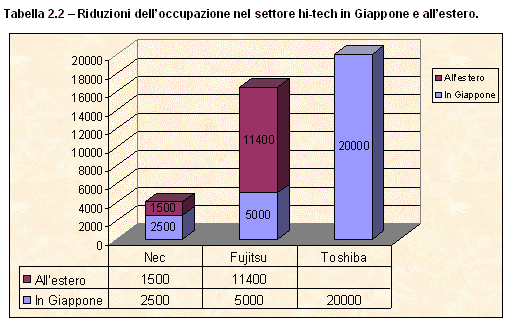
The birth and extension of a new paradigm (such as that of ICT) always implies a long and difficult process of continuous revision for both large and small companies, intensifying competition and displacing or forcing the change of antiquated procedures and institutions. In this sense, two opposite phenomena can be seen: while, in some industries related to information and communication technologies, small and medium-sized enterprises (SMEs) are flourishing and large companies are often reducing their size, in others, there is refocusing and a wave of mergers is underway. These trends are typical of a period of structural adjustment of the new paradigm, which sees many companies cutting their workforce and making structural changes. From an employment point of view, it should be noted that all these changes and the globalization of rapid technical and organizational innovations have generated dramatic consequences in the industrial and managerial structures of companies. The larger companies (with more extensive hierarchies and departments) found themselves facing the most serious difficulties: in fact, with the availability of data provided by computer networks, middle managers often disappeared. Furthermore, the greater decentralization of production methods towards smaller companies (outsourcing) has increased the push for down-sizing¹, further reducing the presence of middle managers in the company. The performance of SMEs will become increasingly relevant for the purposes of expanding employment, as they will be the ones to enable the employment adjustment started from the restructuring plans of large companies. According to Affari & Finanza (A&F) of 2 July 2001, a strong slowdown in hardware and software sales was already underway, especially in the USA, which had forced the giants of the hi-tech sector into heavy restructuring plans. The golden rule of the PC world, Moore's law, was back in vogue, according to which, as processing power increases, prices are cut. Currently, it is a real obligation for businesses given the period of significant economic slowdown, which in the ICT world has become almost panic. Recently, growth expectations seem to be facing a negative phase: if in the 1980s the most dynamic production system in developed countries was that of Japan, in the 1990s it began to go through a crisis from which it has not yet recovered, even as regards the ICT sector (A&F, 3 September 2001, pp. 10 - 11). The Japanese economy is seeing exports slow down, production decrease, consumption stop and, furthermore, the country is buried under an amount of debt equal to five times its gross product. In short, Japan is hit by deflation (at 2%), recession and unemployment (at 5%). It should be noted that almost 1,000,000 Japanese workers have lost their jobs in recent months, yet only 120,000 are registered as unemployed. The real unemployment rate is close to 10%. In fact, to react, companies had to take the only possible measure, reducing the number of employees. In particular, the generalized halt in consumption led in a few days to a flurry of job cuts: 19,000 at Toshiba (by 2004), 16,000 at Fujitsu, 4,000 at Nec, 14,000 at Hitachi, the majority in the "memory" sector of electronic computers. Then the crisis hit deeper: Kyocera, the largest producer of ceramic sheaths for the protection of semiconductors, cut 10,000 positions (20% of its workforce), while Oki, which makes telecommunications equipment, will lay off 2,200 workers (10% of the total). Inevitably, the rush to consolidate the sector began. We try to invent mergers, hoping that with the launch of Windows XP the memory needs of computers will increase. Currently, "the decline in sales is such that factories are operating at no more than 60% of power, production costs are now double the selling prices and the prices themselves have fallen by up to 90% in the last year: a chip that was selling for 9.47 dollars... today is on average at 2.92. If in 2000 the overall market was 29 billion dollars, this year it will not exceed 12" (A&F, 3 September 2001, page 11). The only possibility of averting the catastrophe is to carry out the necessary extraordinary structural interventions by the government for the economy and employment.
Source: our elaboration www.studioeidos.com
As if that wasn't enough, the September 11 attack on the Twin Towers in New York generated a climate of mistrust and negative expectations and the economy of the three great Western blocs (United States, Europe and Japan), which was already going through a slowdown phase, now finds itself averting what is inevitable: global recession. We wonder what the repercussions of the war that the United States is fighting against terrorism will be: experts believe that the immediate effect of the war will be to further delay the recovery of those who do business online. For the Internet giants, the repercussions of the attack were heavy, but on the stock market, a month later, the indices have substantially recovered the levels prior to the terrorist attack (A&F, 15 October 2001, page 4). For some, there is a fear of a potential contraction in advertising revenues in the short term and a cascade of staff cuts, increases in the costs of some services and the frantic search for new revenues to replace advertising ones. For others, the war should increase advertising investments in news services on television and radio, as during the Gulf War. But the fact is that online advertising had already been in crisis for several months: there is a fear that a cause-and-effect phenomenon such as less advertising - fewer online and offline purchases could occur. Hence, other layoffs at AOL both in Europe and in Latin America (A&F, October 1, 2001, page 8). As of 5 October 2001, according to Federcomin², television confirmed itself as the means of communication which attracted the largest share of advertising investments: in 2000 it collected approximately 58% of the total, equal to over 7 billion Euros, followed by the press (34%) and radio (5%). In the first five months of this year, from the comparison with the same period of 2000, a substantial stability of TV adverts emerges, while radio advertising revenues are significantly reduced (-9.9%). In Italy there are almost 21 million families equipped with a color TV, almost 3 million families with satellite reception equipment, 3 million cabled residential units. The number of Pay-TV subscribers in our country does not yet reach 3 million (almost 11 million in France, almost 14 in the United Kingdom, almost 25 in Germany). The forecasts for 2001 confirm growth in all countries, driven mainly by the satellite platform and cable services. The revenues deriving from Pay-TV services in Italy amount, according to 2001 forecasts, to just under 650 million euros (almost 3 and a half billion euros in France and almost 5 in France and Germany). The trend of the Italian fixed telephony services market is characterized by two main phenomena: the increase in traffic volumes and the decrease in per-minute prices on the main routes, which leads to a decline in operators' revenues. The 2000 data show a 15.7% growth in connection minutes - mainly due to the development of online services - and a 4.7% drop in turnover from telephone calls. The diffusion of broadband lines in Italy is increasing rapidly and according to estimates at the beginning of September this year "broadband" connections (xDSL and fiber optic connections) reached a total of around 340,000 users. At the end of the first half of the current year, there was an 8% growth in the number of mobile phone owners compared to the end of 2000 (in Italy there were approximately 45 and a half million at the end of the first half of 2001). The percentage growth in the number of SMS users during 2000 was equal to 177%, for a total of over 14.3 million users, which became approximately 18.7 million according to estimates for the second half of 2001. Based on these indications, therefore, at the end of the first half of 2001 approximately 41% of mobile phone owners were also users of SMS services. Paul Krugman³ (A&F, 8 October 2001, pp. 2 - 4), who states that Bin Laden has "hit the nerve centers of global capitalism", maintains that to understand the economic risks that we might have to face in the future, the reasons for the crisis that already preceded September 11 must be fully understood. Initially, Krugman explains how an economy can be affected in two ways: it can decrease supply or demand. In any case, the attack will not interfere with the ability of the US economy to produce, while it may cause people not to spend and industries will no longer find buyers. A crisis in demand would be generated which would lead to the depression of the economy, due to a psychological issue: everything will depend on the "feelings" of consumers, on their animal spirits, as Keynes called them. By the way, Krugman states that "the only thing we have to fear is fear itself." Modern states have powerful weapons against the slowdown of the economy: monetary policy (the central bank can reduce interest rates to convince businesses and consumers to ask for loans and spend, which creates new jobs and increases consumption) and fiscal policy (with which the government can encourage demand by lowering taxes or increasing public spending). From the 1930s to today, the former has always worked, among other things, reviving the USA from the three recessions of the last thirty years, in 1975, 1982 and 1991. At times it has worked too well, as it often induces the countries that adopt it to pursue excessively high product and employment growth policies, thus producing inflation4. According to some economists, the second type of policy, fiscal policy, is not necessary to deal with most recessions. Krugman talks about the Japanese crisis and the importance of state intervention to try to avoid it, unfortunately these policies have not produced concrete definitive results: short-term rates have been reduced to zero (but there have been no signs of inflation or recovery: there is talk of a liquidity trap) and huge deficit spending has allowed the country to stay afloat, slowing down the decline of the economy (although it has not reversed the long-term trend). In this regard, "Japan has used grandiose public works projects to create jobs and pump money into the economy." However, there has been a sharp increase in bankruptcies, in the home of the lifetime job and the convoy system. In the USA, terrorists have indirectly caused a revival of the economy, producing expansionary monetary and fiscal policies, although the inflated US economy, Japan's problems, the psychological impact of the attack could lead to a prolonged state of stagnation. Krugman concludes that "for things to really change, effective leadership is needed that recognizes the gravity of the situation, does not give up action for fear of political repercussions...that is prepared to explore unorthodox remedies if traditional solutions prove useless." Despite all the current difficulties and restructuring, over the last decade Information Communication Technology has represented the activity with the highest growth rate in the world both in production, consumption and employment. Furthermore, it recorded the greatest increase in capital and labor productivity. Even if the determination of software productivity is particularly complex, Lichtenberg's study (1993) demonstrates that investments in computerization have brought extraordinarily high returns: this is still the case today, even if they refer particularly to the Internet. On 1 October 2001 we find that the general director of Velodea writes: "The Internet is alive. It is the new economy that is dead, at least the model seen up to now" and then adds: "It is true that most of the portals dedicated to e-commerce have failed, but it is also true that today twenty million Americans (PhoCus Wright Research 2001 data) purchase airline tickets directly online and travel in general has become the top-selling category on the Internet...According to research by Jupiter Media Metrix, 29% (of teenagers) use the Internet to find information on the products they will purchase off-line...The adult population of the Internet is clearly growing (+18% in April 2001)...The reconversion is starting from the United States" (A&F, 1 October 2001, page 10). Therefore, there is talk of reconversion, while on July 23 it was argued that: "The whole new economy is in crisis, but e-commerce is in crisis more than anything. Ariba, leader of B2B6 solutions, is sinking into a sea of losses... after a write-off of 70 million dollars in restructuring and job cuts" (A&F, July 23, page 9).
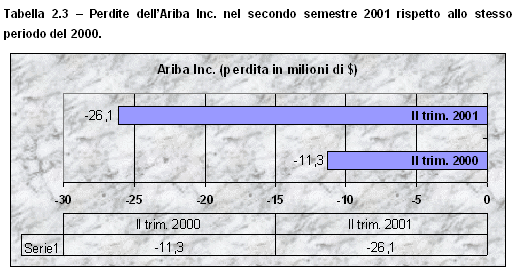
Source: our elaboration studio èidos
On 5 October 2001 Federcomin presented the second issue of the "Federcomin Observatory on the ICT market", which aims to focus on the competitiveness scenarios in which net-economy Italy operates. Data relating to the main Italian and international trends relating to the ICT market have been released, following the recent dramatic American events. According to this market research, two scenarios are possible regarding the trend of the Information Technology (IT) market in Europe: the first, more probable, sees growth of 7.9% in 2001 and 8.5% next year. The second scenario is less favourable, but, in any case, assumes a positive trend, both in 2001 and 2002 (7.4% and 6.5% respectively). The forecasts for the ICT sector in Europe have a positive trend, although not as in 2000 (13.0%) or 2001 (11.0%): the growth forecast for 2002 is 8.9%. The Italian IT market amounted to 19.59 billion euros in 2000, with an increase of 11.7% on the previous year. Growth was driven by all three main sectors: hardware (11.5%), software (10.2%) and services (12.4%). Estimates for 2001 (11.3%) indicate market growth at rates slightly lower than those of 2000 (11.7%), and are slightly higher for 2002 (11.6%), with a greater push coming from the software and services segments, which partially offset the expected slowdown in the hardware sector. In any case, the migration of companies towards the Internet will continue at a very high rate, mainly because the Internet is an excellent tool for cutting costs and optimizing processes. Hence, a very heated battle between PC manufacturers over technology and prices, as supported by the now well-known Moore's law. It is important to note that employment and productivity go in opposite directions only in mature or declining sectors, that is to say that a significant increase in productivity leads to a decrease in employment only in sectors such as, for example, agriculture and mining. Instead, in growing sectors (such as ICT), the birth of new products and services generates a "virtuous circle", given by a significant increase in income, employment and also productivity: these develop together and intensify each other.
Note 1: This expression refers to the reduction in the level of qualifications of a company's personnel. Note 2: Federcomin is the Federation of Confindustria, which brings together approximately 1,000 telecommunications, radio and television and IT companies. This data was taken from the website www.wayvision.net. Note 3: Paul Krugman is one of the best American economists and an extraordinary popularizer. He regularly collaborates with the New York Times and has published various books. This quote is taken from his essay "The economy of fear", which appeared in full in the cited issue of Affari & Finanza. Note 4: To prevent governments from aiming for the political advantages of growth in the short run, while neglecting the inflationary costs of monetary policy in the long run, all developed countries have central banks that are independent of the influence of other government bodies. Note 5: By convoy system we mean a system through which stronger companies help weaker ones. Note 6: The acronym B2B means business-to-business, it indicates commercial transactions via the Internet between companies and suppliers. Other similar acronyms are B2C (business-to-consumer, regarding sales transactions between companies and end consumers) and B2E (business-to-employee, in which information circulates among all company employees).
2.3. Structural changes, employment development and international relocalization
2.3. Structural changes, employment development and international relocalization
Currently, an international process of productive relocalization of traditional manufacturing activities is taking place (Wood, 1994), to which is added, thanks to Information Communication Technology, a further internationalization of service activities, previously non-transferable. Consequently, the emergence and further expansion of ICT generates new employment, but this is more likely to be created in countries far from those of origin of the new technologies. The fear of technological unemployment in developed countries, resulting from the greater extension of the ICT paradigm, is linked to two phenomena: on the one hand, to the generalized growth of productivity and, on the other, to the transfer of many repetitive production and service activities to regions and countries with low labor costs. As regards the first point, it can be said that in the European Union (E.U.) productivity growth has been quite strong. It can be the consequence of many causes: it can depend on shifts between the various sectors (in particular, those between industry and services), or on changes in tasks and skills, in competitiveness and development possibilities or even on the creation of employment in new hi-tech services (of which some may undergo international transfers, while others may not). Finally, it can be linked to generic positions with high remuneration and qualification. It is true that the increase in productivity tends to lead to a decrease in jobs, however it is very important to understand whether it generates a change in employment elsewhere, for the purpose of a serious and constructive political debate. Given that a slowdown in productivity growth (especially for the economic development of the EU) is in fact not sufficient to increase the number of employed people, it is appropriate to look in depth at the structural changes in the economy, in particular those resulting from technical innovation. Regarding the second point, we refer to productive relocalization, the birth of the E.U. (in an economic and monetary sense) has made our country's politicians more aware of the international implications of their choices. It is the international structural change, which has provoked new exchanges between the North and the South of Europe and the world, and the productive relocalization of some activities in developing countries that call into question wage automatic mechanisms and the ability to create employment in economies characterized by high labor costs. Over the last two decades, there has been a general shift in employment from agriculture and industry to services in most countries around the world. In particular, in developed countries the tertiary sector is by far the main source of employment. Let's analyze the causes. Part of the decline in industrial employment is due to the subcontracting of activities previously performed within the industry. Furthermore, during every growth process structural transitions take place, i.e. continuous shifts in employment from one sector to another, linked to the complex interrelationships between technology and demand. Technology will bring with it greater efficiency in agricultural and industrial production, reducing employment, only if the increase in product does not compensate for that in productivity, thanks to the elasticity of prices and incomes. Insufficient compensation occurs for food products and basic consumer goods, as stated by Engel's law¹, whose effects together with technical improvement cause the constant decline of agricultural employment in the long term. Employment growth in industrial sectors with high labor remuneration and high technology, however, derives from the strong and continuous expansion of domestic and foreign product, which has more than balanced the increases in productivity in these sectors. On the contrary, employment growth (in the financial and personal services sectors) corresponded to minimal increases in productivity, as it was the result of a rapid expansion of domestic product. Further redundancies are also expected in the financial sector, due to the greater efficiency and transferability that ICT will bring to these services. Of course, an expansion of demand and industrial product could increase employment, but the increase in productivity, necessary to remain competitive, could be so high as to cause, however, a drop in employment in some of the sectors considered.
We now carry out a sectoral analysis at an occupational level of ICT², and consequently distinguish essentially six areas: IT hardware, telecommunications, electronic components, radio and television, domestic appliances and lighting. The first sector, the IT-hardware sector, concerns personal computers, office automation machines, point of sale equipment and cash registers. In the first half of 2001, the IT sector showed an increase in turnover and orders. The sale of personal computers is decreasing, while that of "assembled" products and peripherals is stable. The total number of jobs occupied remains more or less stable, remaining at the levels of the end of 2000. The recovery could, however, come from new investments and government tax breaks. The telecommunications sector concerns telecommunications equipment, systems and networks (fixed and mobile) with the related installation activities. This sector has grown in recent years, but in the first half of 2001 it recorded a slight decline in turnover. Instead, some positive signals come from exports and infrastructure. Employment is mostly stable, although with a slight trend decrease. Electronic components are semiconductors, integrated circuits, active, passive and electromechanical components. The trend of this production sector, which is strategic for ICT, is fluctuating. In the first quarter of 2001 there was a slight increase (due to the fulfillment of orders at the end of 2000), but, on the contrary, in the second there was a slowdown. Overall, there was a slight increase in employment. The radio-television sector concerns television, antennas, video recorders, video cameras and audio systems. During the first half of 2001, radio, TV and electroacoustics recorded a drop in their turnover: the most affected segments were those of car radios, color TVs and hi-fi. On the contrary, domestic devices linked to digital technologies such as DVD players, combined televisions and video cameras are growing. Employment remains stationary with a slight tendency towards reduction. In the fourth sector, in addition to large and small household appliances, air conditioning and heating appliances and electric tools are included. In the first half of the year there was a trend of growth in turnover also driven by the good performance of exports. As regards the domestic market, the most dynamic segments were those of freezers and clothes dryers, while microwave ovens and refrigerators were less so. Employment remained basically stationary. The last ICT sector concerns light sources and electrical and electronic components for lighting. The positive trend, which was recorded in the second half of 2000, continues. Of note is the good performance of exports. All segments of the sector (appliances, components and light sources) appear to be growing. In terms of employment, no significant changes have been reported. To conclude, it should also be highlighted that foreign trade and international competition are significant sources of new employment and geographical movement of manpower. The ICT sector is by far the most dynamic in world trade and, moreover, it seems to have, from an international point of view, a notable effect on expanding trade; in particular, it stimulates the transferability of services traditionally sacrificed by the geographical or temporal contiguity of production and consumption. Quinn (1986) defines services as those activities whose product is consumed at the moment it is created, such as a concert. Typically, they are classified according to their function (such as distribution services, or intermediation services between industries, or even personal or social ones). Information Communication Technology certainly causes an increase in exchanges between all sectors (primary, secondary, tertiary), although with different intensity for each of them and, furthermore, it allows an ever-increasing number of services, thanks to the new spatial and/or temporal dimension it offers, to separate production and consumption, further increasing internal and international transferability. Due to the increased flexibility and increasing decentralization made possible by new technologies, a further reduction in the spatial geographic dimension between production and consumption can be expected in many industrial sectors. The increase in physical transport costs (of products and people) compared to that of information can bring production units closer to consumer markets, also considering the environmental costs of transport. International relocalization, implemented by multinationals towards areas/countries where labor costs are lower, will continue to cause significant drops in industrial employment in developed OECD countries with high labor costs (Freeman and Soete, 1994, page 105). This trend falls within the logic of international trade, the birth of the global company and the deregulation of capital movements (realised in 1992 in Italy). The local administrative authorities must take action: if they intend to keep foreign companies in their region, they must create the economic conditions that ensure their subsidiaries are deeply rooted in the area's economy, so that the latter becomes indispensable for their own competitiveness. Local authorities can also provide subsidies to attract foreign companies or create favorable infrastructural conditions (such as training and refresher courses, connections with local small and medium-sized subcontractors, collaborations with universities, technical institutes, laboratories and research institutes in the area), which deeply link foreign subsidiaries to the region in which they are located, but also national companies.
Note 1: Engel's law states that an increasingly smaller share of growing income is spent on food. Note 2: These data are taken from the supplement of Corriere della sera, il Corriere Lavoro, dated 5 October 2001.
2.4. Salary and organizational flexibility and professionalism
2.4. Salary and organizational flexibility and professionalism
To overcome structural unemployment, there is a common belief that flexibility in the labor market is essential, to which various meanings can be attributed. The classical tradition speaks of the relevance of wage flexibility and labor mobility. Instead, historians have emphasized international migration and urbanization. In recent years, an effective increase in the degree of flexibility of employment relationships has characterized employment policies in Italy and Europe and has brought important consequences, such as competition from low-wage countries and the increase in the level of participation of women in all industrialized countries. This is partly due to employers (who have continuously searched for cheaper labor) and partly to the recent organizational restructuring of production processes (which are connected precisely to the massive diffusion of information and communication technologies). We have already seen that one of the typical characteristics of the ICT paradigm is the design, production, commercial and distribution flexibility of services (which allows geographical mobility to be reduced). There are also two other important types of flexibility: one linked to the methods of organizing work and the other to the learning of new skills by workers. Both are necessary to address changes in the product mix and production techniques. Achieving organizational and skills flexibility is extremely more difficult than obtaining classic flexibility in the job offer: they, however, will only depend on the ability of each country to promote rapid technical and institutional changes and to rapidly raise productivity, while allocating the related gains to expanding employment. The classical and neoclassical tradition of employment and technical progress is based on various compensation mechanisms to restore equilibrium in the labor market, balancing the supply and demand of labor. The role of wage and interest flexibility is essential, even if the labor market cannot be assimilated to others. However, the issue of the distribution of profit shares has always been a source of acute social problems. According to some economists (Layard and Philpoytt, 1991), to combat long-term unemployment, more than flexibility, strong attention to training, the obligation to accept work or training and also financial pushes and stimuli are needed, both for the employer and for the unemployed person. According to others, however, both in North America and in Europe, there is a need to reduce the relative wages (and social benefits) of less skilled workers and young people, since it is believed that it is the absence of downward wage flexibility that does not expand the potential for low-skill/low-wage job creation. This has not been the case in reality where, due to a more consistent penetration of imported products, it is precisely the low-wage sectors that have suffered most from the decline in employment. Paradoxically, therefore, pursuing wage flexibility would seem to mean implementing a fundamentally protectionist policy of autarky. This would certainly create employment greater than that lost with the decline in exports to the rest of the world, but it would produce an obvious decline in well-being. Furthermore, the loss of dynamic competitive stimuli resulting from imports would damage growth and competitiveness. Instead, in an open world, decreasing wages would lead to the "importation of underdevelopment" (Freeman and Soete, 1994, pp. 120 - 121). In conclusion, it is clear that the arguments in favor of a reduction in wages are substantially weak. To avoid unemployment, institutional changes are essential that ensure positive expectations and the necessary stability in industrial relations in the long term. In this sense, a quick transition to highly qualified activities with strong added value is certainly preferable to the solution of lower wages, even if the typical policies to recover part of the profits during negative cycles are mainly based on the weakening (if not outright prohibition) of trade unions. However, this risks decreasing aggregate demand for consumer goods, worsening the crisis and Keynesian unemployment. Going beyond the traditional theory of wage flexibility, the organizational and employment contracts theory is of extreme importance, as is the qualification of workers². In a market economy, these can be provided by subcontracting³, which allows companies to adapt to changes in the composition and timing of new orders to be fulfilled. SMEs allow flexibility to be achieved: with their birth and development, they have been recognized everywhere as indispensable for renewing employment development and the flexibility of the system itself. The use of ICT has accentuated the demand for forms of employment that do not define standardized working hours and which are accompanied by fewer contractual constraints. Some investigations recently carried out by Isfol (Colella, 2001)4 allow us to analyze the actual impact on the Italian labor market of the use of part-time and fixed-term work.
Thanks to the transposition of the EU Directive n. 81/1997 on part-time5, currently contracts with this contractual modality constitute 8.4% of total employment. In the year 2000, almost a quarter of new employees were hired with this contractual modality. Previously, 47% of them were inactive or looking for work, 28% had a permanent contract, 9% a fixed-term contract and 16% self-employed. Isfol data show a trend increase in the probability of finding employment with a part-time job. Unfortunately, however, the probability of moving from a part-time to a full-time contract decreases. Studying the twelve-month employment outcomes of part-time workers in April 1999, we find that out of 1,600,000 workers, 16% no longer have a job, 58% remain part-time, while 25% obtain a full-time contract. The average number of hours worked is 30 hours per week, with a maximum of 36 hours for 16% of part-time workers.
With regard to fixed-term work, for Isfol between 2000 and 2001 it increased by only 2.8%, because employee work of this type includes many types of relationships: the fixed-term contract itself6, the apprenticeship7, the temporary agency8, the internship9, the job training contract (CFL)10, the job sharing11 and also the professional insertion plan (although the latter is not an employment relationship in the strict sense). The growth in the use of apprenticeships and CFLs reveals a significant setback: the former have been the subject of a reform "not metabolised" by the companies, however, the latter have been "overly monitored" by the community control bodies. Temporary work has taken off, but its impact on temporary work is still limited with only 40-50,000 units per year. Internships have great potential, even if they currently have little numerical consistency, while professional placement plans are exhausting their function. In any case, high levels of job satisfaction arise from these agreements. Temporary work has seen a decrease in male presences (-29,000 units), while its flexibility has led to an increase in female presences of 69,000 units in the last year, reaching 51% of the total temporary workers (compared to 46% just five years ago). More flexible schemes are found in the private sector than in the public sector, although things are changing in the latter sector too. With more precision we refer to the third Bassanini Law, n. 191 of 1998, with which the new era of flexibility in the public sector was established, thanks to the use of teleworking only on an experimental basis12. However, the risks of the trend towards flexible part-time work should not be overlooked. These can be summarized in a delay of social security in adapting to the changes and in an attempt by some companies to escape their responsibilities towards employees with this type of contract. Furthermore, there are significant risks for the competitiveness of a company that arise from the underestimation of human capital: the existence of a strong link between employment stability and professional training is clear to everyone. Characteristic of the increase in structural unemployment in recent years is the growing "incompatibility" between lost jobs and current employment opportunities, in terms of both training and experience. As regards the topic discussed here more directly, the mismatch between the demand and supply of work related to ICT is also due to the difference between the professional skills sought by companies and those offered by the workforce looking for employment. Direct consequences of technical progress are structural changes and changes in the demand for professionalism and qualification. Table 2.4 shows that the incompatibility in the specializations of the workforce comes from changes in the sectoral composition of the product and of the workforce itself and also from changes within each company, which have occurred at least over the last 50 years.
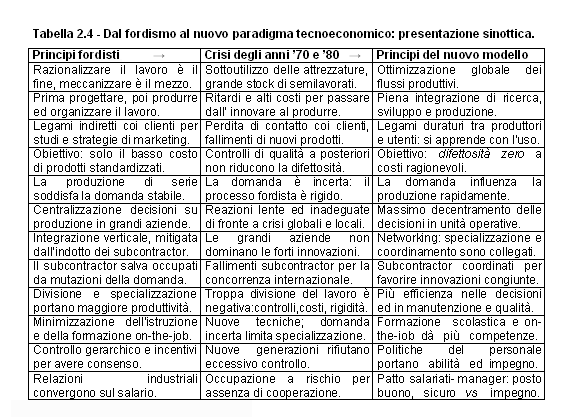
Source: our elaboration Boyer (1989)
Redundancies of workers with obsolete professional characteristics must be absolutely avoided. In this sense, a serious "permanent training13" program is necessary to prevent the knowledge acquired in the field (learning by doing) and theoretical knowledge from losing its value and "impoverishing the human capital of the worker and the company". To increase employment, in the weakest sectors (IT maintenance and advanced telecommunications) most often negatively affected by the introduction of technological innovation, programs could be set up in which national and European companies (or public agencies), after having been jointly interested in training the specific skills necessary to operate, twin themselves in order to implement them, with profits for both, in a reasonably short time. Support for such initiatives could come from local authorities, national governments and the European Union. Sectoral shifts in employment and changes in the composition of workforce specializations in almost all sectors cause some aggregate effects. Firstly, the long-term trend of increasing the presence of "information workers" in total employment is expected to continue. Today, the flexibility of companies, administrations and business networks depends on a workforce with a good level of general education, training and updating and with basic notions in the management, processing and transmission of information: to this end, training14 and retraining coordinated by the company are necessary for employees at all levels, as well as elementary knowledge of IT and good communication skills. Secondly, there is a need to improve the quality of education, especially for the most limited, who often are unable to adapt to current exam and teaching models in classes. Information technology (thanks to multimedia systems, CD-ROMs, virtual reality...) now offers real possibilities in this sense through learning opportunities tailored to the student, in full compliance with their needs: this is how e-learning is spreading. Finally, to increase the level of flexibility of the system it is necessary to integrate an average standard of general education with intensive training on specializations, in particular those relating to ICT. Hardware and software professionals are at the center of the ICT revolution, but they are accompanied by the parallel, albeit less felt, need for a certain volume of professionally qualified personnel at different levels. In conclusion, the trend of the ICT revolution seems increasingly aimed at increasing individual training (basic and specialist) and decreasing the presence of workers with poor specialization and qualifications. Certainly, a higher degree of flexibility can facilitate structural adjustments, although it must be possible to make forecasts with a certain stability.
Note 1: Importing development is a process that increases the division of labor at the international level, so that wage differentials between developed countries are increasingly similar to each other. Note 2: This topic will be addressed in the next paragraph. Note 3: Subcontracting allows you to enter into partnerships and form consortia, increasing the degree of flexibility. Note 4: The data are updated as of 3 July 2001. Note 5: In Italy, part-time (or partial time) involves, in agreement with the employer, the carrying out of daily work for a quantity of hours lower than that usually employed in the same type of employment. Note 6: Fixed-term work in the strict sense requires the worker to be employed full-time (or full-time) for a limited period of months (three, six...). Note 7: The apprenticeship involves a minimum training period of 120 hours per year. Apprenticeships, internships and temporary work are regulated by law 196 of 1997. They use European funds. Note 8: Temporary work (or rented work) is a fixed-term employment relationship, in which staff are sent to a company by specialized companies, recognized by the Ministry of Labour. Note 9: The training and orientation internship (or internship) consists of a short work experience for young people which takes place during or after their training. Note 10: The CFL is a particular type of fixed-term employment, which concerns young people between 16 and 32 years of age and companies in all production sectors, consortia, business groups, foundations, cultural and professional associations, public economic bodies, professionals registered in professional registers and sports associations. Young people are trained with courses modulated on the basis of their qualification and their educational qualification. Note 11: With the job sharing contract, two workers share a full-time job, dividing the hours of work and agreeing the time between themselves, which they then communicate to the company. The company's only interest is that the work gets done. Both are jointly responsible for the obligations that arise from their work. Note 12: The expression telework is intended to indicate that type of employment which is carried out from home via a computer connected to the company headquarters. Note 13: The expression "permanent training" refers to a continuous learning process over time, both as regards the notional aspect of the profession and as regards on-the-job learning. Note 14: The expression training refers to a training course for specific tasks in the company organization.
2.5. The new professional figures required
2.5. The new professional figures required
Despite the latest crises, the Italian net-economy does not seem to have been excessively affected by American problems, so much so that companies are now starting to really invest to develop their businesses. The need to train new professional figures that respond to the changing needs of the market comes to the fore. Currently in Italy the skill shortage, i.e. the lack of specialist skills in the ICT sector, can be quantified at around 200 thousand units in the first months of 2002¹. The new business consultancy operators entering the Internet are looking for staff, offering services both for the graphic design and content of the site, and for the security and construction of databases. The most requested figures are experts in the Unix, NT and Linux environments, followed closely by web development experts, from site designers to project managers. Currently, the most requested skills are "mixed" ones, i.e. business and creative, rather than exclusively technological, which have strong personal aptitudes for collaboration and teamwork. These figures are missing, also because their training is not limited to short refresher periods, but is inevitably based on a longer schooling process. The problem is serious: it is estimated, in fact, that in 2001 this gap will cause the Italian GDP to lose a market of 17,000 billion. One solution could be the "importation" of IT technicians from other continents: it is no coincidence that some countries, such as Germany, are more oriented towards human resources than other markets. India, for example, is increasingly investing in the preparation of qualified figures, churning out almost 200,000 specialized units a year, 25,000 of whom are engineers. After the events of September 11th, some trends can be indicated regarding what awaits us in the future. The first half of 2001 saw the IT market grow by more than 10% compared to the corresponding period of the previous year: a positive trend with double-digit increases recorded for nine consecutive years. The sector was primarily driven by mobile telephony, with more than 46 million active lines in our country. Employment in the telecommunications sector remains stable, before strengthening with the diffusion of technologies in the GPRS and UMTS telephone sector. The skill shortage phenomenon is confirmed and now mainly affects the so-called professions. niche. There is a decline in the search for figures that revolve around the web, due to excessive trust given to the new economy. Even in Italy, after a few months' delay, the consequences of the dot.com failures are being felt, leaving on the table the losses of stock market shares and the reduction of the skill shortage, a problem which, however, in 2000 the labor market placed as one of the main ones to be solved. Companies in the sector are carrying out an operation to slim down the professional figures linked to new information and communication technologies. We are currently looking for skills with precise niche characteristics, experts in specific sectors, such as web security or programming languages for mobile telephony. The dot.com phenomenon has highlighted that after a year, digital workers need retraining, since fundamentally the preparation linked to intermediate figures is no longer usable on the job market.
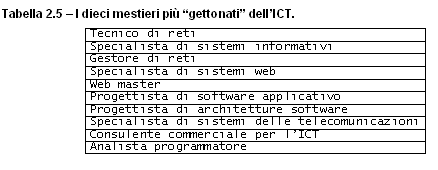
Source: Federcomin - Anasis (September 2001)
Let's now examine the most requested professional figures for each ICT sector. For call centers and customer care, it should be highlighted that the former within companies and outsourced are an essential means of managing information and assistance. The professions concern communication activities in and out of switchboards, integration with company databases and web communication experts. Regarding mobile telephony, the new GPRS and UMTS technologies require telecommunications and IT skills. The skills required vary from network maintainers and installers of telecommunications equipment to telephone exchange programmers. ADSL and fiber optic network cablers are also in great demand. Regarding the Internet world, the development of activities linked to it continues, even if the crisis of the new economy has substantially reduced the number of skills sought. After the period of mass hiring of website developers, companies currently aim to consolidate smaller (even if consortium) entities to outsource work. Professionalism related to the networking of content remains in demand. The computer networking industry is growing, due to companies' need to link internal intranets with the Internet. We are looking for professional figures related to the design and maintenance of networks, system administrators and integrators. Increase the number of those who work in digital marketing and online advertising (web advisors). The sector of security experts has always seen this professional figure find work easily. The latest events in September make IT security important in corporate communications. We are looking for skills to control access to information networks, to combat possible hacker attacks and prevent the spread of viruses. This request for security comes in particular from the banking, insurance and public sectors. Software and programming appear to be a continuously growing sector. The professional figures required range from classic programmers in basic languages (such as C++ and Visual Basic), to Java and Java Script experts, or even database programmers. In first place we find banking and management IT specialists, while new figures are emerging, increasingly in demand, such as those of Linux software engineers, increasingly chosen as an alternative to Windows.
Note 1: This data can be found on the website www.smau.it.
2.6. The employment situation in the ICT sector and the prospects for the next twelve months
2.6. The employment situation in the ICT sector and the prospects for the next twelve months
The forecasts of employment growth linked to ICT in Italy see a boom that has no equal in Europe and which, accompanied by data on the development of information technology, telecommunications and the Internet, represents a truly epochal turning point for our country, which has so far lagged behind both the other nations of the European Union and the United States. The largest increase in terms of employment (+5%) is recorded in the IT and telecommunications sector: hi-tech work will become highly sought after by Italian companies in the coming years. The third annual survey on employment in the ICT sector, presented by Assinform¹, reveals that in Italy the IT and telecommunications sector continues to increase employment and the birth of new businesses. From 1998 to the first half of 2001, approximately 5,000 new businesses were created (many of them in the South), and approximately 47,000 new workers were employed. According to the findings carried out, unlike previous years, employment in the ICT sector has continued to grow at faster rates than in industry and services as a whole in the last three years (486,000 in 1998, 514,000 in 1999 and 533,000 in 2000, including self-employed figures), when it had decreased on average by 0.5% each year. The 2000 figure for ICT workers (533,000), combined with the number of ICT specialists in user companies (from banks to public administration), brings the number of Italian workers linked to information technology and telecommunications to 1,034,000. The number of businesses is growing at even faster rates, going from 64,000 in 1999 to 67,000 (+4.7%) in 2000. In 1999, they had already grown by 4%. The growth rates of the number of businesses are almost everywhere higher than those of the number of employees, confirming the orientation towards small-sized units and, indirectly, an increasingly widespread entrepreneurial and professional vocation in Italy. Currently, the birth of new companies takes place in a very different context from that of the first half of the nineties (in which there was an expulsion of workers from the ICT sector). Already since 1997, the origin of new companies coincides with strong growth in the ICT market (at rates between 12 and 13%) and with a substantial shortage of qualified personnel. This increase occurs at rates more than double that of industry and services as a whole. Between 1998 and 2000, the development of new businesses was concentrated in the form of "sole proprietorships". In the period in question, the latter (essentially VAT numbers) grew by 20%, joint-stock companies (Srls and Spas) by 8% and partnerships (Sas, Snc and others) by 1%, while the other legal forms by 5%. Individual companies have developed exceptionally in the hardware and technical assistance sector (+47%), given that the barriers to entry for individual consultants are low; instead, joint-stock companies have evolved above all in the field of telecommunications (+12%). The territorial dynamics is also interesting, especially in the South. Compared to 1998, the increase in the number of companies is between 10 and 15% in Sardinia and also in the entire area ranging from lower Campania, to Basilicata and Puglia. The province of Lecce recorded the greatest development at a national level, with a significant +21.4%; a similar value was found in L'Aquila. In the North, the best performances are seen in the North-East, in the Brenta area and in Friuli: in the areas of Udine and Pordenone, growth rates in the number of businesses of between 15 and 20% are recorded. At the end of 2000, the composition of companies by sector was as follows: hardware and technical assistance, 12.6%; indirect commercial activities, 12.5%; services and telecommunications, 3.1%; software and services, 71.8%. Employment opportunities are concentrated above all in the latter sector (software and services), where the number of employees went from approximately 233,000 in 1998, to 251,000 in 1999 (+7.4%), to almost 264,000 (+5.3%) in 2000, the year in which they reached almost half (49.5%) of the total workers (533,000) of the companies ICT. The newfound dynamism of the hardware and technical assistance sector is also confirmed: after growth in 1999 to almost 54,000 employees (+3.6%), it also shows a good performance in 2000 with approximately 56,000 employees (+4.4%), equal to 10.6% of all those employed in ICT companies. Less dynamic is the telecommunications sector, where the number of workers went from 173,000 in 1999 to almost 175,000 in 2000, with a modest increase of 1%. In this case, a clear phenomenon of adjustment emerges compared to the more significant increases of previous years. The weight of telecommunications workers on the total number of ICT workers reduced between 1999 and 2000 from 33.7 to 32.8%, however it is still very significant. Regarding the increase in employment by company size classes, the contribution of SMEs is preponderant. Net revenue (entries net of exits) increased by 9.2% in companies with 1 to 9 employees, by 6.7% in those with 10 to 49 employees, by 5.5% in those with 50 to 249 employees and by only 2.5% in companies with over 250 employees. The ICT sector confirms itself as the one with the greatest demand for qualified figures or, in any case, with high levels of education. 30% of hirings involve graduates or employees with a university diploma (while the national average for industry and services is 7%), 64% have diplomas (compared to 32% in the secondary and tertiary sectors) and only 6% are individuals with lower level training certificates (compared to 61% for the industry-services group as a whole). Even micro-enterprises with no more than 9 employees have a high absorption of graduates (15% of new hires) and diploma holders (70% of new hires). As regards the most requested degree qualifications, information sciences, engineering and statistics are at the top. By the end of 2002, according to Enrico Bucci of Cisco Systems², the ICT sector will be looking for around 50,000 employees, but there are those who foresee a requirement close to 70,000 units. It will be driven by the increase in consumption, mainly oriented towards telecommunications (cellular telephones and satellite television). Furthermore, according to forecasts, the IT market will continue to record growth of 9 -10%; in addition to this, the modernization of the most obsolete systems towards online services is underway. Finally, for the software area, there will be a further increase especially in management systems and services oriented towards the Internet and corporate networks (over 12.6%). As regards employment demand, the highest growth trend is recorded in network management (webmasters and technicians), in the application development sector (management software engineers) and in that of so-called integrated services (telephony and IT experts).
Note 1: Assinform is the national association of IT and telecommunications companies. This data is available on the site www.wayvision.net. Note 2: Cisco Systems is a world leader in network, hardware and software technologies.
3rd: Internet and E-Commerce
3.0. Introduction
3.0. Introduction
In the last decade, there has been the explosive spread of Internet, the global hypermedia network that touches more than 200 countries in the world, connecting millions of users, whether businesses, schools, institutions or families. The Internet is configured as a media phenomenon without geographical or temporal boundaries, which provides an almost unlimited quantity of resources, without dimensional problems. Its economic (and, therefore, employment) potential is enormous: the Internet allows not only to communicate in small groups or large meetings or to play games, but also to exchange information and, among other things, to buy objects and services, obtaining advice and assistance. In this third chapter, we intend to examine the Internet phenomenon and, in particular, show the employment opportunities that electronic commerce offers. In the first paragraph we will frame the topic, defining, in particular, what will be meant by the expression e-commerce in the continuation, in the second we will illustrate the current situation of electronic commerce in Italy and in Europe, while in the third we will extend the analysis of its trend at a global level. The fourth paragraph will examine the effect that the new intermediaries produce on the net-economy, finally in the fifth we will analyze the type of marketing of Italian companies on the web.
3.1. Birth and development of electronic commerce
3.1. Birth and development of electronic commerce
Currently, the Internet is configured as a large global market for products-services and information activities, which have so far been prevalent. Its global diffusion and its hypermedia technology make it an in itself unique means of communication and exchange of goods for various reasons: the Internet has no geographical borders; telematic communication can be of two types, synchronous¹ (like in a chat) or asynchronous² (like that via e-mail); access to virtual stores (thanks to web servers) is continuous; allows multimedia communication between seller and customer. Furthermore, through intelligent agent³ technologies, the Internet allows purchasing after comparing proposals from different suppliers, and, finally, it allows both the integration of marketing processes (from the design of new products to communication with the customer) and that between the sales process and the company information system (improving the process of collecting market information and the accounting, financial and logistical management of orders). The growing diffusion of the Internet among the Italian population is confirmed by the data relating to users who have access to the Internet: at the end of the first half of 2001, in fact, there was a total of over 15.7 million Internet users, compared to 14.39 million in the first quarter of 2001 (+9%). The home segment leads the access market, exceeding the threshold of 10 million users. The ratio between Internet users and the number of PCs connected to the Internet remains substantially unchanged compared to the end of 2000. The average time that each user spends connected to the Internet over the course of a month is also growing: at the moment, it is estimated that it is over 22 hours per month in Italy, with a higher use in work environments (25 hours per month) compared to connecting from home (only 19.5 hours). However, we are still far from the nearly 40 hours per month of US users. From 1994 to today, that commercial application of the Internet has materialized, which has now become an undeniable reality, which has conquered the market with exponential growth: e-commerce. Peter Bøegh-Nielsen4 defines electronic commerce as the sale of goods or services via the Internet at any level of the supply chain, whether between businesses, between businesses and consumers or between the public and private sectors. The sale is based on an online order, but the final delivery of the good or service and their payment can be online or offline. The main advantages, which have certainly favored its diffusion, are two: firstly, it should offer a better service and quality/price ratio, at least in theory, and, furthermore, it brings a reduction in operating costs for the offer (Mariotti-Sgobbi, 2000). Although the industry's temporary stall has slowed growth lately, more than half of for-profit Internet sites say they are profitable, and 28% of e-commerce site administrators believe they will break even by the end of the year, according to an ActivMedia Research survey5. Around 500 managers of English-language e-commerce sites around the world were interviewed: 66% of these were for-profit, the remaining 34% pursued other objectives, such as promoting a company to its customers. For 54% of the sites analysed, if there was a crisis, it was overcome and began to produce profits again; the remaining 46%, which practices aggressive marketing to try to gain new market portions by any means, is still in deficit. The increase in the number of Internet users is accompanied by the growth of online shoppers, who use the Internet not only as a means of work or entertainment, but also as a channel for their purchases. Throughout 2000 the total number of Italian web buyers was equal to 1.83 million, but in the first half of 2001 alone the sum of all those who purchased online amounted to almost 1.6 million. The annual growth rate of this indicator should be around 91% for 2001 (for a total amount of Italian web buyers of 3.5 million). By the end of this year, approximately 22% of Internet users will have made at least one online purchase, compared to 14% in 2000. Previously, in paragraph 2.2, it has already been introduced how electronic commerce is actually expressed in various relationships: primarily there are two, business-to-consumer (B2C) and business-to-business (B2B). As regards the first, which concerns the "virtual" commercial exchange between businesses and consumers, the existence of networks (Internet, Intranet) overturns the role of the consumer of the digital market, who can design the product, directly providing the information concerning him. While the entrepreneur with a little flexibility, producing goods-services with the characteristics requested by his buyers, can multiply their value. This highlights that regardless of the nature and type of the good-service exchanged, the raw material of electronic commerce is information. The company must know how to communicate, its resources are all committed to the business. Regarding B2B, in relationships between companies the presence of networks has a strong impact on corporate efficiency and effectiveness, compared to the more expensive and closed solutions of the past. For thirty years Electronic Data Interchange (EDI) has connected manufacturers, suppliers and distributors, as electronic commerce has done for the last nine years at much lower costs. An important difference between B2C and B2B should be underlined: while the presence of a certain delay is evident in sales to the final consumer, trade between companies has never lacked signs of vitality. If we analyze the data from ActivMedia Research, we note that during the second quarter of 2001, the value of spending sustained by private individuals on the Internet (B2C) amounted to over 510.3 million euros. In the first half of 2001, a B2C trade volume was generated higher than the total in 2000 (+15%). Therefore, the annual growth rate for 2001 is expected to be around 129%, which should bring the value of spending to almost 1.9 billion euros and estimates for 2004 speak of more than 10 billion. In Italy, B2B spending in the second quarter of 2001 came close to 4 billion euros, while if we consider the first six months of the year the total value is around 7.47 billion euros. Much will also depend on the type of users who will use the Internet in the coming years: therefore, to evaluate the growth possibilities of the sector, we propose two recent studies below. In September 2001, the IDC conducted research6 in the USA to investigate the age of Internet users expected to access the Internet by 2005. The data highlights real opportunities for the development of e-commerce, which will be able to count on a wider clientele in the 35 to 54 age group and, therefore, on greater economic availability and consumption possibilities. In this class, 28% of new navigators will be placed. If existing Internet users are added to them, in 2005 users between the ages of 35 and 54 will make up as much as 76% of the total. A second important segment for companies that have switched to e-commerce is represented by young people between 12 and 17 years old, future customers to win over and retain. Based on some of the data emerging from the IDC research, 81% of this category was already online in 2000 and the percentage should remain substantially stable in the coming years. The same applies to the age group between 18 and 34. 68% of Internet users belonging to this segment were already online in 2000; furthermore, the relative percentage is expected to grow less rapidly than that of the 35-54 year old group. As regards the over 55s, however, the number of surfers will double by 2005, making up 26% of the entire population. Older surfers will be able to appreciate the possibility of shopping from home: the research foresees ample growth opportunities for sites that offer products and services aimed at this market segment. It is expected that, by 2005, the American population connected to the Internet will double and the number of new users will be around 85 million. The other analysis on the global digital market that we consider is contained on the Forrester7 website. It identifies a different type of segmentation of those Internet users who shop online and differentiates them into four groups. The first of these categories is made up of the so-called pioneer navigators (or pioneer internetters), who have been using the Internet for some time now also for habitual purchases. They are mainly men with a high education and a high income; they mainly visit sites that deal with financial products. The second category analyzed is that of the new generation (or generation next): it is mostly made up of young and technologically trained users, who have been browsing the Internet for less than a year, who are informed about the opportunities it offers and also use it for shopping. They mainly visit film and entertainment sites, chat sites and also purchase videos, electronic products, travel packages, CDs, books and software. On average they connect four or five hours a week. Their main motivation for purchasing online is the low price. The third class defined by the research is given by the buyers of the future (or future buyers): they have been using the Internet for less than two years and are only now starting to understand how it works. They are expected to purchase online in the next six months. They are mainly women, who search the Internet for businesses present at a local level, also to purchase online. The last category considers all those not inclined to online shopping (or shopping hold-outs), 40% of Internet users. They have been using the Internet for more than two years and have the same profile as pioneer surfers, but are less technologically prepared and interested and connect to the Internet five hours a week. The profiles above can be represented in table 3.1, based on the relative degree (low, medium, high) of trust, need and experience.
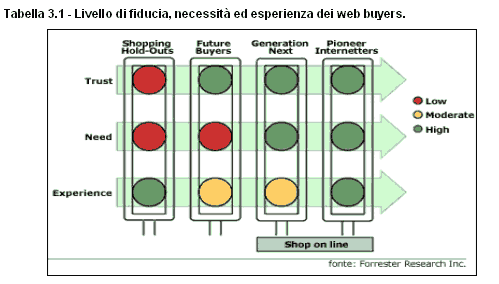
At a European level (in the five most industrialized countries), Forrester predicts that in 2003 the population of online shoppers will grow by 32% compared to that of 1999. The following graph (table 3.2) shows the percentages of buyers via e-commerce, divided according to their motivations (work, family, entertainment, other activities) in the United Kingdom, France, Germany, Sweden and the Netherlands respectively.
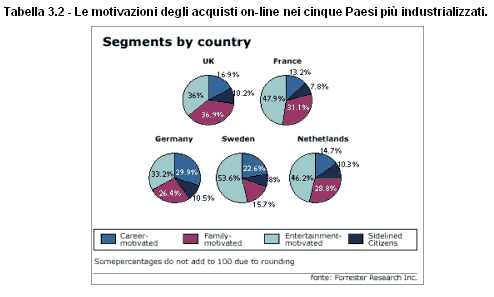
Table 3.3, however, allows us to compare the 1999 situation of Internet users, connected from their homes, in the five major European industrialized countries (identified by the acronym TG-E) with that estimated for 2003 and also to make a parallel comparison with the condition of the United States in 1999. In the five countries in question, forecasts announce that electronic commerce should more than double the volume of its users. However, the percentages of the segments which, compared to the total, are destined to increase significantly should only be those of pioneer navigators and buyers of the future, while the number of those not inclined to online shopping should increase, compared to the population considered, by only 1%.
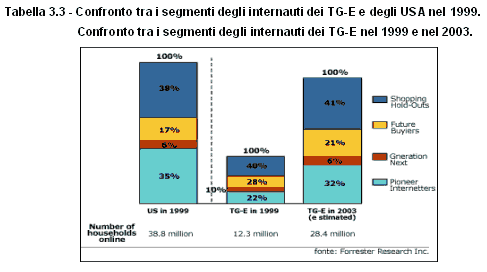
In any case, Forrester, based on the information collected, is convinced that e-commerce will have an exceptional diffusion throughout Europe in the near future, especially due to its ability to foster commercial relationships between buyers and sellers, who would be difficult to come into contact with offline. In this sense, the Internet allows the creation of new and important business relationships, for example through those portals which put traders directly in contact with suppliers. The need to computerize companies or to use technological products can be the consequence of a period of little work activity and a decrease in earnings or of explosive growth and high profits, of market saturation and limited revenue margins (economic stagnation), of fashions or of continuous technological development of products. This is clearly linked to the growth curves of goods over time. In table 3.4, we now propose some graphs of the growth curves according to the type of product. The classic growth function is linked to the television market, a slow development is typical of fax machines, while a type of rapid growth is that linked to mobile phones. Finally, a market that is continuously growing, with ups and downs, is that of personal computers.
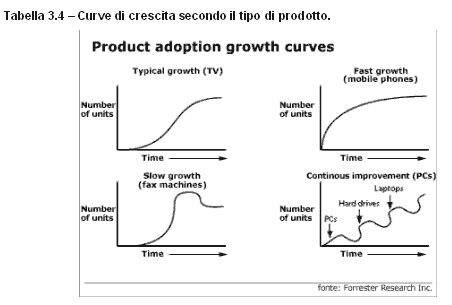
Note 1: Synchronous communication occurs in real time. Note 2: In asynchronous communication the recipient can respond to a message at different times. Note 3: An intelligent agent, or software agent, is a program to support the search and selection of online information, which takes into consideration the specific user profile. By collecting and processing information on the basis of specifications dictated by the consumer, it can, for example, visit some sites that offer the product sought online, offering the user the "best" product based on some parameters, considered relevant. Note 4: The speech by the head of the Danish statistics division is taken from the third session of the Commerce 99 round table B on electronic commerce, a seminar held in Brussels in November 1999. Note 5: ActivMedia Research is a division of ActivMedia Inc. specializing in web-related research. Note 6: This study is available on the site www.wayvision.net.
3.2. The situation in Italy and Europe
3.2. The situation in Italy and Europe
In Italy, despite the crisis of the new economy, B2C is expanding (although below expectations) with 425 million euros in revenues in 2000, compared to 115 in 1999 and 46 three years ago. In any case, Italians now buy everything through the Internet: books, CDs, software, computer equipment, travel, financial products, tickets and food (A&F, 24 September 2001, pp. 26 and 56). The region that has the leadership of e-commerce sites is Lombardy (28% of the total), followed by Tuscany (14%), Lazio and Emilia Romagna (both 10%) and Piedmont (7%). 41% of total B2C sales are represented by Made in Italy, followed by hardware, software and publishing (8%) and multi-product grocery (5%). Interesting is the massive entry of online sales by Italian large-scale retail giants, such as Coop and Esselunga (A&F, 17 September 2001, page 21).
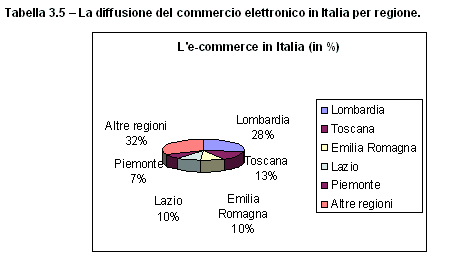
Source: our elaboration www.studioeidos.com
From market research conducted by Gfk, on behalf of the "Wall Street Journal of Europe¹", it emerged that Italians spend more than other Europeans when making purchases on the Internet. The target audience of the survey is aged between 14 and 69, the countries involved are: Austria, Denmark, Finland, France, Germany, Italy, United Kingdom, Spain, Sweden, Czech Republic, Poland and Hungary. 38% of Italians have access to the Internet against 43% of the European average, 18% of our compatriots make online purchases against 34% of the European average, but the most curious figure is that 35% spend more than 500 euros (a figure spent by 19% of Europeans). The reasons that push Italians to shop on the Internet are the variety of products (54%), the possibility of buying anywhere in the world (57%) and at any time (42%). Outside the virtual circuit, it is necessary to create a virtuous one of effective delivery. In fact, an important element of the commercial service, both traditional and digital, is the distribution function of logistics, which makes the purchased goods available to the consumer. In e-commerce, neither the distributor nor the customer needs to carry out a logistics function, which will be developed through a specialized economic agent. Furthermore, the impact of e-commerce will be profoundly different depending on whether it concerns goods or services. When it is necessary to physically transfer a good, the virtual channel is at a disadvantage, since the transport cost borne by the distributor is added to the price of the good. For banal goods, such as supermarket products, logistical costs are particularly high and the disadvantage is greater; for problematic goods, which are more expensive and less purchased, for which a research process is needed to obtain information on the variants available on the market, the logistics costs are lower. On the contrary, electronic commerce is particularly suitable for the distribution of services when the customer does not directly intervene in their performance, or can do so remotely (as, for example, happens for financial services), or even when he purchases a right to a service that will be provided subsequently under conditions not influenced by the purchasing methods (a typical case is that of booking services, which can be of various types: travel, tickets...). Table 3.6 shows the situation in Europe of the best-selling goods on the Internet. Once the total number of surfers who buy online is 100, we can see which categories of goods are bought the most: essentially, in the first places are banal goods, for which the Internet is like a shop window, then there are various types of services.
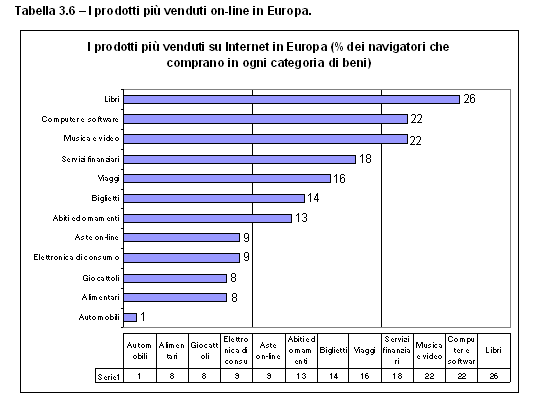
Source: our elaboration studio èidos
The Boston Consulting Group (BCG) has made an interesting discovery in its latest research on e-commerce in Europe²: even if e-commerce does not develop exponentially, it multiplies sales outside the web and, therefore, allows producers of goods and services to increase their turnover. In other words, the Internet is used as a "shop window" to learn about the product, which is then normally purchased in a shop or department store. The research in question finds that in Europe 37% of "surfers" use the web to choose a good or service to purchase. 85% of them, equal to 24% of "surfers", will then make purchases outside the Internet. In the first three months of 2001, one European in six used the Internet to obtain information on products and services. During the same period, one in eleven adults placed an order online. In Europe, in terms of web commerce, Denmark, Sweden and Switzerland are in the lead, while Belgium together with Luxembourg, Italy and Spain account for a very small amount of commercial traffic. In particular, in Spain, the so-called new economy is generating 25.46% of employment³. Paradoxically, job creation runs parallel to the stagnation of the entire sector. Anna Birulés, Minister of Science and Technology, highlighted the problem of the lack of skilled labor in the new technologies sector in Spain, and recalled that her ministry has launched a training program for 14,000 unemployed people in order to cover the shortcomings of this sector. Birulés also indicated that the ministry will promote actions to stimulate the training of Spaniards in new technologies. One of the main strategies implemented is the approval of tax incentives for the purchase of computers. Half of the Europeans who have connected to the Internet in the last six months to obtain information on products have placed an order. The English, Norwegians and Swedes lead the ranking, while the Italians and the Spanish are more reluctant to use online commerce. Europeans, however, are far from the US values, where 30% of surfers buy online and as many as 74% of these make purchases online every month. From all this data it emerges that it is extremely relevant to integrate the Internet with traditional channels, also for possible future employment implications. Multichannel, this seems to be the magic word of e-commerce: this is how the Internet can increase a company's turnover. In fact, the idea of pure-players4 of trading only on the Internet has disappeared: the Internet must be used as another channel to be integrated into the real distribution network, together with its warehouses and services. Whoever manages to do this can earn well, as demonstrated by the case of the British supermarket Tesco5 (A&F, 23 July 2001, page 25) and, therefore, can also grow and increase its need for personnel. Conversely, operators born on the Internet are also creating points of sale in the area with their brand, where their products can be found. This strategy is pursued among others by Chl, Attinet and Esperya (A&F, 26 November 2001). In other words, identifying a "recipe" to establish a healthy collaboration between the real network and the virtual network could generate an increase in production and employment, which would benefit the entire system, increasing well-being. Despite the e-commerce crisis, which began at Christmas 1999, after a series of bad choices, Amazon also managed to apply this recipe successfully, personalizing it. Instead of competing with traditional distribution (hypermarkets, department stores, chains of specialized retailers) it has taken the path of alliances: it has chosen not to sell everything itself, but to offer its know-how in logistics and in the use of the Internet, "hosting" the online shops of other companies on its portal. For Amazon, offering such services to other companies provides very high profitability margins (up to 60% gross) compared to direct e-commerce, but still constitutes only a tenth of its revenue (A&F, October 15, 2001, p. 8). However, the leader of e-commerce sites6 remains eBay with 8 billion page views in the last three months of 2000, well more than double Amazon's 3 billion and 200 million. The other sites in the sector have less than a billion visitors, as shown in table 3.7.
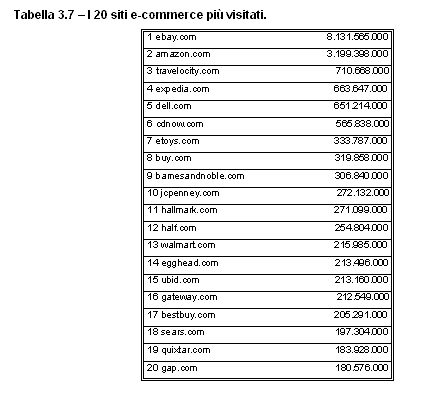
Source: our Alexa Research elaboration
Note 1: This study is available on the website www.wayvision.net. Note 2: This refers to "The multichannel consumer - Need to integrate on-line and off-line channels", available on the website www.wayvision.net. Note 3: These data are taken from the Infoempleo 2001 report, drawn up by the Circolo del Progresso together with Banco Bilbao Vizcaya Argenteggiare (BBVA) and Telefónica. Note 4: With the use of this terminology, we refer to operators who act commercially only on the Internet. Note 5: Tesco is defined by the Bcg as "the most successful online food supermarket in the world". With a network of 200 supermarkets, Tesco can serve 90% of British people, thanks to a valid home delivery system. Its e-commerce site, www.tesco.com, has integrated the physical network with Internet services: 70% of its customers purchase products online and has given Tesco a turnover of 570 million euros. Furthermore, there was a focus on the best customers (core customers) to further retain "those who really spend" through the Internet, rather than to reach any type of customer. Thirdly and finally, the aim was to satisfy the consumer, who thus consumes up to 71% more and carries out transactions ranging from double to two and a half times those of unsatisfied customers. Note 6: Alexa Research reviewed this data in its "E-commerce report Q4 2000", in which it analyzes and ranks the electronic commerce sites with the highest number of page views.
3.3. E-commerce in the world
3.3. E-commerce in the world
As regards the international situation, according to the "Global E-commerce Report of 2001¹", the United States, which has the highest percentage of online buyers (with 33%), is followed by Germany (with 28%), and Great Britain (with 24%). Furthermore, TNS interviewed surfers about their intention to buy online in the next six months. Although the survey revealed that only 17% of Internet users in Japan have already purchased something online, the country boasts the highest level of future online shoppers, with 41% of Internet users planning to buy something in the next six months. Germany follows in second place with a good 30%, while, at the moment, the United States only occupies seventh place with 23%. Taylor Nelson Sofres then discovered that 15% of the world's Internet surfers buy online, 15% buy off-line after having obtained information from the Internet, and 15%, despite having decided to purchase via the Internet, do not complete the purchase. The Report also highlights how at the top of the list of the most purchased items online are books and CDs: in 2001, 26% of surfers said they had bought books via the Internet and 17% said they had bought music CDs. According to sales indices in North America and Canada², total spending on online sales increased from $3 billion to $3.4 billion in February 2001. In April 2001, households making purchases on the Internet grew to 13 and a half million (compared to 13 in January), while consumers spent on average $248 per person in February, compared to $229 in January. Let's see which were the most interesting sectors that grew thanks to e-commerce in the USA at the beginning of 2001. Household appliances are starting to play an important role in overall spending, going from 24 to 44 million dollars. Jewelry and flowers also performed excellently, growing by almost 40% (from $99 million in total in January to more than $166 million in February). Instead, among the categories that saw online sales decrease are video cassettes (from $83 to $52 million in January), office supplies which fell to $69 million in February (-21%) and toys and video games which reached $86 million in February (-31%). Before 9/11, despite the economic slowdown, the Internet continued to thrive as a channel for consumer purchases in North America. Instead, the Nielsen/NetRatings³ report shows that the countries in which online commerce is most developed at a global level are Australia, New Zealand, Sweden and Denmark. In Australia and New Zealand one in four adults uses the Internet to search for information regarding products, and the number of purchases via the Internet is high. As for the other Pacific regions, if the number of purchases from South Korea is growing (three out of five Koreans transform the request for information into a purchase), only a third of adults in Hong Kong or Taiwan buy online after carrying out an online search. The study "Reviving Japan's economy4" examines the situation of the Asian electronic market, studying the way in which Eastern entrepreneurs operate compared to European ones. The analysis highlighted an enormous Asian efficiency, which neither Europe nor America can match, given that Asian sites dedicated to e-commerce cost on average less than in the West, but manage to attract a greater number of customers at the same cost. This competitive advantage is linked to the fact that oriental online entrepreneurs avoid wasting financial resources to capture an excessively large audience, while they prefer to invest in specialization. This allows you to obtain a higher profit margin on each individual product, compared to what a European or American entrepreneur is able to obtain, who uses more generic products, services and targets. Throughout the world, in recent years, the Internet has seen a dramatic increase in traffic, which is symptomatic of the explosive expansion of the digital market. The forecasts for the future are optimistic: for 2004, it is believed that we may witness hypergrowth in Eastern Europe, in the Asian area overlooking the Pacific, in North America and in Latin America.
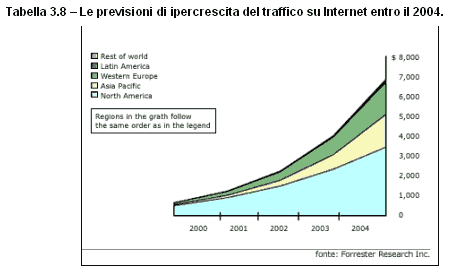
Between 2000 and 2010, all these countries will take part at the same time in a development process, which will lead in 2005 to a worldwide turnover of approximately 7 billion and 230 million euros, of which 75.8% will belong to North America, 12% will belong to Asia-Pacific, 11% will belong to Europe and only 1.2% will belong to America Latin.
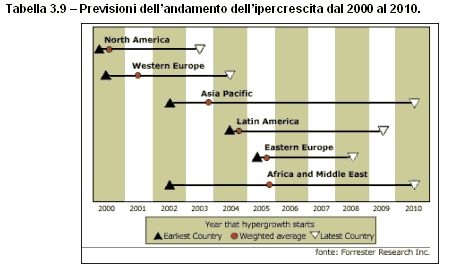
In Europe the retail sales market will experience rapid growth similar to that seen in 1998 in the USA; in fact, it went from a turnover of around 17 million euros in 1998 to 385 million euros in 1999, up to 1 billion and 350 million euros in 2000. One of the most promising markets for the sector is Latin America: in this regard the following graph (table 3.10) represents the growth trend that the Internet should generate by 2003 in Brazil, Argentina, Uruguay and Paraguay.
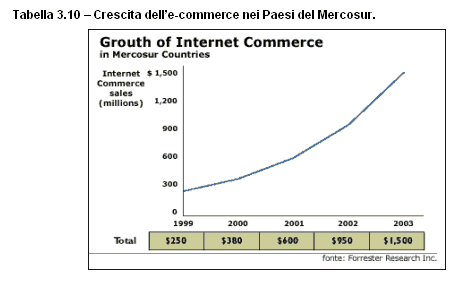
In Figure 3.11, we illustrate how consumers are likely to shift their online purchases between B2C and B2B by 2004. In that year, the B2B market will reach a turnover of 6 billion and 715 million euros, while in 2005 B2C should reach 470 million euros.
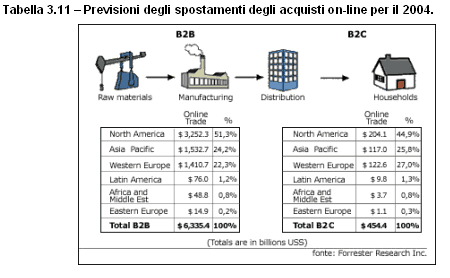
Note 1: This report was prepared by Taylor Nelson Sofres (TNS) and is available on its website: www.tnsofres.com. Note 2: The National Retail Federation (NRF) and Forrester Research Inc., in association with Greenfield On-line, have presented the fourteenth North American and Canadian Sales Index Survey, available at www.wayvision.net. Note 3: Nielsen/NetRatings represents the measurement service of ACNielsen. Note 4: This research was carried out by McKinsey. It is available on the website www.wayvision.net.
3.4. The net-economy and e-commerce: the new intermediaries
3.4. The net-economy and e-commerce: the new intermediaries
The net-economy essentially describes the shift and increase in added value from the industrial production of physical goods to the supply of "intangible" and/or knowledge-based products. The latter requires a high level of intellectual know-how, as in the case of computer software. With the Internet, the economy and work have begun to develop in a new way, following economic systems that are profoundly different from the traditional ones (typical of the organization of the market in industrial society). The innovative scenario outlined by the net-economy determines a new way of conceiving the economy, in which knowledge becomes a source of business. Every good quality production today has been automated and incorporates high quantities of innovative ideas and new technologies, which have changed the production, distribution, assistance and personalized marketing communication systems (one-to-one customization). In the transition from a production of physical goods to one of intangible goods with a strong intellectual content, the focus of the creation of surplus value shifts from raw materials and machines to the intellectual contents of production. If we add to all this the ease of communication at increasingly lower prices, we can understand how the net-economy accelerates the transformation of the global market. The physical space via the Internet disappears, vice versa a localization of business activities in space was typical of the logic of the traditional local market (place market), which was of the "you sell what you produce" type. From this perspective, the value chain was linear and went from local production, to the intermediation of services (information, financial, transport...), to consumption. Currently, with the extension of new technologies (computers, WAP telephone systems, satellite net-TV...), spatial localizations no longer exist: the market is inserted into the Internet, now we talk about space market, in which physical barriers and geographical boundaries are cancelled. Information on the world wide web (www) is accessible anywhere in the world in real time and without bureaucratic impediments, therefore the physical location becomes purely virtual. In fact, it is customary to say that "everything that can be distributed wherever it is produced is sold", since those who access the Internet communicate with the whole world. This global dimension of information on the www contributes to increasing the speed of trade, which takes place at negligible prices with any country in the world. Given that the equivalence between time and money applies, economies that actively engage in electronic commerce (such as the US one) are experiencing exponential growth: this is the reason that must push us to facilitate the extension of e-commerce worldwide¹. The speed of commercial exchanges typical of electronic commerce strongly characterizes the value of the net-economy, which has moved from space to time. It follows that the organizational processes of telematic exchange activities between companies (B2B) must be redefined and it is necessary to correlate online information flows with commercial exchanges on the Internet. It is clear how the Internet, by eliminating costs and frictions, could bring the virtual market closer to perfect competition with complete information, prices equal to the minimum long-term average costs and so on, but in reality this is not the case. There are transaction costs, the product-service is certainly very differentiated, there are barriers to entry (for example advertising), prices differ depending on the site offering the various product-services and, furthermore, reputation mechanisms play an extremely important role in guiding buyers' preferences. The best approximation of a perfect online market is made up of those intermediaries who provide supply and demand with only a "virtual meeting place" on the Internet, coordinating the parties without interfering with content and marketing. The most widespread method of this recent type of intermediation is online auctions, the profit of which generally consists of a commission on transactions carried out. In particular, the eBay company provides a portal to support one-to-one exchanges between private individuals. The persistence of information asymmetries and reputation mechanisms increase the degree of imperfection, which leads the market power held by companies carrying established brands on traditional markets to transfer to the Internet. In any case, imperfect virtual markets increasingly see the entry of new subjects who acquire many of the advantages of the net-economy, the so-called infomediary-extended telematics enterprises. These companies are affiliated with each other, operate in delocalized virtual infrastructures and use the Internet to develop e-commerce, sharing complementary knowledge: this corresponds to the archetype of the polycentric network company². These new online intermediaries may also be the result of an aggregation process of traditional commercial intermediaries (wholesalers, transporters, financiers, information agencies, chambers of commerce, trade or consumer associations...), who want to develop the management of e-commerce relationships online, both in the purchasing sector (e-procurement³ buy site) and in the sales sector (e-procurement sell site). The new intermediaries must be able to coordinate information between purchasing groups and actively collaborate to personalize sales to the final consumer. These new and complex electronic market intermediation agencies (e-market4) owe their success to their ability to reduce management and exchange time, both of orders and turnover, facilitating new commercial agreements based on the expansion of the markets and giving new visibility to sales offers. Failure to understand the reason for the introduction of these new intermediaries leads to the inability to create new job opportunities with high professional qualifications. However, with the rapid growth of the net-economy, the old forms of market intermediation services, organized in hierarchical and inflexible structures, become increasingly useless. These appear to be predestined to failure if they do not find renewed ability and speed in adapting their organizational processes to the Internet, in order to carry out a rapid transformation of their structures. In this sense, creative knowledge and technological know-how become increasingly effective development factors in the ICT system: in industrial society it has been possible to separate knowledge from production; but not in the net-economy, where development depends precisely on their integration. Therefore, it is not enough to insert new information on the Internet to obtain tangible economic successes from the use of the www: if the separation between knowledge and the production of goods and services remains, it is unlikely that the know-how (even if it is transferred to the Internet showcase) will become a decisive source of business, an essential component of the creation of added value in the net-economy. In conclusion, the change imposed by technology, especially with regards to ICT, has produced an unstoppable dynamism that affects the entire economic and social organization of work. Therefore, unknown potential for socio-economic development will be able to assert itself where it is understood that human resources and technical progress represent the cognitive and organizational basis of the net-economy and mark the very future of the knowledge society, so promoted by the European Union. To seize these growth opportunities, professional qualification and continuous innovation of production techniques are crucial; it follows the need for investments in educational and training processes and in research and development, as already seen in paragraph 2.6. The phenomenon is complex: we have now stopped believing that the Internet solves all IT problems of companies. This has led to the downsizing of small businesses, created by young work teams, while it has led customers to concentrate their business on large software houses or outsourced companies5, capable of promptly dealing with both hardware and software aspects. It is for this reason that experts are sought who can concretely apply their technological knowledge to business realities, such as corporate network integrators and programmers capable of transporting Intranet contents to the web. It is a moment in which we feel the need to "capitalize" the information heritage, trying to adapt it to the world of the Internet, with rapid execution times and low costs. This has not always been done properly. The e-commerce experience is indicative. Many have created electronic catalogs and sites with virtual shops, worrying less about developing marketing actions and enriching the pages with new content. The result was market stagnation with consumers' low propensity to purchase online. In the first half of 2001, the overall value of the Italian IT sector market was equal to 30.5 million euros. Around September, some setbacks occurred due to the reduction in corporate investments for B2C e-commerce. Currently, conditions of uncertainty are emerging related to the decline in household demand and the decrease in IT purchases by SMEs. We still have time to remedy this situation, but we need to ensure that "virtual businesses" turn promptly and with greater attention to web marketing operations.
Note 1: The role of institutions and some industrial policy considerations for the diffusion of electronic commerce in the world will be addressed in paragraph 3.6. Note 2: In particular, the use of outsourcing can lead to different results depending on the criticality of the outsourced processes. The more the outsourced activities are based on distinctive complementary skills, the greater the push towards polycentric solutions. Note 3: By e-procurement we mean the management of company processes linked to procurement via the Internet, using new ICT technologies. This topic will be discussed extensively in the fourth chapter. Note 4: The configuration and evolution of an e-market, made up of complex transaction governance structures, appear strictly complementary to the characteristics of the institutional network, which presides over the social organization of economic activities. Note 5: In the fourth chapter we will present a case study in which we will analyze a company that deals, among other things, with outsourcing services for its client companies.
3.5. Online marketing of Italian SMEs
3.5. Online marketing of Italian SMEs
According to ISTAT's Annual Report on the country's situation in 2000 (ISTAT, 2001a, pp.158-162), in recent years the diffusion of ICT in small and medium-sized enterprises has significantly increased throughout Europe, in particular the use of computers, the Internet and forms of communication via the Internet (electronic mail, chat...) has increased, furthermore all sectors use the www. However, there are still barriers to e-commerce. More precisely, the initial investment to introduce new technologies and electronic commerce in small and medium-sized enterprises tends to be proportionally greater than in large ones. Likewise, the fear of "an insufficient critical mass of users of e-commerce", the lack of professional figures specialized in activities related to e-commerce and the difficulty of understanding the different languages used on the Internet can discourage its use. Other obstacles are represented by logistical problems, the uncertainty of contractual conditions and payments. In March 2000, to study the extent to which the attention of small and medium-sized Italian companies is directed to the web with the aim of increasing sales, Freepping carried out research through 1000 telephone interviews with as many SMEs, with a turnover between 2.5 and 25 million euros in Italy: 60% of them were made up of production companies, while the remaining 40% were service companies. There was a strong focus on the web: 59% declared they had a website, while 16.5% declared they had one under construction or in planning. So, in total, around 75% of those interviewed are present on the web or want to be present in a very short time.
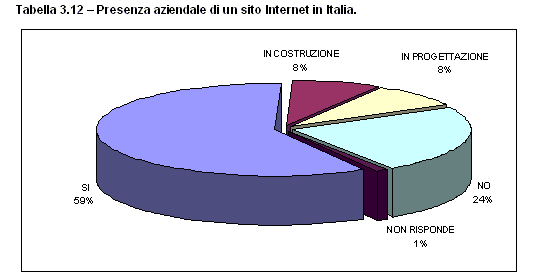
Source: our Freepping data processing
Companies are convinced that the Internet can create opportunities for development, however multimedia knowledge is not widespread enough to suggest uses other than the creation of a company website, mostly an online brochure. This is probably because the approach to the Internet, in these first years of mass diffusion, was IT in nature (not through marketing or communication techniques). The investments and technical skills necessary for managing web activities are not considered an obstacle: respectively only 11% and 8.2% of companies declare they have difficulties on these fronts; the problems linked to the fear of not obtaining sufficient visibility and visitors for the site and to poor company motivation are greater.
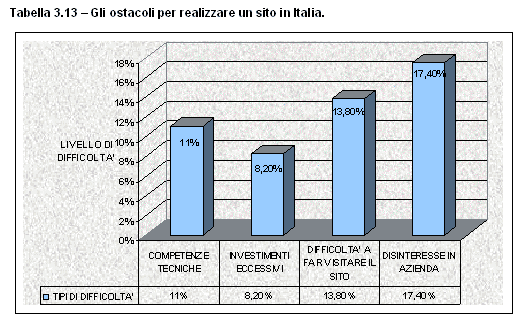
Source: our Freepping data processing
In general, the companies interviewed demonstrate a non-strategic vision of the Internet, since its first diffusion: the web was created to reach the same message to multiple people at the same time. The request from SMEs, which clearly emerged, is to segment the market, sending specific messages to narrow and identifiable targets, to increase the number of visitors to their sites. A third of those interviewed believe the Internet is a more useful tool for small and medium-sized businesses than for large ones, given that the latter, unlike the former, also have other channels for making themselves known. However, more than half of the sample does not consider the Internet to be an agile medium, particularly usable by innovative companies such as SMEs.
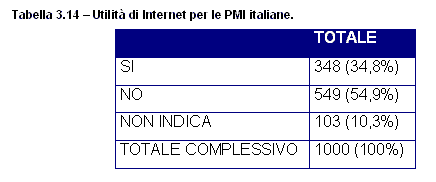
Source: our Freepping data processing
According to Mariotti and Sgobbi (2000), the reduction of costs allows small and medium-sized enterprises to geographically diversify their outlet markets without those financial constraints imposed by a "physical" sales and marketing network. Even in large companies, the choice of the electronic channel leads to the reduction of operating and management costs. This reduction is also linked to rationalization processes, including the massive use of outsourcing and the cutting of professional figures who have now become obsolete due to the introduction of e-commerce. An indicative example of this re-engineering¹ of business processes brought about by electronic commerce is given by the commercial management of Cisco Systems, in which online orders, collected and processed through the company's IPC (Internetworking Product Center) software, represent approximately 80% of the company's turnover. In fact, e-commerce has substantially decreased the time needed to collect, verify and fulfill orders and the staff assigned to carry out these tasks. It is precisely for this reason that, according to Campodall'Orto and Scalfi (2000), from an employment point of view, it is important to note that electronic commerce also reduces the personnel costs of companies, in the sense that the productivity of the online service requires a high level of staff, but numerically smaller. By the way, Cisco also states that through the creation of its website, the company was able to avoid hiring 1000 new employees in the sales and after-sales area. It is clear that in the short term e-commerce prevents the creation of new low-skilled jobs in ICT companies. Also for this reason, being able to integrate "virtual" and "real" work (for example, enhancing multi-channel, flexible contractual forms, training and the role of new intermediaries) would be even more relevant. Freepping's research also highlights a limitation of companies that approach the Internet without a clear strategy: whatever tool they use is experienced in a static manner. Once activated, the site is not updated frequently, there are scarcely any elements of interactivity with visitors and, if there are, they are not used correctly by companies. In other words, there is no culture of the medium and its potential is not exactly known. 30% of the companies interviewed declare that they have allocated a specific item of their 2000 budget to the Internet. The perception of expenditure necessary to create a site does not appear very high: half of the SMEs examined consider an amount of less than €5,000 sufficient, confirming that there is not sufficient awareness of the necessary investments. 35% did not provide any answers on the matter: these are the undecided, who have not yet taken a position towards the new medium. This situation is illustrated by table 3.15.
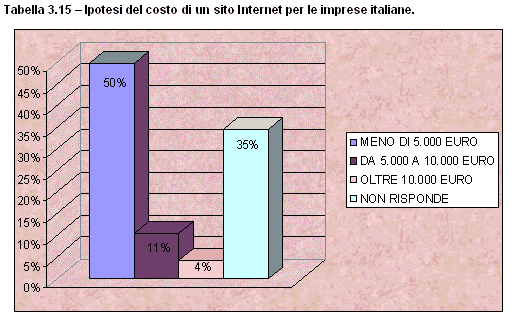
Source: our Freepping data processing
There would be a willingness to increase investments if tools or paths were offered that could make the results of using the Internet clearly perceivable, given that the web is perceived as a means of communication that is certainly cheaper than traditional ones. In conclusion, e-commerce is a formidable opportunity to truly connect Italian SMEs to globalization. If they conquer new markets, reducing management costs and focusing on product quality, the traditional problem of size, which has always been a limitation of our industrial system (in which, in fact, large companies are few in number), could be compensated by the greater elasticity that the Internet era offers to companies.
Note 1: This topic has already been introduced in theory in the previous chapter, in paragraph 2.1.
4th: THE UNITEC CASE
4.0. Introduction
4.0. Introduction
In this chapter, we intend to report the results of an empirical research conducted by us on a company, UNITEC¹, which offers services to businesses and, in particular, deals with e-procurement in outsourcing (which falls within B2B), an absolutely innovative activity, which it is essential to define from now on. The expression procurement² refers to all those activities related to the management of supplies. E-procurement³ indicates the possibility for companies to manage business processes related to procurement through computerization and the Internet. This allows you to instantly connect with suppliers and customer companies and issue supply requests and orders online, thus responding to the growing need to optimize times and procedures. Outsourced procurement4 involves the delegation of procurement activities and those connected to it to an external partner (the so-called outsourcer), to achieve the managerial and administrative consolidation of all activities. For example, a company could transfer the management of 200 suppliers to UNITEC, reducing the number of incoming monthly invoices and payments to be made from 200 to one. Outsourced e-procurement5 delegates procurement activities to the outsourcer using new ICT and Internet technologies. In addition to management and administrative consolidation, the consolidation of e-catalogs6 is also achieved and the possibility for the client company to move from conventional management on a paper document basis to e-procurement, without having to maintain two different structures for the two different management methods (traditional and electronic) of the same activity. This brings a multiple advantage: the reduction of paper material, invoices, payments and, above all, the elimination of the traditional management structure. For example, a client company can give UNITEC management of 200 suppliers with e-catalogs and 200 who do not have one, since they do not yet trade online or do not have the possibility of providing one for technical-commercial reasons. UNITEC's task is to create a personalized electronic catalog for its customer, which includes the products of all 400 suppliers used. The customer thus avoids having to maintain two internal structures with different management methods (one online and one paper-based), thus moving on to completely electronic document management. During the chapter, we will clarify why UNITEC proposes itself as the manager of this and other services and, above all, we will study the quantity, type and quality of jobs that the company under investigation offers to its staff.
Note 1: At the beginning of this chapter, I would like to extend special thanks to Mr. Vincenzo Marino, founder and CEO of UNITEC, for the collaboration offered and for the availability demonstrated in providing us with data relating to the level of technology and type of employment of his company. Note 2: Procurement literally means supply. Note 3: The expression e-procurement indicates electronic procurement. Note 4: Outsourced procurement literally means outsourced procurement. Note 5: The expression outsourced e-procurement indicates outsourced electronic procurement. Note 6: E-catalogs are electronic catalogues, which offer online viewing of the products that can be purchased online, from the supplier who offers them. Unitec note: The numerical data have been adapted for statistical needs.
4.1. UNITEC
4.1. UNITEC
UNITEC-D High Tech Industrieprodukte Vertriebs GmbH¹ is an international limited liability company headquartered in Augsburg, Germany, specializing in e-procurement, outsourced supply chain management² and international industrial brokerage³. In 1990 an entrepreneur, Mr. Vincenzo Marino established it to provide qualified assistance to companies using German industrial technical products. Already from the initial years of the activity, the company management has always pursued the continuous improvement of the organizational structure, especially with regard to the efficiency of internal processes. Since its inception, UNITEC has acquired increasingly greater competitiveness, continuously studying and developing innovative services for its customers, so much so that it has achieved leadership in its market segment and become a reference company in the sector. The use of the Internet and new ICT technologies led UNITEC to achieve the complete computerization of the company workflow in 19954: today UNITEC uses an ERP (Enterprise Resource Planning) software system, which deals with the planning of the company's resources and is based entirely on its specific needs. The ERP system allows it to manage all the steps relating to the procurement process in a computerized way, achieving management savings due to the drastic reduction of process interference: this raises the quality of the services that customers benefit from, which reaches levels close to zero error. When UNITEC developed the ERP there was no similar system on the market. Today the company continues to use it, adequately updated, given that it is specifically calibrated for its activities and is not of a general type like those currently on the market. In 1997 the computerization department evolved into an independent company, UNITEC Services & Web, based in Italy, in Sabaudia (LT). UNITEC S&W is an IT company for the development of software and Internet providing services and ASP (Application Services Provider) with ministerial authorization. Towards the end of the 1990s, UNITEC left the hierarchical vertical organizational scheme for a more modern matrix-type structure, characterized by the division of staff into teams, the improvement of the efficiency of activities and the increase in staff motivation5. The quality and innovation of UNITEC procedures are now recognized by the ISO 9001 certificate; Furthermore, the company is a member of various German organizations: the DIN, the NAM and the VDI6. In addition to the offices in Augsburg and Sabaudia, UNITEC opened another in Brazil in 1999, in order to be closer to its customers and their factories in South America. In fact, it appears that Brazil is the Latin American state with the greatest presence of European car manufacturing companies, many of which are UNITEC customers. Furthermore, Brazil offers countless opportunities to make new contacts. Thus UNITEC South America takes care of the activities of Brazilian client companies and neighboring nations, directly on site. In all, the three companies have one hundred and eighty employees, of which one hundred are in Germany, sixty-five in Italy and fifteen in Brazil.
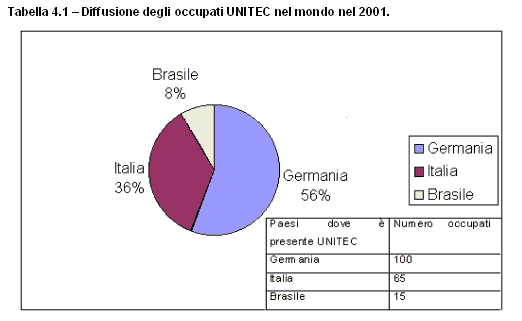
Source: our UNITEC data processing
Furthermore, over the years, UNITEC has opened representation and support points in numerous European countries (Belgium, France, United Kingdom, Russia, Spain, Turkey) and in the Italian regions where its customers are present. These structures offer employment to around a hundred people, who represent the company. Generally, they are freelancers, with whom a collaborative relationship is formed: their services are mainly requested in the context of industrial projects. To date, UNITEC is the first outsourcer which, due to the extension of its services at an international level, proposes and implements the complete outsourcing of company procurement activities, including administrative and logistical ones. This service is applicable to any type of supply (raw materials, semi-finished products, industrial machinery and related constituent parts). UNITEC currently manages approximately 77,000 products for its customers (including technical components for industrial plants and so-called non-production goods 7) from 4,750 manufacturing companies. The activity in question is not limited to a particular industrial sector, nor to specific product classes of materials to be supplied, because it follows the needs expressed by the applicants. UNITEC's client companies have decided to adopt its services also because it has been able to develop a modular outsourcing application that can be easily introduced into company structures, configured to their needs, which allows the achievement of immediately verifiable results. There are three modules and they have been designed to be applied in sequential order. The first module delegates the management of supply request processing to UNITEC, but ownership of the goods is not transferred; the second adds to the first the management of logistics and administrative activities, involving the transfer of ownership of the goods; the third extends outsourcing to warehouse management and the item database. The activities are immediately transferable and the results immediately quantifiable8. Many international industrial groups are interested in using the services and concepts proposed by UNITEC. Among the company's customers, we find Audi, BMW, companies of the Fiat group (such as Iveco), Ford, Piaggio and Porsche for the automotive industry; Enichem, Goodyear, Michelin and Procter & Gamble for the chemical industry; Siemens, Whirpool and Zanussi for household appliances and others such as MAN Roland, Mondadori and San Pellegrino. In particular, the MAN Group, after some phases of pilot projects, has already introduced the outsourcing of supplies in two companies of the group (MAN Roland Druckmaschinen AG and MAN B&W Diesel AG), completely delegating the management of 400 suppliers to UNITEC. Having seen the positive results, new pilot projects are also underway within the other companies of the group. Another company that uses the services provided by UNITEC in some companies it manages is Iveco, in particular its Eurofire department has delegated the management of 300 suppliers to UNITEC. Let's now see why companies choose to collaborate with UNITEC. A difficulty that all companies have to face is the variability of activities in relation to the economic cycle, which fluctuates from peak to trough moments (in particular, think of companies that work seasonally, such as those producing ice cream or panettone). In this regard, let's look at table 4.2.
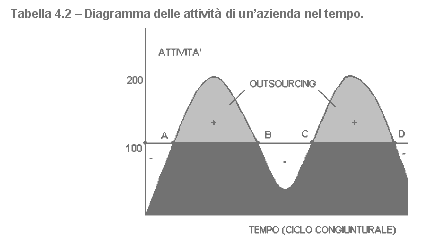
Source: our UNITEC data processing
This sinusoid represents the economic cycle to which all companies are subjected. The area enclosed by the curve indicates the quantity of activities that the company's structures must carry out at each moment of the cycle. To illustrate, we can assume that this diagram refers to the activities of the purchasing department. Depending on its structure (and, therefore, the means and employees), this department can provide a predefined maximum number of services within the company. This level is depicted in the graph by the line placed at the activity level of 100. The area underneath it indicates the quantity of services that can be provided. Furthermore, it is noted that in some periods the number of services requested from this department, for entrepreneurial and/or economic economic issues, is higher than the maximum that can be provided (activities between levels 100 and 200). From the diagram it emerges that the analyzed structure is efficient only in four moments of the period of time considered (corresponding to points A, B, C and D). This situation creates serious damage to the departments upstream and downstream of the analyzed structure, as the waiting times for responses increase. On the other hand, normally the company does not tend to oversize these structures (beyond activity level 100) so as not to have excess costs in times of negative economic conditions. This situation constitutes the ideal field for the application of business process outsourcing. In the specific case of the company covered in our investigation, the outsourced electronic procurement service offered by UNITEC allows client companies to have a ratio between cost and cost objective (effectiveness) of their departments equal to one, in most of the economic cycle. The outsourcer takes care of absorbing the peaks of these activities, which (if they were not managed within the required time) would cause additional costs in the other departments of the company. It is precisely in the peak moments of the economic cycle that the services offered by UNITEC are most convenient and advantageous. UNITEC, through e-procurement, manages all those activities that companies are able to carry out autonomously only under the constraints of very high costs. In this way, UNITEC's client company, by outsourcing the management of operational activities, transforms the costs to be incurred for their implementation from fixed to variable. The latter follow the economic performance of the company. UNITEC thus allows its client companies to proportion costs to needs, transforming the most expensive part of the internal procurement procedures into services that can be purchased on the market9. In conclusion, the more procurement procedures are managed with the integration of purchases, the greater the economic return will be, transforming costs into resources. With outsourcing, client companies increase the effectiveness of the structures responsible for company activities, thus increasing turnover and ensuring and developing employment. The outsourcer's situation, however, is represented in table 4.3.
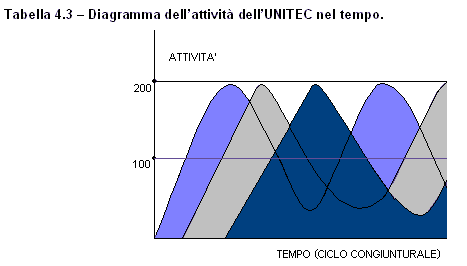
Source: our UNITEC data processing
This diagram shows how the outsourcer, UNITEC, is subjected to cyclical market variations to a lesser extent than its customers, since it is able to exploit the temporal shifts of the economic cycles of its client companies, thus managing to optimize its resources. This situation means that UNITEC is able to distribute this added value to its customers. From the figure it is also clear that each of them absolutely cannot optimize their economic cycle without the collaboration and support of the outsourcer. Thanks to e-commerce and new ICT technologies, UNITEC eliminates waste and, transforming it into resources, offers the client company the opportunity to dedicate itself to its core business and increase its added value. UNITEC offers its customers some innovative services: supply outsourcing and integrated supply. With the outsourcing of supplies, UNITEC takes over the management of the client's current suppliers, reducing their number virtually and managerially to one. With this type of service, the customer highlights the relationship with the supplier, keeping it alive in technical and product terms. However, the administrative and logistical management of this relationship passes to UNITEC. In this way, the client company does not lose the know-how that the supplier has acquired regarding its needs and, moreover, it can continue to manage those products that the supplier himself had designed specifically for it. Integrated supply, on the other hand, is a commercial service offered by UNITEC, which acts on behalf of the client company as a broker. By operating in this way, he manages not to increase the number of suppliers or even reduce it. In this case, the customer requests UNITEC that the product conforms only to some technical-economic specifications. These two different types of service offered lead to different degrees of consolidation of activities, according to the customer's needs. As regards the outsourcing of procurement processes, UNITEC allows its customers to save 50% of the costs relating to their management. Generally, the procurement process is carried out by companies in a linear way, adding the total expenses of the various cost centers10 and thus obtaining the cost of procurement. Finally, to understand the impact of accounting on the cost of a single product, the company divides the general cost by the total of the goods or services generated by it. Ordinary linear company accounting absolutely does not allow the cost of the individual procurement process to be calculated, much less does it allow it to be rationalized. To succeed in this aim, UNITEC (specialised in reducing the costs of procurement processes, in particular of class B and C goods) offers its client companies a so-called ABC (Activity Based Costing). This consists of an evaluation of production costs, based on the activities actually carried out, in order to control and measure the expenses and times of the various phases of the business process. ABC is the basis of a company's choice to outsource part or all of the activities related to supplier management. Let's see table 4.4.
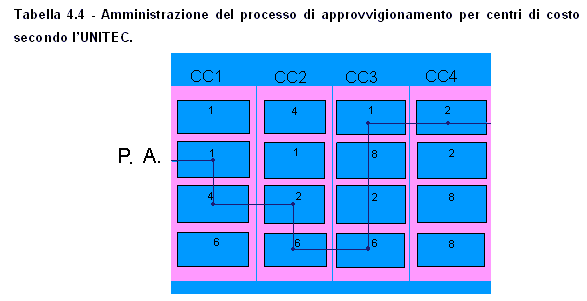
Source: our UNITEC data processing
Each column of the table corresponds to a cost center; the rectangles within them identify specific activities; the time needed to complete them is shown in the center of these (for example, hours). The procurement process (workflow) is represented by the line that connects the activities involved in its management (for example, production department, purchasing office, accounting, warehouse). For the ABC accounting proposed by UNITEC, the procurement cost is given by the sum of the times of the steps actually taken in the procurement process multiplied by the unit hourly industrial cost. In the example, the cost of the exemplified procurement process will be: ABC = (1+4+2+6+6+1+2) 5€ = 22 * 5€ = 110€. ABC allows for outsourcing, which frees companies from operations that have low added value. Furthermore, it gives companies the opportunity to measure the times, costs and added value of each activity and, therefore, to take advantage of them, allowing the effects of reengineering to be accounted for. We therefore continue our investigation by now presenting the integrated supply service. Integrated supply takes care of all the procedures and operations necessary to deliver the goods (compliant with the technical-economic specifications requested by customer companies) at the desired time, with a single document. Thus, the costs of each supply are reduced. The more procedures are managed with integrated supply, the more benefits will be deriving from the recovery of efficiency.
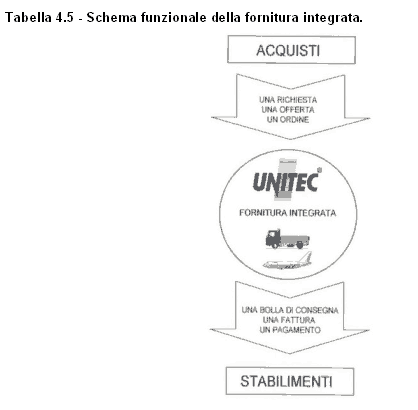
Source: UNITEC-D, 2001
Table 4.5 illustrates the flow in its logical-temporal sequence: from the integration of requests we move on to that of offers to arrive at that of orders. After the shipment of the materials there is the integration of transport, delivery notes, invoices and payments.
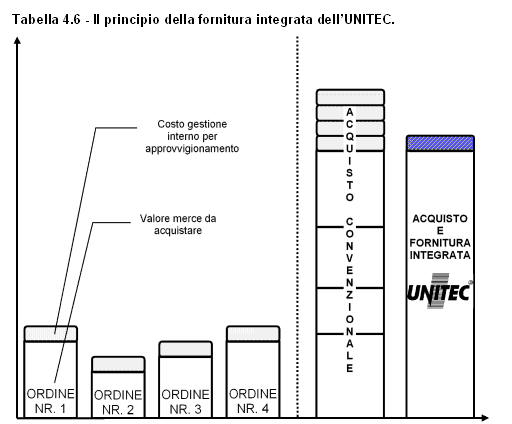
As table 4.6 shows, the savings on the internal management cost of supplies for the client company are considerable. With the integration of purchasing, procedures are compacted, process costs are reduced, creating economies of scale. Furthermore, all those conditions are created that improve efficiency and free up resources to invest. Furthermore, integrated supply streamlines administration procedures, allowing more resources to be dedicated to the core business. The administrative situation is illustrated in tables 4.7 and 4.8. In the first we see that with a traditional procurement scheme, any company must bear administrative costs for every single relationship it has with each of its suppliers.
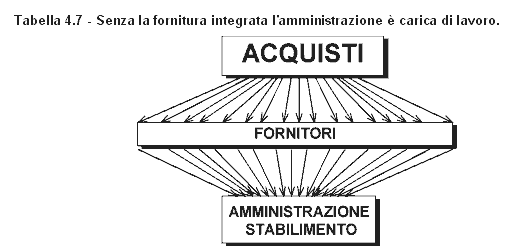
Source: UNITEC-D, 2001.
In the second table, 4.8, however, we note how the number of reports and, therefore, the related administrative costs can be reduced (or even eliminated), by delegating part (or all) of the management of the procurement process to UNITEC.
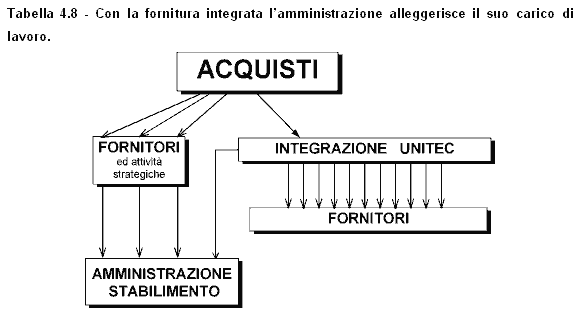
Integrated supply offers logistical improvements, among other things, so we address the issue of the physical transport of goods. UNITEC uses the collaboration of companies specialized in logistics, with which it has stipulated agreements. To evaluate the variables connected to transport, UNITEC has created a software which, among other things, compares the deadlines for supplies to the customer, the delivery terms guaranteed by the suppliers and the logistical transport times.
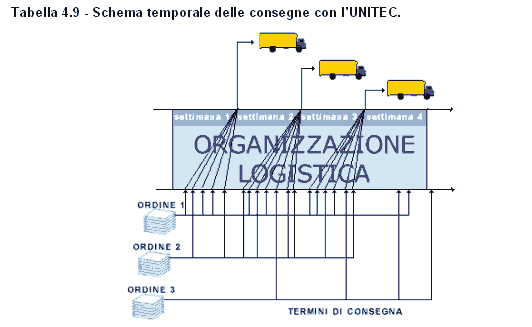
Source: UNITEC-D, 2001
Figure 4.9 illustrates the integrated supply system at a temporal level. The client company agrees with UNITEC the dates for the delivery of the goods, planning the staggered deliveries over time. In this way, arrivals are agreed, warehouse operations are concentrated and speeded up, dead times are eliminated: by increasing the efficiency of the structures, control activities and delivery documents are minimised. Thanks to the improved logistics flow, transport costs also decrease. This is also linked to the fact that through integrated orders the number of times a company turns to carriers is considerably reduced, replacing small and frequent supplies (at relatively high costs) with larger quantities of goods, transported at optimized prices11.
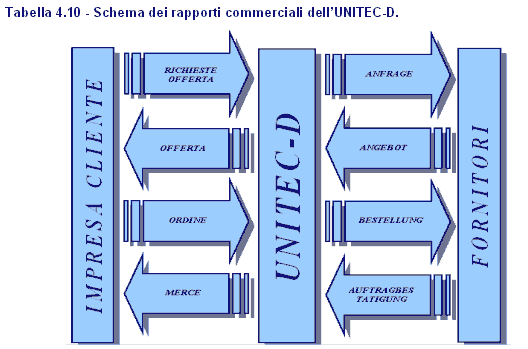
Source: UNITEC-D, 2001
Table 4.10 shows the various types of UNITEC commercial relationships. Once the supply requests have been received, UNITEC processes the offers of the selected suppliers, according to the indications received from its customers, also sending multiple requests (Anfragen) to individual producers. Having received the offers from the suppliers consulted (Angebot), UNITEC evaluates them, selecting the best ones, and prepares the offer to be made to the customer, applying a mark up on the purchase prices, to cover the management costs of the services requested. Then, the customer can choose whether to accept or reject the offers presented. Once the customer has accepted the final order, UNITEC sends its orders (Bestellungen) to the suppliers, who deliver the goods; UNITEC-D's relationships with suppliers end with their written acceptance of the orders (Auftragbestätigungen). The goods destined for customers are subjected to a logistical consolidation procedure, both at UNITEC and at carefully selected logistics nodes (table 4.11).
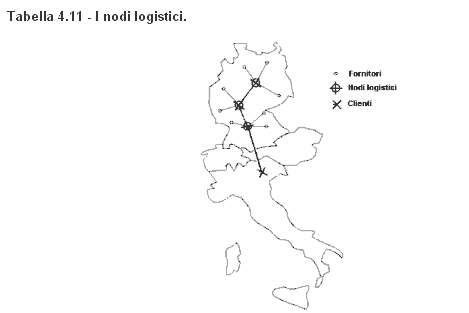
Source: UNITEC-D, 2000
Logistical consolidation allows the reduction of transport costs and related administrative documents: this is precisely one of the added value points of the services offered by UNITEC. Regarding warehouse management over time, the reduction of stocks practiced by the majority of companies has brought financial savings, but has produced an exponential growth in procurement procedures and an explosion of related costs, so much so that the efficiency of internal services has been seriously compromised. Added to this is the need to continually interact with multiple suppliers, given the continuous specialization in production and the consequent ever-increasing differentiation of goods. UNITEC's solution is the outsourcing of management overhead12, in particular of supplies, thanks to the integration of purchases, which among other things allows the rationalization of stored inventories. Let's look at tables 4.12, 4.13 and 4.14 in this regard.
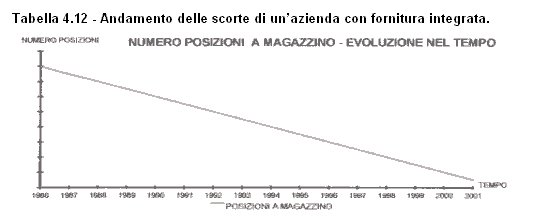
Source: UNITEC-D, 2001
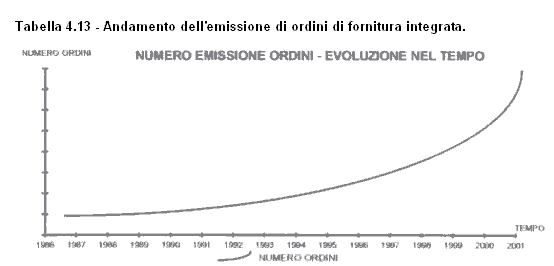
Source: UNITEC-D, 2001
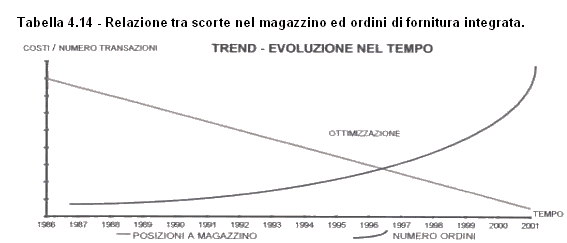
Source: UNITEC-D, 2001
From table 4.12, it can be seen that over the years the trend in the quantity of stocks stored in the warehouse has been marked by a continuous decrease due to the need to economize and reduce the value tied up in it. Furthermore, all this has caused a clear increase in relative management costs, given that supply orders have thus become much more frequent (table 4.13). UNITEC simply noted this situation and to resolve this costly inconvenience for its client companies, it decided to offer among its services also one for the optimization of warehouse management (table 4.14). In this regard, UNITEC also offers an extremely futuristic application called Virtual Warehouse, which exploits the different warehouses of one or more industrial groups, logistically sharing their material stocks and allowing access between participants. The Virtual Warehouse is physically made up of the complex of warehouses owned by UNITEC's client companies, which they intend to share with each other and, therefore, reduce the stocks contained therein. All companies involved in the value chain obtain significant savings. In this way, it is possible to significantly reduce inventories, but the quantity of available goods increases, since network technologies allow the sharing of information and the consequent rationalization of inventory management. The creation of this type of warehouse confirms what is stated in Jeremy Rifkin's book "The era of access: the revolution of the new economy". In fact, he claims that in the future the aim will no longer be to possess goods, but simply to be able to access them. UNITEC is responsible for managing all the data regarding each of the warehouses and the activities relating to replenishment and common purchases (buyer aggregation). It must be said that there are goods and services used by all companies, regardless of their core business. Noting this, UNITEC concluded that a fair level of sharing of goods can also be present in companies belonging to different sectors, as highlighted by table 4.15. The intersection area represents the components shared by the various industries.
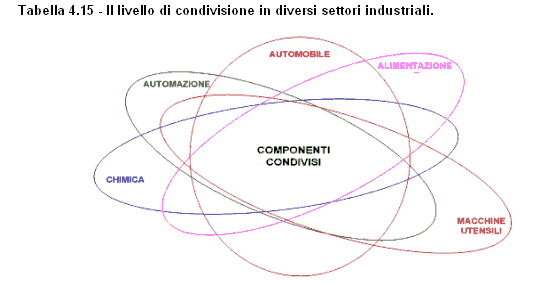
Source: UNITEC-D, 2001
The Virtual Warehouse transforms physical goods into shared logistical information and contributes to the coordination of industrial economic actors, concentrated in a defined territorial area. In fact, for optimized management of goods logistics, the geographical proximity of companies is convenient.
Note 1: The expression High Tech Industrieprodukte Vertriebs generically indicates the sector in which the company deals, i.e. the "marketing of high-tech industrial products". The German acronym GmbH (Gesellschaft mit beschrankter Haftung) literally means limited liability company; is equivalent to the Italian s.r.l. Note 2: Outsourced supply chain management consists of managing the supply chain in a outsourced manner. Note 3: UNITEC's international industrial brokerage engages in the sourcing and purchasing of specialized information, goods or services for the client worldwide. Note 4: By corporate workflow we mean the company's production process, divided into various subsequent steps. Thanks to its computerization, the times and quality of every single step of this process have been optimised. Note 5: This change will be illustrated in detail in paragraph 4.3. Note 6: The DIN (Deutsches Institut für Normung, literally German Institute for Standardization) is a German body recognized worldwide, which defines safety standards relating to both the construction and management of industrial production plants. Instead, the NAM (Normenausschuss Maschienenbau) is the regulatory commission of industrial machinery manufacturers and the VDI (Verein Deuscher Ingenieure) is the Association of German Engineers. Note 7: Non-production goods are those goods that are essential to production activity, but which do not physically make up the finished product, such as spare parts for the production plants of numerous types of industries. Note 8: Immediately quantifiable results are also called win-to-win, literally earning to earn. In other words, those who offer services to customers receive a profit, but they also make money for those who receive them. It is in this way that UNITEC allows its client companies to easily control the advantages it provides with its work. Note 9: In this regard we talk about BPO (Business Process Outsourcing), i.e. the outsourcing of business processes. Note 10: This term refers to the various sectors of the company (such as production, design, administration, distribution...), which in order to carry out their activities must incur costs which must be included in the ordinary company accounting. Note 11: The use of express couriers for urgent deliveries is limited to cases in which the customer explicitly requests it. Note 12: By management overhead we mean those additional management costs generated by an over-flow situation, i.e. overflow. In this regard, see figure 4.16.
4.2. UNITEC and ICT
4.2. UNITEC and ICT
In this paragraph we will describe the technological evolution of the company that is the subject of our practical case. In 1990 UNITEC was founded in Germany, managing its activities conventionally. In that period the company was already using the advanced technologies that existed at the time, the first personal computers, connected to each other via the first local networks, the so-called. LAN (Local Area Network)¹, which allowed the company's electronic computers to be connected to each other, sharing common data. Until 1994, simply the standard applications of the Office package were used to support these activities. With the advent of relational databases, UNITEC realizes the need to develop its own IT department, in particular for the management of company processes. Thus, with its own division of programmers, UNITEC-D began to produce Office Automation programs for its own needs, given that in those years no standard management applications were available on the market. This department studied all conventional processes and began to gradually transform them from paper to digital, re-engineering and optimizing them. As time passes and with specialization, a continuous improvement in the phases of the company workflow emerges: each activity is increasingly divided into successive steps, so much so that the internal management of the activities is now carried out with a vast sequential computerized process. The development of internal applications was accompanied by the production and offer of advanced management systems on the market also for client companies. With the use of information technology and ICT, UNITEC has increased internal operational efficiency, decreased management costs (of telephone use, overtime working hours and interference), improved the efficiency of the company workflow and increased the independence of workstations. Furthermore, ICT has now become fundamental also in the management of supplies (e-procurement), both for current activities and for its future developments. It is for this reason and for the diffusion of the new WAN networks (Wide Area Network) that the company opens the new headquarters in Sabaudia, dedicated to services and the web². 1998 was the turning point year. UNITEC manages to develop its own computerization system to the point of reaching the so-called paperless office³. This allows company management and, in particular, the communication and approval flow within the company, to take place without the production of paper documents. Following the development of digital communications, UNITEC has established its own Internet provider4 in order to manage and use electronic communication technologies to make services to customers even more efficient. These technologies allow it to reduce paper material, guaranteeing service twenty-four hours a day anywhere in the world thanks to the Internet. Also in 1998, UNITEC's corporate and managerial management (applied to outsourced integrated supply processes, the development of paperless management processes and Internet applications) received a quality certification from Lloyd's Register Quality Assurance (LRQA). In fact, 1998 will see the radical transformation of the operating methods of UNITEC employees and the definitive change in the very vision of work for the company. Finally, again in 1998, UNITEC S&W presented the first existing Web application of industrial outsourcing e-procurement: Netsourcing.
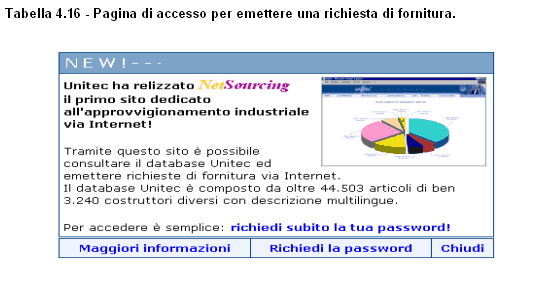
Source: UNITEC-D, 2001
From 1998 to today there have been countless technological evolutions within the company, both in terms of hardware and software. In the first case, an incredible change was found in internal and external communication systems, especially to improve the company's response times. In the second, new programs and operating systems were gradually adopted and a mixed network was configured (LAN, WAN, Internet, Intranet, Extranet).
Note 1: It should be specified that in the case of LANs, the connection of the computers on the local network is not achieved via the telephone line, but thanks to cables and wires that physically connect the equipment. This type of local network is used intensively in medium-high corporate environments and has proven to be of extraordinary relevance and practicality. Note 2: Among the applications it has developed, the most innovative are certainly: the paperless office, the Netsourcing system and the Virtual Warehouse. Note 3: Currently, with integrated supply, a reduction in paper management components of almost 100% is estimated. Note 4: This provider provides applications for outsourcing on the Web in ASP (Application Service Provider) mode.
4.3. UNITEC and employment
4.3. UNITEC and employment
In this paragraph, we will discuss how UNITEC's employment has evolved, both qualitatively and quantitatively, from its establishment until today. In 1998, due to the radical change in operating methods, the knowledge required of workers also changed, which is essentially of two types: linguistic and technical. Both have evolved over time and with the expansion of company activities. As regards languages, within the company there are employees who speak only one, but there are also those who know four, as illustrated in tables 4.17 and 4.18.
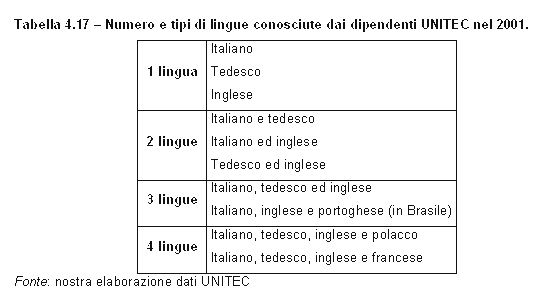
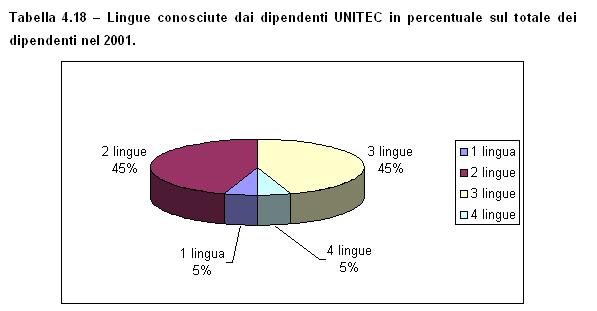
Source: our UNITEC data processing
It is clear from table 4.18 that UNITEC staff are substantially multilingual, in fact, as many as 95% of the company's employees speak more than one language. As regards technical knowledge, this is essential to be able to communicate with the customer and carry out the company's technological intermediation activity, always aimed at improving the service it offers on the market. Nowadays, trained personnel are needed in the technological field (closely linked to the hi-tech sectors) and also in e-procurement. Advanced knowledge of various computer systems is required and, of course, the use of standard Office applications.
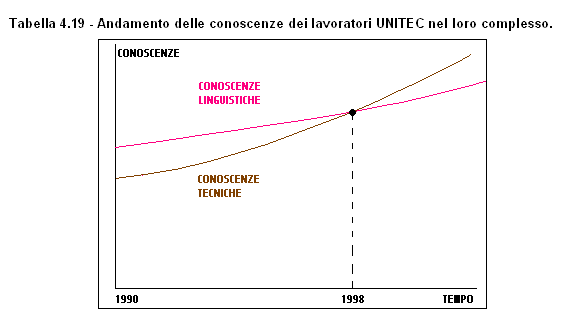
As can be clearly seen from table 4.19, when the company was founded in Germany, first of all, linguistic knowledge was required (it was essential to know at least three languages) and, secondly, technical knowledge (to fulfill customer requests). Initially, in fact, UNITEC's task was to simplify communications between companies, customers and suppliers, therefore speaking multiple languages was an essential requirement for new hires. As time passed, the company grew more and more both structurally and commercially and specialized more in its technological activities. This is how UNITEC found itself faced with the growing difficulty of finding collaborators who had both an excellent knowledge of languages and in-depth technical preparation. It is precisely starting from this consideration that it was decided to start a process of re-engineering UNITEC's activities. Thus it has become possible to divide the areas of technical competence from those of linguistic competence: now for new hires it is sufficient to know one language very well for the management of their market area (formal communication) and one for internal communication. Furthermore, to further improve communication within itself and with its customers, UNITEC has established a special multilingual group. It is clear that a company's knowledge increases with the number of its employees. In fact, with the increase in its staff over time, UNITEC has enriched itself with the various specializations of its new collaborators. This has led to the improvement of the various departments of the company. All this certainly allows for greater ease in hiring extremely qualified personnel in their field of expertise and brings concrete and consistent positive implications as regards the quality of the service offered by UNITEC to its client companies. Examining some projections of the educational qualifications of UNITEC staff, it was found that they are mostly made up of high school graduates (171 out of 180 employees) and to a lesser extent graduates (9 out of 180), as emerges from table 4.20.
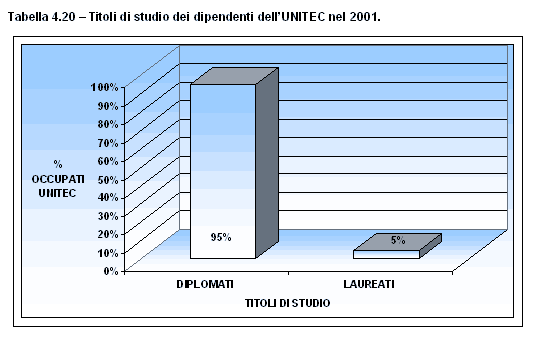
Source: our UNITEC data processing
By carrying out a further breakdown of the qualifications category we can consider the type of diplomas and degrees held by UNITEC employees¹. Let's look at them in more detail in the following tables.
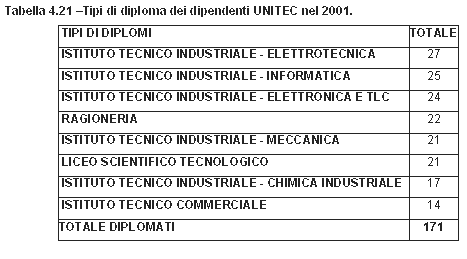
Source: our UNITEC data processing
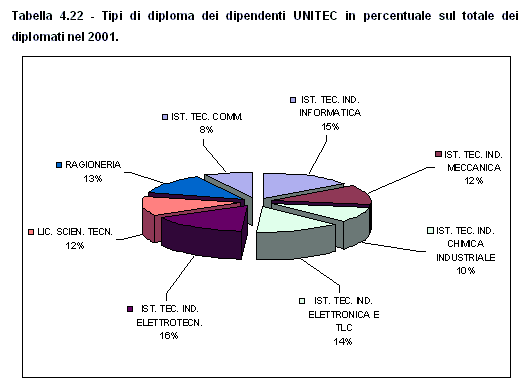
From tables 4.21 and 4.22 it emerges that the majority of UNITEC graduates come from the various fields (computer science, mechanics, industrial chemistry, electronics and telecommunications, electrical engineering) of the industrial technical institute (67%). If we add to them the employees coming from the scientific-technological high school (12%), we will have that as many as 79% of UNITEC's graduate personnel belong to the technical sector: this is motivated by the various possible needs of the client companies, when they decide to resort to the services provided by UNITEC. The remaining 21% of graduate employees have administrative and logistical functions within the company and come partly from accounting institutes (13%) and from the commercial technical institute (8%). Let's now see in tables 4.23 and 4.24 the types of degrees held by UNITEC employees.
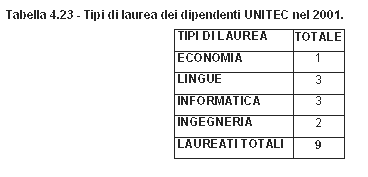
Source: our UNITEC data processing.
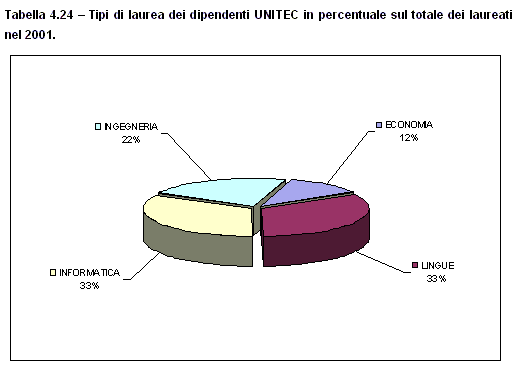
Source: our UNITEC data processing.
Below we present the professional training/updating plan for the company's staff. To keep up with the times and be able to maintain the competitive advantage acquired, UNITEC has decided to undertake on its own behalf advanced training for new hires in the direction it hopes for and a valid project for the permanent updating of its employees. So he began to carry out training courses, based on his needs. Some of them are carried out by an external consultancy company, which also certifies the quality levels of the preparation of its employees, according to the personnel training criteria ISO 9000. Furthermore, the department heads take care of both the training and professional development of company collaborators. Workers already hired periodically receive update manuals (every six months, generally), drawn up by the company. The company in our survey also encourages its employees to continually search for new educational material, including via the Internet. The Internet thus becomes a tool for ongoing training. In the event that a collaborator finds information that he intends to share with other colleagues, he independently transmits via e-mail the links on which he found it and a brief description of the content. If the material is deemed to be of general interest, its publication on the company Intranet is requested. In the end, the collected know-how is reported in a monthly internal report, which will also be used to draw up the six-monthly update manual. In concrete terms, therefore, for the training of new hires and the updating of employees, UNITEC has various tools at its disposal: internal and specialized literature (such as, for example, the various theses published on the UNITEC website, which concern the company itself); semi-annual external audits²; participation in courses held by third parties (including evening courses) for learning and specializing the technical skills required by UNITEC. Furthermore, ad hoc courses are planned for the company's salespeople. Let us now address the issue of the types of contracts to which UNITEC employees are subject. They refer to the category contracts in force in the various countries where UNITEC is present. Currently as many as 89% of them are employed full time, as depicted in table 4.25. Substantially the staff employed on a part-time basis are those assigned to occasional services and maintenance of the structures, but also to some services that UNITEC has outsourced.
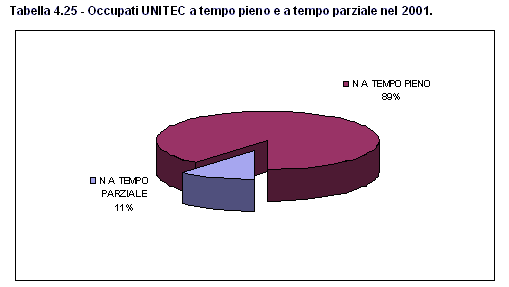
Source: our UNITEC data processing
In the next table, 4.26, however, we see the trend in the number of employees of the three UNITEC companies, always full-time and part-time, but this time over time, i.e. from the establishment of the company (as already mentioned, which took place in 1990) until today. We can note that until 1996, all those employed belonged to the German UNITEC. Since 1997, the trend of the nascent Italian company has emerged, which since 1999 has merged with that of the Latin American UNITEC.
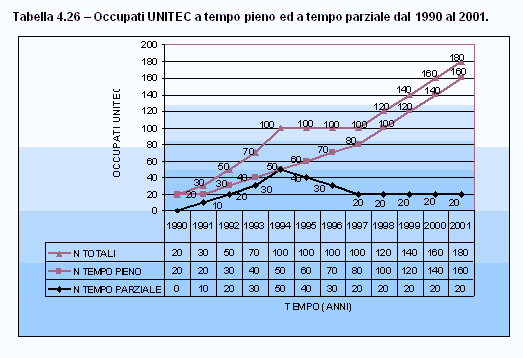
Source: our UNITEC data processing
Regarding permanent and fixed-term contracts, we can say that since 1998 UNITEC has gradually and to a lesser extent begun to use the latter. In fact, the latter allow the collaborator's position to be rechecked at fixed deadlines (generally every three or six months). Furthermore, fixed-term contracts represent an important incentive to grow on a professional and cognitive level for those who are subject to them. In table 4.27 we see the current situation, while in 4.28 the trend that the phenomenon has taken from the establishment of the company until today is illustrated, compared to the trend of UNITEC's total employees.
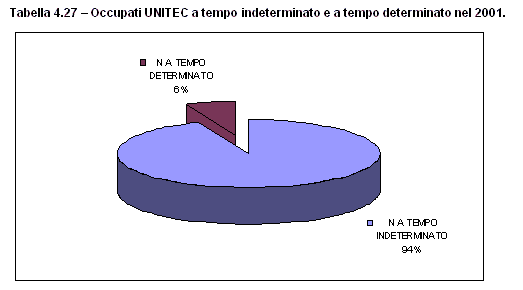
Source: our UNITEC data processing
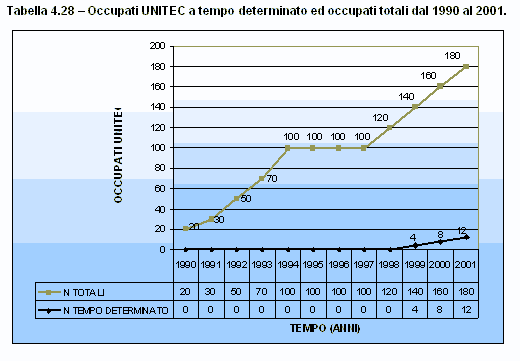
Source: our UNITEC data processing
Note 1: In this paragraph, 4.3, we will study the UNITEC occupation as a whole. In subparagraph 4.3.1, however, we will analyze in more detail the characteristics and type of jobs of the women employed in the company under investigation. Note 2: An audit means a control operation of the assigned tasks, in other words it consists in verifying the progress of the planned activities, also with reference to the progress of the staff's skills and training needs. This control is carried out both on collaborators and on the various departments and also on the company as a whole.
4.3.1 UNITEC and female employment
We have already said, when introducing the company, that it employs 180 workers. 45% of these (equal to 81 people) are women. In the survey we decided to also disaggregate this data and study how the female component of UNITEC is employed. There are 77 graduates, while the remaining 4 are graduates. We can see table 4.29 in this regard.
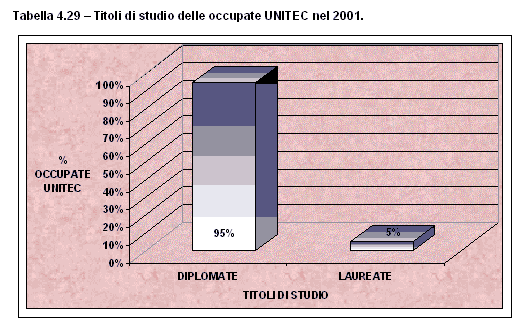
Source: our UNITEC data processing
In fact, the ratio between male and female graduates fully reflects the distribution of qualifications valid for the majority of employed people (which corresponded to 5/95, equal to one nineteenth). There are 20 graduates in accounting (27% of the total), 20 from the scientific-technological high school (27%), 14 from the commercial technical institute (18%) and the other 23 come from the industrial technical institute (28%). More precisely, of the latter 10 come from IT (12%), 8 from electronics and telecommunications (10%) and 5 from industrial chemistry (6%), as shown in tables 4.30 and 4.31.
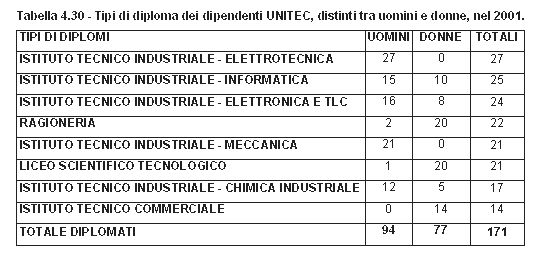
Source: our UNITEC data processing
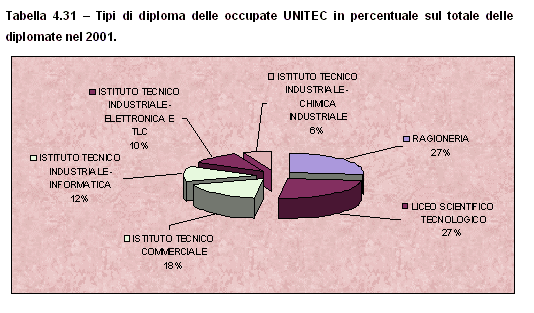
Source: our UNITEC data processing
From tables 4.32 and 4.33 it emerges that there are 2 graduates in languages (50% of the total), 1 in economics and 1 in computer science (respectively, the remaining 25% of the total).
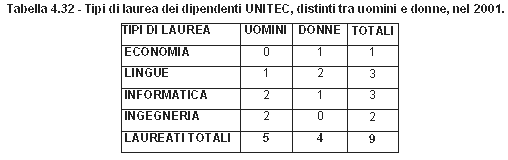
Source: our UNITEC data processing
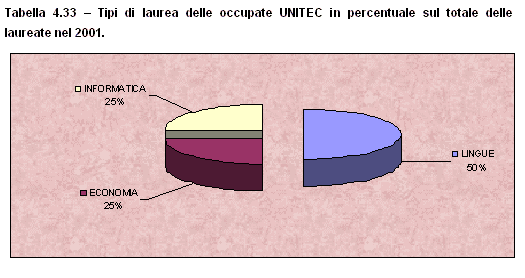
Source: our UNITEC data processing
Analyzing among the tables presented those that illustrate the qualifications of the women employed at UNITEC, we understand the reason why they are mainly employed in carrying out administrative tasks, if we exclude (as already seen) part-time ones: they essentially do not possess, with some exceptions, technical qualifications. Conversely, men are mainly employed precisely for carrying out this last type of activity. As regards atypical employment contracts, all 20 part-time employees of the company are female. The other 61 women have a full-time contract, as presented in table 4.34.
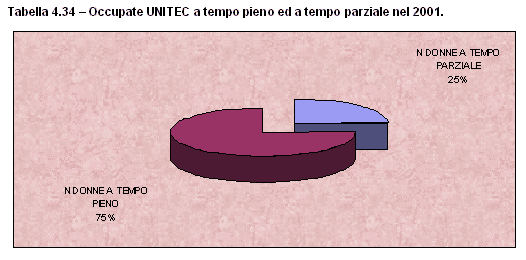
Source: our UNITEC data processing
There are currently 6 fixed-term employed women (corresponding to 7% of the women employed at UNITEC), while the other 75 (93%) have a permanent contract, as highlighted in table 4.35.
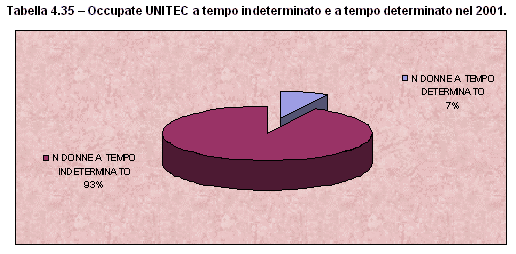
Source: our UNITEC data processing
Substantially, the percentage of female presence in UNITEC has remained almost unchanged over time. Therefore, describing its trend would be redundant: it can be easily understood from the tables referring in general to the entire company, keeping in mind that the female component has always been close to 45%. Finally, to conclude this chapter, we propose below a summary table, 4.36, which summarizes the current employment situation of UNITEC.
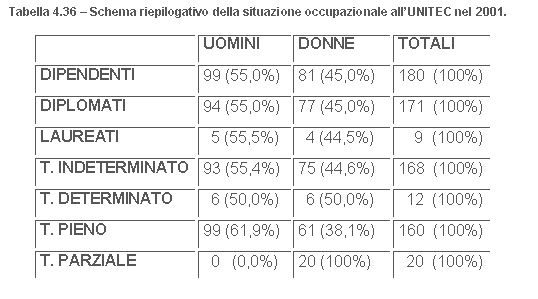
Source: our UNITEC data processing
5th: Concluding considerations: from economic theories to labor policies
5.0. Introduction
5.0. Introduction
In this last chapter we intend to conclude the analysis by reconnecting the case study to the more general problem of the employment effects of ICT. The aim of these conclusions is to draw some reflections from the results of our investigation, which go beyond the pure academic contrast between optimistic and pessimistic theories regarding the relationship between technical progress and employment. Furthermore, these considerations aim to identify the network of causal interconnections through which new technologies act and produce effects on the levels and structure of employment. Finally, the positions taken by the government authorities towards this problem and the lines of intervention envisaged in this regard will be considered.
5.1. From theory to practice, from micro to macro and vice versa
5.1. From theory to practice, from micro to macro and vice versa
As argued by Manelli, Pace and Cecchini (2001) it can truly be said that "the constant of the New Economy is continuous change" (p. 83). In the second chapter, we saw that new technologies are the very essence of the new economy, they play an essential role: they offer everyone greater choice, easier access to goods and services with better quality, they continuously fuel their relevance for the present and for future developments, increasing the need for innovation in the system. They force many workers to change or review their forms of employment, so that the term "flexibility" (often purely understood in the theoretical-political debate with the reductive meaning of "wage compression and/or growth in turnover") instead has the positive value of "rapid qualitative adaptation" to the new methods of production. In fact, as far as it has been possible to ascertain at an empirical level, it has not been possible to state that the introduction of new technologies at company level has decreased the volume of employment; in particular, in the practical case, the growth of the activities linked to them has led to an increase in employment, albeit modifying the characteristics of employment of the workforce. To begin to draw the first conclusions on the employment impact of new ICT technologies, it is essential to recover some theoretical elements, addressed in the initial chapter, and to connect to the different explanations of the relationship between technical progress and employment (key instrument of the dynamic development of individual and collective wealth), proposed by the various schools of economic thought. On the one hand, as you will remember, there is the classic self-regulating, market-balancing model, based on Say's law. We have seen that for the economists who refer to it, the automatic forces of the market manage to re-establish equilibrium even in the presence of technical progress. This is considered by them to be an exogenous and neutral factor. Therefore, unemployment is not due to technology, but to occasional imperfections in the information mechanisms between supply and demand. The theory of compensation applies: for these authors the system will always tend to correspond to a natural rate of unemployment, which will be closely linked to the available technologies. At the other extreme, there is the Marxian model, in which the study of the link between technical progress and capital accumulation (through which innovation enters the system) is necessary to understand the development of the effects on the labor market and the increase in the level of mechanization of the production process. The use of machines is an important tool to resist the wage pressures of the workforce. In an intermediate position, the Schumpeterian and post-Keynesian models are found. In the first, it was seen that innovations are linked to a short-term breakdown of previous production balances. As Reich rightly points out, "a healthy economy is never in perfect equilibrium" (Reich, 2001, page 53), since the triggering of a process of creative destruction constitutes a fundamental element for the evolution of markets. Innovation leads to the introduction of new products, processes, markets and production and organizational methods. The post-Keynesian model, however, states that, however, the presence of "creaks and squeaks" must be recognized. Noting the importance of the relationship between technology and capital accumulation, the supporters of this theoretical model no longer believe that technical progress is neutral with respect to employment. This only happens if equality of growth rates between capital and labor occurs. In essence, the system is not capable of guaranteeing investments capable of absorbing all the available manpower. Technical innovation implies repercussions on the economic-social level, due to the effects it induces at the institutional and organizational level of social structures. Pasinetti's multi-sectoral disaggregated dynamic model considers the variations in productivity in the various branches of the economy and defines the concept of vertical integration of the production process. From this it can be deduced that technological innovations lead to strong changes in the inter-sectoral (as well as intra-sectoral) distribution of the economy, therefore the existence of a strong mobility¹ of the workers themselves between the different branches of the economy would be fundamental. Sylos Labini focuses on the endogenous/exogenous nature of innovations with respect to the economic system and on the factors that favor the introduction of machinery in production. Perez and Boyer estimate that adjustments are achieved only through social and political changes, adapted to the peculiarities of new technologies. We see that the variables involved in the aggregate and disaggregated vision are in general the following: productivity, production, factor prices, the sectoral composition of production, demand and in a dynamic vision, time. Obviously we know that the rise of new technologies, the decline or development of entire sectors, new infrastructural investments, shifts in the international location of industries and technological leadership, State interventions in favor of this or that sector, a change in regulations change the reference framework in which the technology/work relationship evolves. But just as it is true that this link varies over time, it is also true that the context of reference also changes. Each of the above models does nothing more than attempt to explain the link between technical progress and jobs, considering the change of some variables and the constancy of others and trying to more or less simplify the reality of the facts. This inevitably increases the difficulties of those who try to define the trend of the phenomenon under investigation in the long term. Objectively, there is a need to refer to a disaggregated vision of the analysis, given that the aggregate one is excessively simplistic and generic. We could, therefore, start from a post-Keynesian approach (where a hypothesis of "involuntary unemployment" foreign to the orthodox neoclassical school can be harbored), but qualify it with "micro-founded" aspects (where there is room for both the analysis of individual behavior and - above all - the long-term dynamic approach). Today we know that technical progress brings great changes to the world of work. In general, production is entrusted to machinery, which certainly takes away manual labor, but at the same time reduces prices and, consequently, increases purchasing power. If consumers buy more, businesses produce greater quantities of goods and services and will need new workers. We know that human needs are inexhaustible: if employment decreases in the primary and secondary sectors, it certainly increases in the tertiary sector to satisfy many needs that go far beyond essential needs (entertainment, intellectual stimulation, communication, family well-being, financial security, health). In short, we can say that technological unemployment could cure itself, or almost, under the condition that the existence of qualified personnel serves not only to combine physical and human capital in an adequate and more productive way, but also and above all to "manage" the foreseeable increase in average factor productivity, in favor of an increase in employment. It is known, in fact, that a growth in productivity induced by technical progress has, as the first consequence that can be visualized in a graph, the upward shift of the production function (from Y to Y'), marking an increase in the product per unit of factor used (the demand curve shifts to the right).
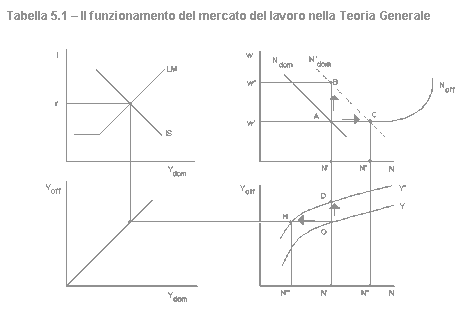
Source: Capparucci (1995)
Other things being equal, this increase in output per unit of factor could lead to an increase either in the wage level, or in profits (if union power were weak), or in employment (from A to C, rather than B). In the event that, following technical progress, we were "satisfied" with the same level of product prior to the innovation, we could have a contraction in employment (from point O to H). If we choose, instead, to allocate the increases in productivity to new and greater employment, it is important that (in a purely Keynesian logic) the greater supply of product (consequent to the greater employment N') corresponds to a parallel greater quantity of income demanded. Up to this point the analysis still remains at an aggregate level. The problem, in reality, lies precisely in the fact that, if on the one hand, the introduction, adaptation and diffusion of technical progress require adequately qualified personnel, on the other, the use of the latter could lead to the "crowding out" of less qualified workers (for example, the work of three workers could be carried out by a single IT operator and a computer). In order for there to be no technological unemployment at an aggregate level, it is essential that (microeconomically) timely steps are taken to retrain and/or assign personnel with obsolete professional profiles to other tasks. In this context, therefore, training takes on a crucial role both from the point of view of analysis and of intent.
Note 1:We remind you that mobility means the ability and willingness to move to find a job suited to one's skills.
5.2. Technology and the new era of human capital
5.2. Technology and the new era of human capital
The studio has become the investment par excellence in human capital. It constitutes the very basis of progress and social well-being. Let's start from the fact that work needs capital and raw materials to produce. Technical progress changes the way work is combined with other factors and also the types of work required. The inequality of wages from one country to another also depends on this, i.e. on the modes of production¹. Advanced management and cutting-edge technologies allow for higher productivity with a consequent increase in demand for qualified and better-paid work. Therefore, developing countries, equipped with elementary production techniques, have lower wages and a lower demand for qualified personnel. For a country to have superior technology that allows for a high point of balance between supply and demand for work, the existence of good administration is necessary, that of a market with simple and transparent rules and that of workers, who are all the more qualified if they are educated. Training thus becomes the keystone of economic development: those who do not have it are heavily penalized. The country that invests in education provides its citizens with the conditions to access a qualified job market and, moreover, accentuates the wage gap between those who have the necessary skills and those who are left behind on the education and training ladder. The center of work organization today is information, transmitted and processed by new ICT technologies. The man/machine relationship has changed as the ability of man to communicate with the computer operator has been added. Also for this reason, continuous training, which does not stop only at compulsory schooling, acquires ever greater importance over time: it must gradually create a population of informed and qualified workers. In a globalized world, the need for knowledge and skills is common to everyone and creates the basis for worker mobility. It does nothing but attenuate wage differentials between geographical areas. The objective of reducing them, for the same tasks, can be achieved by switching to more complex production methods. Low wages for unskilled jobs remain low if the worker does not increase his skills and is unable to place himself in a better position on the labor market than the previous one. However, the transition from one category to another must be facilitated by the individual's abilities and by continuous training organized partly at a government level and partly at a private level. Furthermore, the investment made in the past in human capital orients both the worker and the economic system towards specific production frontiers. In fact, we must always keep in mind the cost of energy (time and costs) necessary to specialize in a new profession and/or to acquire other skills. Wage inequality is mainly the result of the ability of individuals and institutions to provide themselves with knowledge, training, physical capital and production techniques. In particular, technology is truly responsible for these gaps, both within individual countries and in relations between the various states. However, history teaches that it would be wrong to hinder the imports of products from developing countries, where they cost less, to reduce the worsening of inequalities. In fact, the proceeds of these imports are allocated by emerging countries to the import of sophisticated goods, produced in developed countries, demonstrating that international trade is a positive-sum game. With the monetary union and the single market, Europe has become a place of exchange of goods, consumption and work. Despite the high unemployment rates of some EU member states, the advent of the euro encourages labor mobility (as Pasinetti proposed in his dynamic multisectoral model) and, thanks to the mutual recognition of qualifications and professional certificates, further broadens the geographical space of trades and professions. European citizens can also look for work via the Internet, comparing salaries in a single currency. It should not be overlooked that in the perspective of the single market and economic integration it is essential to possess communication skills: knowledge of languages appears to be a fundamental element for placement in the job market. English is, by far, the most requested language, in 90% of job applications (Isfol, 2001). E-commerce and the Internet are modifying the labor market and also causing an incisive change in its organisation, opening new channels for the dissemination of knowledge and interactivity within the various activities. Through the use of the Internet and workgroup technologies it is possible to produce teleworking, which allows, in addition to the reduction of structural costs, the acquisition of resources and professionalism, today a true strategic force for industrialized countries. The company itself is reorganized with more flexibility and adaptability, while the functions and capabilities of the workers are redefined through training and updating. SMEs should be able to find the skills that their development requires at lower costs and at the same time they can afford to maintain the advantages that small size offers. The difference between today's employment and that of tomorrow is given by the growing push that the introduction of technology gives to increasing productivity and quality and to reducing times and costs (and, consequently, the prices of final goods, in order to remain competitive). Technical progress offers better goods and services, but in order not to cut companies off from the market, it forces them to always produce better than their competitors. However, this is not enough: in addition to increasing quality, reducing times and costs, it is also necessary to continuously improve the organization of work, making it capable of generating goods and services before others: this also gives rise to the need for research for development. The problem that every company faces is attracting traffic and visibility (through word of mouth, direct marketing, telemarketing, diffusion through well-known brands). To this end, the objective of companies must only be to maintain the reputation of offering the best deals: in the new economy, in fact, the economic value of companies depends on the solidity of the relationship of trust that they have managed to create with their customers. Since technology is the future, in the future the spirit of innovation will extend to economies around the world: ICT, by amplifying creative ideas in a particular field or market, will increase their value and make them spread in real time. We now know that the initial efforts imposed by the computerization of management processes, with the change in production techniques from conventional to computerized, are decidedly high (as already seen in table 3.15). However, technology brings added value to the company and has important strategic values for the company's existence. This means that technical progress offers the possibility of significant profit margins and considerable advantages for the company; Furthermore, under certain conditions (first of all, the continuous retraining of staff), it could preserve employment, preventing many employees from finding themselves without a job with the closure of obsolete plants. ICT transforms not only the company's activities, but the company itself, allowing the computerization of documents and the automation of processes. This is how investments in new technologies help to acquire further human capital and change work from manual to automatic. Furthermore, since the control of these automatic activities is of a conceptual nature, a change in the qualifications required is necessary with new training or refresher courses by the company's employees: among other things, this contributes to the intellectual improvement of the employees. It is necessary for staff to continuously specialize in the design, programming and maintenance of new IT tools. Finally, by allowing greater creativity and the possibility of moving beyond mere manual occupation, it has been verified that new technologies allow greater individual satisfaction for workers. By innovating, as we could also see in the case study we proposed, space was created for further added value and employment gradually increased; similarly, we found that in client companies the jobs have not decreased, but their quality has improved. This event occurred because new technologies have allowed a de facto increase in income. Typically, the company that hires new workers is small or medium sized and belongs to the mechanical or business services sector². It has high levels of profitability and a high propensity to innovation and export. Furthermore, it has a certain intensity of labor use (measured by the hours actually worked per employee) and its hiring is linked to the best destination of the present workforce. The propensity for innovation is a determining element, as it connects the labor market to the way of producing and to the demand for an increasingly qualified type of employment. It should be noted that in our country companies have a capacity to innovate that is not linked to formal research laboratories: they, in fact, introduce new products or modify existing ones on the basis of experiences and learning of various kinds with an eye continually turned to demand and the evolution of the market. In conclusion, in light of what has been explained so far, we can argue that technology gives the company the possibility of progressing, but at the same time forces it to do so, otherwise it would find itself cut off from the market.
Note 1: The expression modes of production refers to the complex of technology and work organization that defines a production structure. Production methods change continuously, following the introduction of technical progress and process innovation. Note 2: In particular, growth was found to be even higher for those companies that provide specialized services, which require specific technological knowledge. Once again, the employment growth of the workforce rewards high professional qualifications.
5.3. New technologies, subordinate and atypical work
5.3. New technologies, subordinate and atypical work
As we saw in the case study addressed in the fourth chapter, the aspects linked to the employment situation of a company are not easy to define, but require a highly disaggregated analysis. In the practical case, on a quantitative level, the trend in the total number of workers in the company examined was studied. It has been possible to verify that over time the number of people employed has substantially increased, although not constantly. Furthermore, even if these have remained the same for a certain period of years, their composition has changed. We saw in the previous chapter how UNITEC was founded with around twenty employees and in the space of just four years managed to quintuple this number. Subsequently, a three-year period of adjustment occurred, crossed by the change of contracts from part-time to full-time. In 1997 employment began to rise again and in the same year law 196 on temporary work was introduced. In 1998, permanent contracts were no longer the rule and since then fixed-term contracts have begun to be used, albeit very feebly. To date, out of one hundred and eighty UNITEC employees only twelve (equal to 6.5%) have a fixed-term contract. We can say that work is changing in its structure. In Italy there is an ongoing process in which workers and companies aim to better modulate working hours. At a general level, this is because businesses have to continuously cut expenses, not only by not buying everything they can rent and looking for lower-cost suppliers, but also by leveling hierarchies in flexible contractual networks¹. Flexibility: we have already seen how many and what meanings can be attributed to it, but in any case it proves to be a variable of fundamental value. Even if it cannot be stated irrefutably that forms of guaranteeism, rigidity and high labor costs are at the origin of the current lack of jobs, it is undeniable that a "right dose of flexibility" can help companies and workers to remain on the market. As will be remembered in paragraph 2.4, it has been shown that the creation of new employment appears increasingly linked to less rigid contractual forms of employment, such as atypical employment contracts (part-time, fixed-term, temporary, seasonal work, CFL, apprenticeship and job sharing), which are becoming increasingly widespread in Italy. In particular, the fixed-term contract allows the collaborator's position to be rechecked at fixed deadlines (three or six months) and, according to the companies, represents an important incentive to grow on a professional and cognitive level for those who are subject to it. This type of contract entails innumerable advantages for the company, a little less for the worker, although it should be noted that in this way he has the possibility of carrying out a job for a few months, rather than remaining without a job. On the other hand, it should not be overlooked that, in general, these types of contracts offer companies the possibility of reducing the cost of the worker in the long term, both because they can better adapt the flow of employees to changes in the economic cycle, and because they can reduce a worker's stay in the company and with it his fixed costs (such as T.F.R.), when his professional profile becomes obsolete. Considering the current legislation more carefully, it cannot be denied that there are currently considerable incentives for companies to resort to temporary work, rather than traditional forms of employment. However, it must be recognized that with the introduction of the figure of temporary work into the current legislation, Law 196/1997 managed to open a breach in the rigorous guarantee regime of subordinate work, institutionalized since the beginning of the 1960s. In the current economic-social situation, the main problem is certainly employment and to solve it it is certainly necessary to propose innovative solutions. The lack of employment represents the denial of the value of man: therefore, mobile and/or temporary work must be considered preferable to long-term unemployment with no prospects. However, we are equally convinced that some changes are necessary that allow temporary work to be temporary also in relation to the individual's working life cycle: a sort of incentive that facilitates entry into the employment structure, where however a "right degree of stability" is also the prerequisite for being able to plan (for the worker, as for the company) investments in training and learning by doing processes, where permanence in the company also means growth in human capital and profitability for the investments made (also in terms of social security and social security). Today the European labor market is subject to competition from newly industrialized countries, within which new opportunities arise in recently created sectors (in particular, electronics and telematics). For our employment, the prospects depend on reforms aimed at restoring mobility and flexibility to a labor market that must keep up with the times. In the practical case, we found that the technical knowledge required of the employees of the company studied has gradually increased over time: it is therefore the high qualification that has allowed the employment of new personnel. In this regard, it is clear that education plays a central role; furthermore, the income of the more educated continues to grow compared to those who have stopped studying. As argued in a recent analysis (Seravalli, 2000), if it is assumed that the training process is combined with the deregulation of employment regimes (with the possibility of dismissal without just cause, in any case), the company would not be permanently linked to its employees, educated/trained at its expense, and they would not have an incentive to stay if other companies (which did not bear the costs of their training) offered them better salary conditions. In this case, by abandoning their jobs, the workers would expropriate the company of the capital of skills invested in them. It is also probable that, to guarantee an average level of income in the long term, the salary they require would be higher than that of permanent employment. Faced with this situation, companies would be forced to increase their investments in training employees' skills, so as to allow rapid and content-rich learning. Further competition would be created between companies to "grab" the best workers, for whom they have not incurred any training costs and who, therefore, can afford to pay more. If the model were implemented precisely in these terms, in a virtuous way, there would be countless advantages: increased productivity, greater education and training, increased well-being. However, if the increase in deregulation did not bring positive effects (vicious mechanism), the space for gradual technical development would be reduced and there would be either rapid and convulsive progress or decline. The virtuous or vicious functioning of the mechanism fundamentally depends on the link between the growth of productivity and that of the product. In a scenario of deregulation of the labor market, although the risk of expropriation of the fruits of investments in human capital has grown, if demand developed significantly and continuously, companies would have the means to continue investing in innovation and training. If, however, demand grew little and discontinuously, companies would have pessimistic expectations and limited means and would therefore decide not to invest and to steal trained workers from other companies. The result would be that none of them would invest anymore. On the other hand, it is also true that only if the demand for work grew significantly and continuously, would families continue to invest in their children's education (given that there would be no shortage of work and per capita income would increase). In conclusion, it seems preferable to adopt flexible forms of employment only in the initial phase of entry into work, compared to the two extreme alternatives, full success or decline, without giving up the centrality of the permanent position in the employment stock.
Note 1: In this regard, it will be remembered that in the second chapter, in paragraph 2.2, the topic of down-sizing was addressed, meaning with this expression the reduction in the level of qualifications of a company (and, therefore, in the presence of middle managers), caused by the greater decentralization of production methods towards smaller companies (outsourcing).
5.4. The professions of the net-economy
5.4. The professions of the net-economy
According to the 2001 Isfol Report, the professions linked to the sector of new information and communication technologies are in constant but limited increase (12,446 equal to 4.9% in 2000; 9,524 equal to 6% in 1999; 8,561 equal to 6.6% in 1998). Among the first thirty professional figures requested in 2000, there are some that can be placed within the new economy: programmers occupy fifth place in the ranking (2.5% of the total figures sought), programmer analysts are in sixth place (with 1.9% of total requests), EDP systems engineers¹ (1.7%) are in seventh place, call center telephone operators are in twenty-eighth with 0.8% and, finally, engineers are in twenty-ninth with 0.8%. From a quantitative point of view, for some years now, there has been a growth in professions relating to the new economy area, which is thought to be due to the growth of the telecommunications sector and the spread of the Internet. However, by investigating the qualification aspects required for some roles, it emerges that the cognitive levels of the majority of generic roles (relating to administrative/accounting management and secretarial activity and, furthermore, transversal to all sectors) increase with the introduction of new technologies. As regards the qualitative characteristics of the job application, the candidate to fill the position offered should generally have a qualification corresponding to (or higher than) the one requested, a medium/high knowledge of foreign languages and, in half of the cases, previous work experience. Without a doubt, knowledge of the professional profiles sought would allow a reduction in the time needed to match supply and demand. However, it should be noted that the most requested jobs seem to have a particular link with new technologies: in fact, the trend of new professions (linked to recent technologies) or emerging ones (functional to new market needs) appears to be wavering. The current debate on the nature and prospects of the net-economy is very lively and complicated by numerous economic events (such as the American - after years of continuous growth - and Japanese economic slowdown; job cuts; the end of the speculative bubble in the USA and the saturation of some markets). In any case, the relevance of the new economy is always growing: the objectives to be pursued through it are, firstly, a frictional level of unemployment and, secondly, the creation of the majority of available qualified positions. The extraordinary European Council in Lisbon (23 - 24 March 2000) identified the knowledge-based economy (KBE) as the competitive challenge for promoting growth and achieving full employment. Therefore, the E.U. has set out to "become the most competitive and dynamic knowledge-based economy in the world, capable of achieving sustainable economic growth with more and better jobs and greater social cohesion" (Lisbon European Council, 2000, p. 2). To this end, we have increasingly tried to insert the Internet economy into the Old Continent. In the European Commission's Employment in Europe 2001 it clearly emerges that the world economy is currently subjected to the globalization of processes and the introduction of new technologies, two important challenges that must be overcome in order to take full advantage of the growth possibilities linked to KBE and to finally achieve full employment. Unlike the "American growth model" (which has always relied on entrepreneurial forces and the market and, certainly, does not shine for the guarantees it offers to workers), the European Union has decided to achieve these objectives through the traditional pillars of the "European social model" of solidarity. As regards Italy, the Government, by presenting the DPEF (Economic and Financial Planning Document) relating to the public finance maneuver for the years 2002 - 2006, has assigned centrality to the net-economy through the training of human capital and the further development of new information and communication technologies². The complexity of the national situation (given, among other things, by territorial dualism and weak economic growth in recent years) allows us to analyze only the impact of the net-economy on the professional structure and on the birth of new professions, considering only the IT and telecommunications sector (from which the acronym ICT derives). In fact, we believe that this latter is the most easily identifiable with the KBE.
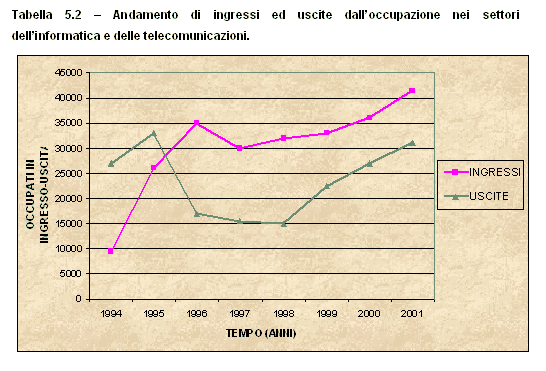
Source: Isfol calculations based on Istat data.
Table 5.2 shows us the trend of entries and exits from the ICT sector. From 1997, entries into information technology and telecommunications began to grow steadily until 2001, recording a balance between entries and exits that was mostly constant from 1999. From the next table, 5.3, it can be seen that those employed in the ICT sector show the same slow growth trend from 1995 (when they were 473,000) to 2001 (the year in which they amounted to 652,000 units), while the manufacturing sector with a high intensity of technological innovations (considered as a point of comparison) has recorded an increase in manpower since 1997, which suffered a slight decline in 2001. However, we can say that overall the incidence of those employed in information technology and telecommunications on the total employed (which amounted to 21,373,000 in 2001) is substantially stable over time, with a percentage slightly higher than 10%.
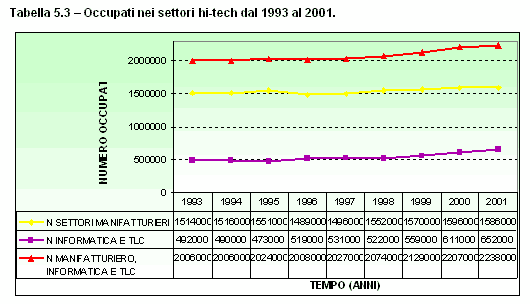
Source: our Istat data processing
Demands for ICT-related occupations have grown very quickly in the last five years, among the top ten most requested professions in 1996 was only that of the programmer, while in 2000 they also included the programmer analyst and the EDP systems engineer. The entire ICT sector has grown rapidly over time, especially in the last three years, and has had to face many difficulties in finding specialized professional figures. The most sought after occupations are those related to programming and software (programmer, programmer analyst, software designer), those relating to the electronic data processing area (EDP system engineer) and Internet (web developer). The new professions created in the last two years refer above all to the Internet area (web developer, web master, Internet expert, web designer, web editor, web content, web marketing), to networking (network system designer, network designer, network protocol specialist), to the systems area (system administrator, systems directors), and to other areas (EDP assistant, EDP collaborator, application consultant). In the ICT sector, a process of substantial "professionalization" is underway: it has led to considerable variability in new jobs with respect to wages, the levels of formal qualification required, the foreseeable requalification of workers already employed in different fields or even the entry into the profession of many new graduates and the inadequacy of companies to develop an adequate manpower requirements plan.
Note 1: The acronym EDP refers to Electronic Data Processing (i.e. the electronic processing of data). Note 2: The DPEF regarding the Government's policies for the information society can be found on the site www.governo.it.
5.5. Employment policies related to e-commerce
5.5. Employment policies related to e-commerce
The model that characterizes the diffusion of e-commerce conditions the collective well-being of civil society, just as the times and methods of institutional change influence the development of electronic markets and influence their organization. The adaptation of institutions is complex and takes time: there is the possibility that different conditions coexist in the various nations for each institutional and commercial context, depending on the products exchanged, the characteristics of the actors present and particular rules of conduct. The institutions and governments of all countries, especially the more industrialized ones, are interested in studying the social and economic impact of the advent of new technologies and, in particular, have analyzed the topic of support policies for the spread of e-commerce at a national and international level. Various types of measures have been proposed to adapt the institutional context both to the formation of a qualified demand (which makes full use of the possibilities offered by the electronic market) and to the support and development of supply. In the first case, we addressed the IT literacy of citizens through the diffusion of ICT technologies in schools, private homes and public places. In this way, the technological up-grading of citizens has outlined new social needs and a new typology of basic communication services. Instead, in the second case (the one linked to the strengthening of the offer), the aim was to spread the business opportunities opened up by e-commerce in SMEs and in disadvantaged geographical areas (such as our South) through pilot projects, which primarily involve the Public Administration both as a customer for the business sector and as a provider of services to citizens. Then there are the proposals for tax incentives for online presence, which range from the tax exemption of investments to the reduction of tax rates on online turnover: however, these measures could generate asymmetries between the different States and between electronic and traditional commerce. A quick examination of the current situation highlights three areas in which obstacles and frictions exist which, without adequate institutional commitment, could limit the spread of electronic commerce. These are the infrastructure, the regulatory framework and the financial circuit. First of all, the complexity of adapting communication infrastructures involves institutional actors and international government bodies. Public intervention must aim to simplify the introduction of new products-services, encouraging technological updating and convergence towards common standards, guaranteeing fair competition with regards to the offer and availability of basic services at prices accessible to the public. Secondly, the regulatory area requires the definition of a legislative framework that considers the peculiarities of online commercial exchanges, from protocols for electronic transactions to the harmonization of international commercial regulations, to the approval of procedures that allow safe exchanges, safeguarding privacy, to the protection of intellectual property. Finally, public financial interventions for e-commerce must be focused on the promotion of solutions that allow the security of online payments and on tax problems linked both to the different regulations in force in the various states and to the ambiguous nature of goods or services exchanged via the Internet. For example, in traditional transactions, software is sold on magnetic media and, for this reason, it is considered a physical good, while it is considered a service if exchanged directly over the Internet. As far as our country is concerned, the Action Plan for the information society on e-commerce has been formulated by the Government. Let's see the main points. Italy can improve its position among the most industrialized states, with significant improvements in the economic and social system, if it manages to undertake decisive action to innovate and modernize its companies and the context in which they operate. The technological and financial effort is not enough: a cultural commitment and a new social organization are needed to effectively support the information society, investments and growth. The Internet and electronic commerce open new perspectives on the global market, contributing to the diffusion of ICT in factories, public and private offices, homes and society, accelerating the process of internationalization of production and trade, creating opportunities for development, competitiveness and work, offering new possibilities for knowledge and exchange. The most important results will be achieved for transactions between industrial, commercial, craft and service companies and it will be SMEs above all who will exploit the benefits deriving from innovation, both in production processes and in commercial activities. This type of company has more difficulty following the rapid evolution of the market and many promotional actions must be aimed at stimulating their competitive capacity. SMEs constitute the backbone of the national production system for quantitative aspects (such as number of companies, turnover, employees) and qualitative aspects (production and organizational specificities), they have a good degree of flexibility and easily adapt to market demands. Furthermore, they represent the main resource for growth towards new sectors and geographical areas; they are strongly exposed to international competition, given that unfortunately they have a low capacity for technological and organizational innovation; finally, SMEs encounter considerable difficulties in finding the necessary human and financial resources. First of all, to develop the supply and demand of the digital market, it is necessary to stimulate cultural diffusion and computer literacy among citizens and businesses. To bridge the technological gap, it is essential to overcome the cultural gap that slows down the penetration and use of ICT technologies and to train the professional figures that are currently lacking on the market. Secondly, electronic commerce will have to be stimulated in its various forms and in the different stages of adoption, from the web promotion of products and services to online transactions (contracts, orders, invoices, payments, etc.), from the integration of electronic procedures into internal company processes (legacy system) to the integration with systems external to the company (concerning the entire value chain). The benefits deriving from the spread of electronic commerce are certainly many, starting from the increase in efficiency in processes and the greater possibilities of access to international markets, up to the expansion of the degree of transparency of the market deriving from a better circulation of information and the greater efficiency of the Public Administration (both in the acquisition of products-services and in the provision of public services to citizens). Furthermore, there would be positive effects on the rationalization of transport flows and the management of mobility in large cities (rationalizing supplies) and an improvement in the position relative to SMEs and disadvantaged consumers (such as those who live in rural and mountain areas or in the South, or who are elderly or disabled). Finally, the spread of e-commerce would generate the expansion in the use of professional resources, both technical and connected to the content production function, with positive effects on employment and the valorisation of cultural heritage and typical national products. The problems arising from the introduction of e-commerce concern specific classes of economic activity and population groups. In this regard, crises will arise in economic activities and in the population with material and cultural access difficulties. There will be the suppression and/or modification of many intermediation activities (such as those of wholesalers, agents and intermediaries), the entry into crisis of employees made superfluous by labor-saving e-commerce and also the disappearance of professional figures, both employed and self-employed, due to the change in the skills required. Further risks derive from the lack of active behavior on the part of the public and business community. For example, both the lack of technological updating of companies (with the exclusion from the new large markets accessible electronically) and the facilitation of accessing and purchasing from foreign producers geographically distant from Italy, but more aggressive in their presence policy on the Internet could have negative effects; certainly, the tendency to "procure" cultural content from other States and the formation of new monopoly categories will not have a positive effect, both in terms of supply (such as the ability to attract demand through large portals) and demand (monopsons or group purchases on electronic markets), and in terms of services linked to e-commerce (certification, payment, logistics systems...) and basic technological platforms. The results of the Action Plan for the information society will be strongly influenced by interventions aimed at creating favorable conditions to determine development and competitiveness. Public intervention is aimed at generating externalities, such as the diffusion of ICT technologies, useful for increasing productivity and demand and for the efficiency of the entire system which (thanks to better relationships between companies and political, economic and social institutions, a system of real services and new rules) can create development, wealth and employment.
The programs in favor of e-commerce concern seven areas of intervention.- The first is that of literacy and the diffusion of IT culture among economic operators, which aims to promote a campaign to raise awareness and managerial orientation and some literacy courses for 45,000 entrepreneurs with the creation of 100 multimedia and technical assistance centres.
- The second area concerns specific professional training, with the establishment of English language, computer applications and network courses at the Chambers of Commerce and the provincial offices of the entrepreneurs' associations. Professional certification is envisaged for the teaching staff who will be trained. Each participant will receive IT equipment (PC, printer, software) which they will acquire upon passing the courses. The training of 3,000 specialized teachers is expected (with universities).
- The third area of intervention provides incentives to SMEs for the creation of portals in relation to particular territories and product sectors, with the creation of 300 vertical portals with an average of 200 companies.
- The fourth is in favor of a start-up with a high technological content: the Government intends to develop relations between Industry and University and, in this sense, proposes a rapid activation of the procedures for the financing and launch of economic initiatives with a high technological content, also taking on stakes in the risk capital of hi-tech start-ups. The incentives provided by law 488/92 will also be partially oriented towards initiatives with high technological content.
- The fifth area concerns sectoral interventions to be carried out in collaboration with the Ministries for cultural heritage and agricultural policies, to protect and enhance the national heritage and to enhance tourism, also by creating multimedia dissemination tools. Furthermore, interventions are planned both to encourage the necessary service supports for e-commerce activities, such as a campaign to disseminate digital signatures, e-procurement and online transactions, and for the creation of integrated logistics platforms (multimedia centres, general warehouses...) together with transport operators, also thanks to various incentives and employee training.
- The sixth area of intervention concerns the system of rules with the approval of the bill on the registration of domain names and the subsequent implementing legislation, to create an integrated system regarding industrial property, patents and trademarks. It then concerns both the transposition of the Community Directive on electronic commerce and the issuing of implementing rules, the formulation of codes of conduct and self-regulation in the field of e-commerce, and actions to encourage the non-jurisdictional settlement of disputes. Finally, within the scope of community guidelines and the principle of fiscal invariance, taxation methods will be identified for online transactions that do not penalize Italian companies.
- The seventh and final area of intervention focuses on quality and security measures with the reunification of skills currently spread across multiple Internet Committees in the Board of Advisors. This will assist the Government both in the definition of strategic lines for the development of online services, and in the representation of Italy in international forums on issues concerning the rules for the Internet and online services and also in the coordination of the bodies responsible for the prevention of Cyber crime and in contacts with similar bodies in other countries.
5.6. Conclusions
5.6. Conclusions
According to what Freeman and Soete (1994, page 163) argued at the beginning of the nineties, "ICT products and services have constituted, over the last thirty years, the category where prices have fallen the most... despite the general inflationary trend". This "is enough to give substance to the idea that an ICT-based economy could be quite successful in keeping prices anchored. But can it generate jobs?". In other words, could that "compensation" mechanism be put in place which, through an increase in productivity, via a decrease in prices, would favor employment growth supported by a parallel increase in demand for goods and services? Rather than entrust "the arduous decision to posterity", we simply note that at a microeconomic level (company and sector) employment trends show a positive sign, but at an intersectoral level negative impacts could also be perceived (such as the reduction of employment in the transport and traditional trade sectors). How much the final outcome gives satisfactory results on the employment front depends (as reiterated several times during the thesis) above all on:
- public and private investments in new innovative businesses; the training of workers and the use of resources in Research and Development;
- the growth and expansion measures of global demand (especially exports);
- the regulatory flexibility of work, to be understood as "temporary and partial" in the working life cycle.
In light of what has been explained so far, we identify four types of employment-friendly technological policies (Pianta, 1998) that could be further developed:
- policies for product innovation¹ and structural change;
- policies for the learning economy;
- policies to stimulate new demand and organize new markets;
- new policies to address economic change and the information society.
First politics. Traditional technological and investment policies have substantially incentivized labor saving innovations, which in any case companies would have been interested in introducing. Therefore, efforts must be concentrated on the creation of product innovations, which create new economic activities and favor the structural change of the economy towards sectors capable of creating new jobs in industry and advanced services. In this regard, a fundamental element is the development of new forms of financing for the most innovative projects, which would be difficult to access today's credit disbursement mechanisms.
Second policy. The relevance of knowledge and learning processes in the economies of developed countries must make us think of policies for education, training and the transfer of know-how as a system that produces and disseminates new knowledge. In particular, incentives (of various kinds, for example tax and salary) for companies and individuals who decide to invest in learning must be increased; investments in human capital could be ensured to receive equivalent treatment to those in physical capital. Specific measures are then necessary for the group of low-skilled people most affected by the problems of technological unemployment, who would otherwise risk being cut off from the job market due to the limited learning opportunities offered to them.
Third policy. The worsening of unemployment is linked to a framework of restrictive macroeconomic policies and productive restructuring at a global level: economic growth no longer necessarily leads to growth in employment. An employment-friendly technological policy should be able to identify economic activities with an innovative content that have the greatest potential to increase the jobs currently available. The most recurring examples are multimedia and new services based on information and communication networks. In this field, the State must operate as an "intelligent consumer" and, therefore, must anticipate the evolution of supply and demand, encourage the "incubation" of new activities and the meeting between different knowledge and skills and, finally, must intervene as a timely organizer and regulator of the new emerging markets.
Fourth policy. The nature of the new economy and the new society is characterized by information and learning. All this suggests that we need to further reconsider the forms and tools for public policies, developing some institutional innovations that re-establish the balance between social and technological change. There is a need to reorganize the use of time and the contractual forms (typical and atypical) that regulate it. The current divisions of time (from that between training and work, to that between employment and free time) must give way to more flexible and articulated ones, which see the succession of periods of training, work and free time. There is also the possibility of decreasing working hours (weekly, yearly or over a lifetime) to distribute productivity gains (which result from technological change) and to enable learning processes. We could then encourage the expansion of the non-profit "third sector", where paid work is intertwined with voluntary commitment, producing services that increase social cohesion and quality of life, as these cannot be provided by the market or by profit-oriented companies. Finally, the reduction of working time can stimulate the demand for new multimedia services, linked to learning, which require a high use of time by those who use them.
In conclusion, the development of employment-friendly technological policies requires significant institutional innovation and an expansion of public intervention with respect to the traditional objectives of competitiveness and cost reduction. The latter have only worsened the employment outcomes of the innovative processes carried out by companies. At the same time, it is necessary to combine current actions on the supply side (which support the technological capabilities of companies) with new actions to stimulate demand and organize markets that favor product innovations and increased production, thus increasing employment. Finally, new policies must be planned, linked to the affirmation of ICT technologies and adapted to the related processes of economic change. They must intervene on training and learning, on the reduction and redistribution of working time, on the search for new resources to finance public policies capable of redistributing the benefits promised by technical progress to the entire community.
Note 1: data from surveys on innovations introduced by companies in Italy (Pianta, 1998) show that process and product innovations have opposite effects on employment: the former systematically replace work, while the latter can have positive effects, especially in periods of expansion in demand. In Italy there is a strong prevalence of process innovations, while product innovations are often limited to new products only for the company or for the internal market. Naturally, the distinction between the impact of product and process innovations on employment is limited to the direct effects that technological change has on the company that introduces it, while neglecting the indirect and compensatory ones that could occur.
Bibliographic references
AA.VV. (2000), "Electronic commerce: what will be the impact of electronic commerce in five years time? Will Internet selling still play a minor role compared to traditional forms of trade?", in Commerce 99: proceedings of the seminar on distributive trades in Europe, European Commission. Affari & Finanza, vari numeri. ARCHIBUGI D.- MICHIE J. (eds) (1997), "Technology, Globalisation and Economic Performance", Cambridge, Cambridge University Press, in Contributions to Political Economy, vol.19, 2000. BABBAGE C. (1835), On the economy of machinery and manufacturers, 4^ed., Reprints of Economic Classics, A. M. Kelley, 1966. BOSTON CONSULTING GROUP (2001), "The multichannel consumer - Need to integrate on-line and off-line channels". BOYER R. (1989), Synthesis Report : New Directions in Management, Conferenza OCSE di Helsinky su "Education Practices and Work Organisation: Technological Change as a Social Process", 11-13 dicembre, OCSE. BOYER R. (1993), Ressources humaines, nouveaux modèles productifs et emploi, paper presentato alla conferenza OCSE di Helsinky su "Technolgy, Innovation Policy and Employment", 7-9 ottobre, OCSE. BRUNETTA R. (1990), Schede di economia del lavoro, Asap. BRYNJOLFSSON E.- HITT L. M. (2000), "Beyond computation: Information Technology, Organizational Transformation and Business Performance", in Journal of Economic Perspectives, vol.14, n.4, Fall 2000. CALABRESE G. (1988), "Progresso tecnologico e occupazione: note introduttive per una ricerca", in Bollettino Ceris, Consiglio Nazionale delle Ricerche, n. 22, 1988. CAMPODALL'ORTO S.- SCALFI G. (2000), "Commercio elettronico e piccole-medie imprese", in RIOLO F.- MASCIANDARO D. (a cura di), Internet banking: tecnologie, economia e diritto, Fondazione Rosselli, Edibank, 2000. CAPPARUCCI M. (1995), Il salario: paradigmi teorici a confronto, G. Giappichelli Editore. CESAROTTO S.- SERRANO F.- STIRATI A. (1995), "Note su disoccupazione tecnologica e interpretazioni dell'attuale elevata disoccupazione", in Quaderni di Economia del Lavoro, FrancoAngeli, n.52, 1995. COLELLA M.R. (2001), "Flessibili ma non troppo", in Pagine Monaci: Speciale Università Formazione-Orientamento Mercato del lavoro, Guida Monaci. COMMISSIONE EUROPEA (2001), Employment in Europe 2001. CONSIGLIO EUROPEO DI LISBONA (2000), Conclusioni della Presidenza, 23 - 24 marzo 2000. Corriere Lavoro, supplemento del Corriere della sera, 5 ottobre 2001. CORSI M. (2000), L'impatto delle nuove tecnologie sulle forme di lavoro: una prospettiva europea, SIE-XLI Riunione Scientifica Annuale, Università degli Studi di Cagliari, 26-28 ottobre 2000. CREMONA C. M.- FRANCESCHI A. (1997), "Business 'reale' per un mercato 'virtuale'", in Finanza & Mercato, BNL edizioni S.p.A., n.4-5, Set-Ott 1997. EITO (2000), "The E-commerce market in Europe", in EITO 99, European Information Technology Observatory. FEMMINIS G. (1990), La disoccupazione tecnologica in Ricardo: mutamento di opinione o di ipotesi? , Quaderni IDSE, Centro Nazionale Ricerche, n.8, 1990. FRANCO G. (1984), "Progresso tecnologico e occupazione (Brevi notazioni empiriche e di teoria economica) ", in Rassegna economica, Banco di Napoli, n.3, Mag- Giu 1984. FREEMAN C.- SOETE L. (1994), Lavoro per tutti o disoccupazione di massa? Il computer guida il cambiamento tecnico verso il ventunesimo secolo, Etaslibri. FREY L. (1989), "Innovazioni tecnologiche e occupazione", in Quaderni di Economia del Lavoro, FrancoAngeli, n.38, 1989. GILDER G. (1993), "The death of telephony", in "The Future Survyed", The Economist, 11 settembre, pag. 91 e ss. GREGORY M.- ZISSIMOS B.- GREENHALGH C. (2001), "Jobs for the skilled: how technology, trade, and domestic demand changed the structure of UK employment, 1979-90", in Oxford Economic Papers, Oxford University Press, vol. 53, 2001. GREGORY T. E. (1930), "Rationalisation and technological unemployment", in Economic Journal, dicembre. HANSEN A. H. (1932), "The theory of technological progress and the dislocation of employment", in American Economic Review, supplemento. HICKS J, R. (1936), La teoria dei salari, in Nuova Collana di Economisti, Vol. XI, Lavoro, UTET. HOWELLS J.- MICHIE J. (eds) (1997), "Technology, Innovation and Competitiveness", Cheltenham, Elgar, in Contributions to Political Economy, vol.19, 2000. ISFOL (2001), Rapporto 2000, FrancoAngeli. ISTAT (2001a), Rapporto annuale: la situazione del Paese nel 2000, Istat. ISTAT (2001b), Rapporto sull'Italia - Edizione 2001, Il Mulino. KEMERER C. F. (edited by) (1998), Information Technology and Industrial Competitiveness: How IT Shapes Competition, Kluwer Academic Publishers. KEYNES J. M. (1930), Treatise on Money, vol.2, Macmillan. KEYNES J. M. (1936), General Theory of Employment, Interest and Money, Harcourt Brace. KONDRAT'EV N. (1925), "The long wave of economic life", tr. inglese in Review of Economic Statistics, vol.17. KRUGMAN P. (2001), "L'economia della paura" in Affari & Finanza, 8 ottobre 2001, pp. 2 - 4. LAYARD R.- PHILPOT J. (1991), Stopping Unemployment, The Employment Institute. LEDERER E. (1931), Technischer Fortschritt und Arbeitslosigkeit, Mohr , tr. inglese Technical Progress and Unemployment, I.L.O., 1938. LEONTIEF W. (1995), "Progresso tecnologico, occupazione e distribuzione del reddito fra lavoro e capitale", in AA. VV., Scienza e società: dieci nobel per il futuro, Marsilio Editori, 1995. LICHTENBERG F. R. (1993), The output contribution of computer equipment and personnel: a firm-level analysis, working paper n. 4540, National Bureau of Economic Research. LINDBECK A. (1986), "La disoccupazione tecnologica non è il vero problema", in TAMBURINI G., Occupazione e tecnologie avanzate, Il Mulino, 1986. MANDELLI A. (1998), "Il commercio elettronico in Internet: dimensioni e natura del fenomeno", in Economia & Management, SDA Bocconi, n.2, 1998. MANELLI A.- PACE R.- CECCHINI R. (2001), "La valutazione delle Internet companies: teoria e prassi a confronto", in Economia Marche, Edizioni Conerografica, n.2 agosto 2001. MARIOTTI S.- SGOBBI F. (2000), "Il commercio elettronico: scenari per la crescita", in Economia & Management, SDA Bocconi, n. 4, 2000. MARSHALL A. (1890), Principi di economia, UTET, 1920. MARX C. (1867), Il Capitale, VII ed. it., Libro I, Cap.IV, Editori Riuniti, 1970. MCKNIGHT L. W.- BAILEY J. P. (edited by) (1997), Internet Economics, The MIT Press. MICHIE J.- GRIEVE SMITH J. (eds) (1998), "Globalization, Growth and Governance", Oxford, Oxford University Press, in Contributions to Political Economy, vol.19, 2000. MURAT M.- PABA S. (1997), "Tecnologia, progresso tecnico e occupazione. Alcune riflessioni sulla letteratura teorica recente e sull'evidenza empirica relativa all'Italia", in Economia & Lavoro, Marsilio editori, n. 3-4, Lug-Dic 1997. OLSON M. (1982), The Rise and Decline of Nations, Yale University Press. PACELLI V. (1999), "Un ambiente in rapida evoluzione: quali strategie per le banche italiane?", in Banca Europea, n. 13-B, Suppl. Ott 1999. PALMERIO G. (1987), "Progresso tecnico e occupazione: aspetti teorici e considerazioni di politica economica", in Rassegna economica, Banco di Napoli, n.1, Gen-Feb 1987. PASINETTI L. L. (1981), Structural Change and Economic Growth, Cambridge University Press. PEREZ C. (1983), "Structural Change and the assimilation of new technologies in the economic and social system", in Futures, vol.15, n. 5, pp. 357-75. PEREZ C. (1990), Technical Change, competitive restructuring and institutional reform, Piano Strategico della Banca Mondiale, paper n. 4, Banca Mondiale. PETTY W. (1690), Verbum Sapienti, ristampa in C. H. HULL (a cura di), Economics Writings, Cambridge University Press, 1899. PIANTA M. (1998a), Innovation, Demand and Employment in Europe, Relazione al convegno TSER, Cepremap, 15 -16 maggio 1998. PIANTA M. (1998b), "Sono possibili politiche tecnologiche amiche dell'occupazione?" in JOSSA B. -VINCI S. (a cura di) (1998), Sviluppo, investimenti e occupazione nel quadro dell'integrazione europea, Collana Economia del lavoro, n. 7, Edizioni scientifiche italiane. PINI P. (1992), Cambiamento tecnologico ed occupazione: recenti modelli di disoccupazione tecnologica, Il Mulino. QUINN J. (1986), The impacts of technology in the service sector, Simposio sulla tecnologia mondiale, NAE, 13-16 febbraio 1986. REICH R. B. (2001), L'infelicità del successo, Fazi editore. RICARDO D. (1821), On the Principles of Political Economy and Taxation, 3^ ed., ed.it. Principi di Economia Politica, UTET, 1947, anche in SRAFFA P.(a cura di), The Works and Correspondance of David Ricardo, vol.1, Cambridge University Press. RIFKIN, J. (2000), L'era dell'accesso: la rivoluzione della new economy, Mondadori. ROSENBERG, N. (1976), Perspectives in technology, Cambridge University Press. ROSSETTI S. (1997), "Aspetti qualitativi della disoccupazione tecnologica: dal mercantilismo alla grande depressione", in Studi Economici, FrancoAngeli, n.61, 1997. SAMUELSON P. (1981), "The world's economy at century's end", in Japan Economic Journal, 10 marzo. SCHILIRÒ D. (1986), "Effetti del progresso tecnico sull'occupazione", in AA.VV. (1986), Flessibilità, concorrenza e innovazione: l'impresa minore e le nuove tecnologie, Mediocredito lombardo. SCOTT W. G.- MURTULA M.- STECCO M. (a cura di) (1999), Il commercio elettronico verso nuovi rapporti tra imprese e mercati, ISEDI. SCHUMPETER J. A. (1912), Teoria dello sviluppo economico, Sansoni, 1971. SCHUMPETER J. A. (1939), Business Cycles: A Theoretical, Historical and Statistical Analisis, MacGraw Hill, tr. it. RENDINGS FALS (a cura di), Il processo capitalistico: cicli economici, Boringhieri, 1977. SCHUMPETER J. A. (1942), Capitalism, Socialism and Democracy, Unwin Paperbacks, 6^ ed. 1987, ed. it. Capitalismo, socialismo e democrazia, Etas Libri, 1977. SELAN V. (1985), "Tecnologia contro occupazione: una problematica distorta", in Rivista di politica economica, Editore S.I.P.I., n.4, Aprile 1985. SERAVALLI G. (2000), Una tesi sul mercato del lavoro locale, Università di Parma. SMITH A. (1776), Inquiry into the Nature and Causes of the Wealth of Nations, tr. it. Indagine sulla natura e sulle cause della ricchezza delle nazioni, ISEDI, 1973. STEHR N. (2000), "The Productivity Paradox: ICTs, Knowledge and the Labour Market", in DE LA MOTHE J.- PAQUET G. (edited by), Information, Innovation and Impacts, Kluwer Academic Publishers, 2000. STEUART J. (1767), An Inquiry into the Principles of Political Economy, Millar and Cadell. SYLOS LABINI P. (1991), "Progresso tecnico: gli aspetti sull'occupazione", in KANOF P. R. (a cura di), Innovazioni tecnologiche: nuove opportunità per gli anni '90, FrancoAngeli, 1991. SYLOS LABINI P. (1997), "Il problema della disoccupazione dopo Keynes", in FREY L. (a cura di), La disoccupazione nel lungo periodo, Il Mulino, 1997. TAMBURINI G. (a cura di) (1986), Occupazione e tecnologie avanzate: vecchi e nuovi problemi per le economie in trasformazione, Il Mulino. VALDANI E. (2000), "I quattro fondamenti dell'economia digitale", in Economia & Management, SDA Bocconi, n.3, 2000. VIVARELLI M.- PIANTA M. (a cura di) (2000), The Employment Impact of Innovation. Evidence and Policy, Routledge. WICKSELL K. (1950), Lezioni di economia politica, UTET. WOOD A. (1994), North-South Trade Employment and Inequality: Changing Fortunes in a Skill-Driven World, Clarendon Press.


