


Inside
Post-university study on the Supply Chain Management, the market of the ERP applications, and "the Virtual Warehouse of District". The Thesis in Italian language is available in zip format in the download areaBy
Federico Godeassi
Internet-based solutions for SCM:
THE UNITEC CASE
Summary
Introduction
The present study is based on the work carried out during an internship carried out from December 1999 to March 2000 at the Unitec High tech Industrieprodukte Vertriebs GmbH company, based in Augsburg (Germany).
The company was founded at the end of the 1980s from the initiative of an Italian entrepreneur to offer an assistance service to an Italian group that operated on contract with German companies in the automotive sector. The group's companies needed support present directly in Germany, which provided technical, logistical and linguistic skills. Unitec's activity was therefore limited to the supply of spare parts/products with German technology, necessary for the orders that the aforementioned company received.
Unitec subsequently began to diversify its service and operate for other customers. This led to greater attention to corporate efficiency, through the improvement of internal processes and a complexification of the organizational structure. Unitec thus becomes competitive as an interface to Germany for Italian companies that need supplies with German technology.
A further leap in quality is achieved thanks to the complete computerization of the company workflow. In fact, the company has a system created internally based on the experience acquired, which manages the entire procurement process in real time. This system allows Unitec to carry out its traditional activity in an innovative way (paperless process and industrialization of procedures) and to operate in cutting-edge areas, such as e-procurement. All this has allowed Unitec to obtain ISO-9001 quality certification for its business management system.
Today Unitec-D's activity focuses on the supply of spare parts for systems and goods not directed towards production for the automotive industry, but it also expands to other industrial sectors such as printing, the production of household appliances and the chemical-industrial one.
Unitec Services & Web, based in Sabaudia in Italy, arose a few years ago from Unitec-D's experience in innovating procedures and tools for supply management. The latter company specializes in the design and implementation of database-based management workflows and Internet-based solutions for procurement.
The study reported below describes the development determined by the use of the Internet of managerial tools and processes for industrial procurement. In particular, the case of Unitec was illustrated, one of the first Outsourcing Providers to implement Internet Procurement Automation services.
Initially it was necessary to include a general study on Supply Chain Management; through the most modern models, the fundamental concepts have been introduced and its range of action has been defined. Subsequently, the market for ERP applications dedicated to procurement was analyzed and, in particular, those based on Internet technology.
After having outlined the overall picture, some themes were explored in depth, the outsourcing of supplies and e-procurement, and how they are implemented by Unitec.
The last part contains information material created to illustrate the "District Virtual Warehouse" project, one of the most advanced services that Unitec can implement. The "virtual warehouse" is the evolution of the Unitec system applied to the procurement and sharing of resources of company warehouses belonging to companies in the same industrial district.
1st: Supply Chain Management
1.1. SCM definition
1.1. SCM definition
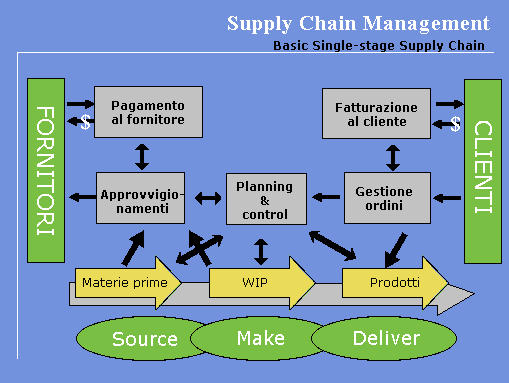
"Supply Chain Management is an integrated, process-oriented approach to the procurement, production and delivery of products and services to customers. SCM manages relationships with sub-suppliers, suppliers, internal operations, intermediaries, distributors and the end customer. SCM includes the management of raw materials/semi-finished/finished products and information and economic flows." [MIT] This definition underlines how SCM is an approach that considers the supply chain as an integrated unit.
source: Unitec
The term Supply Chain Management therefore indicates the coordinated and integrated management of the different phases that accompany the goods from the taking over of the raw materials to the final delivery to the customer, passing through the various and possible intermediate transformations. It is not just about managing a physical flow, but also an informational and financial one.
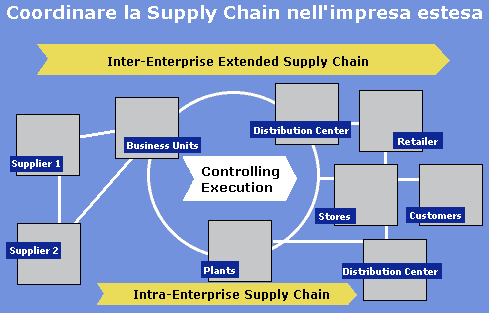
Production systems are increasingly market-oriented, with a view to speed and efficiency. This is leading to the extension of the supply chain concept which comes to "integrate" within it the segments upstream and downstream of the process, including not only the suppliers, but also the suppliers of the suppliers and not only the intermediate customer, but also the final customer.
source: Unitec
This new concept of the extended supply chain is leading manufacturing companies to reconsider their relationships with customers and suppliers, in what some call the “extended enterprise.”
source: Unitec
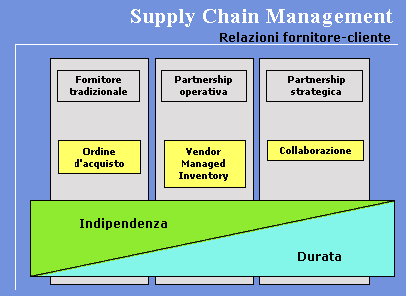
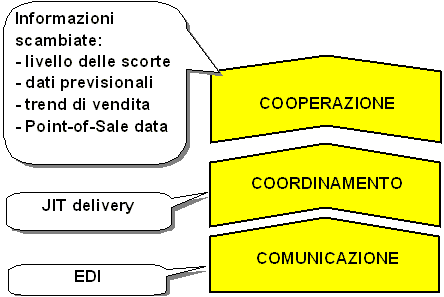
New management models and new market structures are emerging. What were purchase orders in traditional supply relationships are becoming collaborations in strategic partnership relationships. The efficiency of this integration will depend on the ability to assemble the 3c together: communication, i.e. sharing plans, orders, forecasts, production capacity and inventory levels; coordination, in the sense that the above must not be imposed by the manufacturer but agreed upon; cooperation, understood as the ability to agree on objectives and mutual benefits.
"... the increase in economic value is perceived by the customer through the synchronized management of material flows and associated information from the procurement of raw materials to consumption." [B.J. LaLonde, Ohio State University] SCM therefore has the aim of maximizing the level of service to the end customer, while at the same time optimizing operating costs and capital employed. SCM allows you to reduce the uncertainties inherent in the procurement, production and sales processes. Reducing uncertainties allows you to reduce:
- time buffers (decreasing cycle times);
- material buffers (reducing inventories).
This allows you to obtain the following benefits: reduction of working capital, efficiency, improvement of the Service, reduction of costs and increase in revenues.
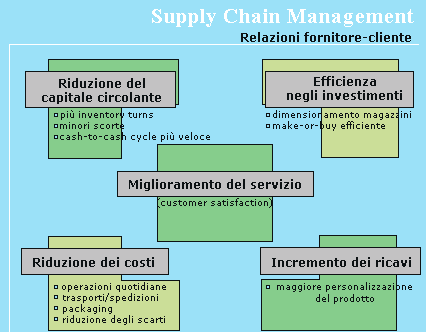
source: Unitec
According to a survey of 1000 successful companies conducted by Lockheed Martin and Penn State's Center for Logistics Research, the most important drivers of SCM are profit and customer satisfaction.
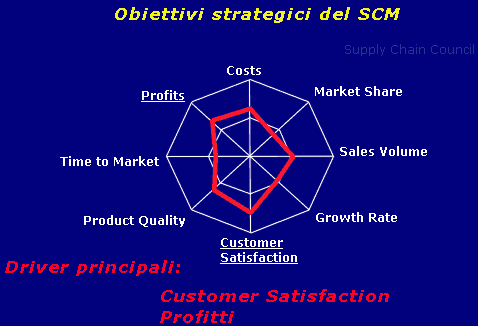
Source: Supply Chain Council
The research also highlights how Purchasing and Inventory Management are the functions for which the greatest advantages deriving from SCM investments are detected
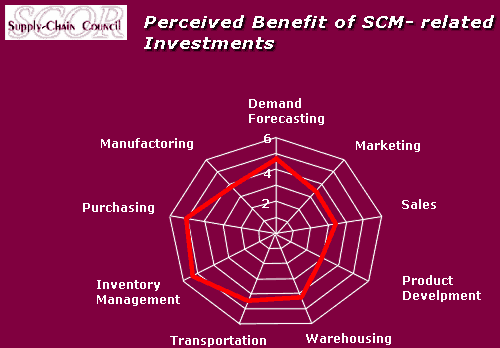
Source: Supply Chain Council
In 52% of companies, resistance to change is the most common obstacle to SCM, while only in 39% of cases is it the lack of attention given to the supply chain that prevents the achievement of greater success. These data emerge from a survey carried out by the Arthur D. Little study on SCM which involved 245 manufacturing companies across Europe. Other important barriers include the limited availability of data to examine (51%), the complexity of process redesign (49%) and the inadequacy of the organizational structure (41%). The objectives that prevent the implementation of the supply chain.| Resistance to change | 52% |
| Low data availability | 51% |
| Design complexity | 49% |
| Organizational structure | 41% |
| Unclear goal definition | 40% |
| Other priorities | 39% |
| Poor functional transversality | 35% |
| Insufficient trust in customers and suppliers | 31% |
Source: Il sole 24 ore, Arthur D. Little
So "Supply Chain Management consists of being able to have the right product, in the right place, at the right price, at the right time and in the right conditions." [R. Blackwell, Ohio State University].
1.2. Scope of action of the SCM
1.2. Scope of action of the SCM
The SCM operates on three levels. On a strategic level it is a question of defining the structure and use of the physical network to achieve business objectives at the lowest cost. On a tactical level, SCM concerns the forecasting of demand, production, distribution and transportation. On an operational level, planning and what happens in real time come together to provide information on the individual plant, on what is in transit rather than being shipped.
To determine the critical phases of the supply chain it is useful to use the model defined by the Supply Chain Council. The SCOR (Supply Chain Operations Reference-model) is a standardized reference model for SCM activities. Inside it there is, among other things, the description of the fundamental processes (Plan, Source, Make, Deliver) of a supply chain. These are the SCOR definitions of these processes:
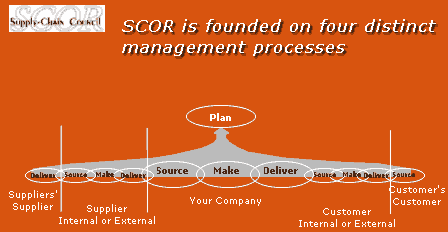
Source: SCC
"Plan: set of processes aimed at balancing supply and demand in order to define a sequence of actions that best allows the satisfaction of the predefined "business rules". Source: set of processes referring to the supply of goods/services to satisfy demand (actual and/or planned). Make: set of processes referring to the transformation of goods to satisfy demand (actual and/or planned). Deliver: set of processes referring to the distribution of goods/services to satisfy demand (actual and/or planned)."
[SCM-Glossary, Atos] In more detailPLAN demand/supply planning:
- resource assessment, aggregation and ordering of demand needs, inventory, distribution needs, production, ability to cut products and channels;
- planning structure management;
- make or buy decisions, supply chain configuration, long-term resource and capacity planning, business planning, product entry and exit phases, increasing production capacity, product life cycle management, production line management.
SOURCE purchase of supplies/materials
- procure, receive, examine, maintain and ship materials
supply structure management
- selection and relationships with suppliers, quality of supplies, internal shipments, component design, contracts with suppliers, initiation of the payment process.
MAKE production:
- request and receipt of materials, manufacturing and testing of products, packaging, maintenance and/or disposal of the product.
production facility management:
- design changes, equipment, production status, production quality, purchasing planning and sequence, short-term capacity.
DELIVER order management:
- placing and executing the order, providing quotes, configuring production, creating and updating customer databases, updating product/price databases, managing accounts, credits and invoicing.
warehouse management:
- collect, assemble and package products, create packaging or labels according to customer specifications, order consolidation, shipping.
logistics and installations management:
- traffic management, transportation management, product import and export management;
- installation planning, installation, verification of results.
delivery infrastructure management:
- distribution channel management, delivery management, quality management of deliveries.
1.3. ERP systems dedicated to SCM
1.3. ERP systems dedicated to SCM
The term ERP (Enterprise Resource Planning) was coined in the early 1990s as a successor to MRP (Materials requirement planning) systems developed for programming production plans and managing materials, cutting efficiency into manufacturing systems.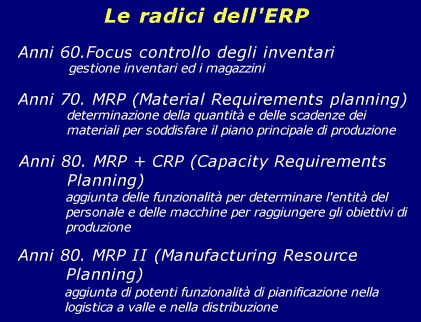 ERP systems are transactional systems, they record and manage information in an integrated manner on a common infrastructure, namely the ERP. These systems cover and improve all business processes. In each of them the system makes simple decisions, suggests alternative solutions or develops entire production and replenishment plans using criteria defined by the user and the context.
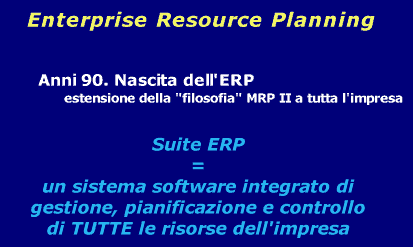
Although ERPs originated in manufacturing contexts and production planning, their area of offer expanded in the second half of the 90s to include "back office" functions such as financial, warehouse, logistics, quality control and human resources management. Today the range of applications has further expanded following the philosophy of the integration of the various processes, including "front office" functions, such as sales force management, e-commerce and supply chain management.
Supply chain management systems, the so-called SCMS (Supply Chain Management Systems), integrate with ERPs, as they are supply chain forecasting and optimization systems.
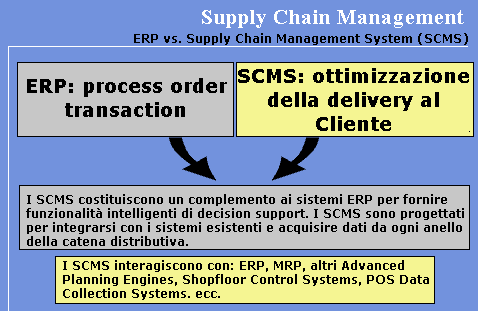
Source: Unitec
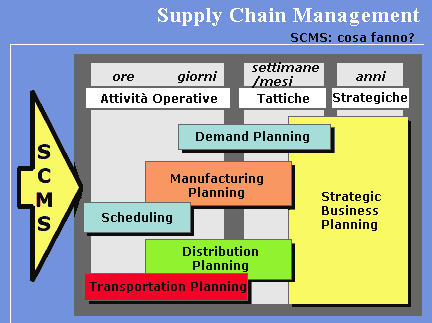
Various specialist software manage the various SCM activities and therefore carry out:
- Demand planning: statistical techniques, analysis and multi-dimensional data representations (by customer, region, product,...);
- Manufacturing planning: production plan with the related set of indications for manufacturing and purchasing, to be used together with scheduling to determine the most effective sequence of operations;
- Scheduling: assembly line sequencing, job-shop scheduling, make-to-order manufacturing;
- Distribution planning: representation of complex distribution networks with multiple supply solutions, overflow areas, co-packing operations, assembly requirements, alternatives for production and transportation,...; Transportatin planning & inter-enterprise track & trace functions: consolidates orders or shipments into loads, selects the transport mode and carrier, assigns priorities and routes the loads."
[Athos]
Source: Unitec
In recent years, a new business tool has emerged on the scene. The Internet is proving to be a real driver of change and this trend has been well understood by ERP manufacturers. The approach of ERP systems to the Internet is following three directions: e-commerce, self-service and supply chain collaboration. "From a B2B point of view, ERP vendors focus on offering tools to guarantee a significant reduction in the costs and times of acquisition of indirect goods and services, through Web interfaces that can be managed by the end user even without specific training." [M. Zigrillo, CWI 29] The second approach consists in offering a series of Internet-based functionalities that allow greater interaction of operators with the system. "These applications allow you to view, search and archive any type of data, at any time and from any remote location, using a normal browser." [idem]
Supply Chain Collaboration means the possibility of establishing greater interaction between the company and the various subjects involved in the production process chain. "Traditional ERP systems centrally manage an enormous amount of functions related to the production process, including resource planning, production scheduling and forecasting activities. However, the management of these activities often does not exploit information coming in real time from the various partners, but is based on a series of historical data, with the consequence of often giving late responses to the changing needs that arise within the supply chain. The solutions now proposed by ERP systems instead aim to guarantee a real-time exchange of information between the different components of the supply chain. Using EDI, Extranet and security technologies, they allow an almost immediate sharing of vital information such as availability, order status, production and delivery. Through real-time access to information relating to supply and demand, production is thus able to satisfy demand efficiently, with greater customer satisfaction and a reduction in inventory levels which translates into a reduction in costs." [ditto]
2nd: Analysis of the market for ERP systems dedicated to SCM
2.1. Market analysis of ERP systems dedicated to SCM
2.1. Market analysis of ERP systems dedicated to SCM
The supply chain includes different phases, characterized by a high flow of information. Uneconomical situations are often highlighted, with delays and losses in efficiency of the process, especially in the transitions from one phase to another. The most effective tool for integrated management is an ERP (Enterprise Resource Planning) system, which is multiplatform and open. By open we mean that, through Internet, Intranet, Extranet and e-mail technologies, it allows you to have the entire situation of the company under control in a direct and immediate way; multiplatform as it must be compatible with other applications and with the outside world
The analyzes already published on this topic are limited to the generic ERP systems market. On a global level this market, which amounted to approximately 19 million dollars in 1997, is growing by 30% per year and in 2003 the Gartner Group estimates that it will reach 60 million dollars. On the other hand, given the vastness of the market that emerged immediately, I thought it appropriate to focus my work on the offer of Internet-based products. The operators of this market can be divided into three clusters:
- ERP vendors;
- service providers;
- software house.
The advent of Internet-based technologies has revolutionized previous balances. A myriad of new software houses (i2, Manugistics, Ariba, ...) are imposing themselves on the market, launching numerous new products for all business functions. For this reason, traditional suppliers of ERP systems (Sap, Baan, Oracle, ...) are introducing new Internet-based applications onto the market, which integrate their ERP suites, in order to satisfy the growing demand for products with this technology and so as not to lose market share. Furthermore, ERP vendors must ensure that their traditional customers, who have invested large sums in client/server ERP systems, do not end up with an already outdated product. Service providers (Atos, Icon Medialab, ...) are entering this market, i.e. consultancy companies which, through alliances with specialist software producers, integrate their offer with these new products. My study, initially aimed at manufacturers of systems dedicated to SCM, was immediately restricted to e-procurement, to analyze the market for products similar to Unitec's NetSourcing. Broadly speaking, NetSourcing can be defined according to three dimensions:
- Unitec system and suppliers;
- Unitec system with customer suppliers;
- e-procurement tools.
The first two types of use are traditional ones, typical of Unitec's activity as an outsourcer or supplier of personalized service for the customer. The third is innovative and therefore not linked to industrial supplies. In my analysis I took the last two situations into consideration, as the first method of use is inextricably linked to Unitec's activity as an outsourcer, while in the other two NetSourcing constitutes an application for e-procurement comparable with other products on the market.
Six e-procurement product vendors were considered in my study: Oracle, Mapics, Baan, Sun-Netscape, Ariba, and HotSamba. On the pages of their website, they highlight that they provide specific solutions for the passive phase of the supply chain. In reality, the first two offer procurement solutions, but not with Internet-based products.
Procurement Management by Mapics is in fact an application based on client/server technology, while Inventory Management, despite being Internet-based, is a product aimed at online tracking and not procurement. Oracle Internet Procurement consists of Exchange and Customer Relationship Management (CRM).
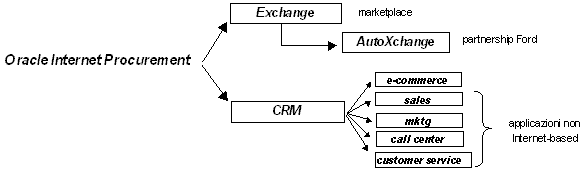
Exchange is a generic business to business marketplace, which can be focused on specific industrial sectors, such as AutoXchange born from the collaboration between Oracle and Ford, which aims to become the platform to optimize the Supply Chain of the entire automotive industry. Customer Relationship Management is made up of application packages dedicated to five business functions, one of which is dedicated to e-commerce. There is no buying application within the e-commerce package.
In the e-procurement market, most suppliers present themselves horizontally, offering systems that allow any type of company to contact thousands of suppliers via the Internet. Baan, like other traditional ERP vendors, has developed the E-Enterprise Platform which allows its ERP system to perform some functions via the Internet.
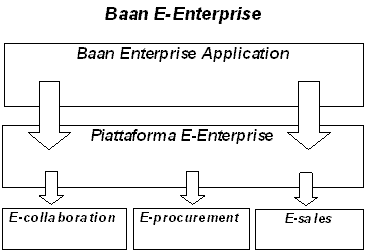
E-collaboration is an application that allows the sharing of information across the network, while E-sales is dedicated to business to business online sales. E-procurement is the Internet-based solution for procurement. Through the electronic catalogs of suppliers, with which the purchasing office of the client company will have previously negotiated, it is possible to make estimates, send orders, check their status and the situation of the invoices. The information provided on the site does not allow further considerations regarding this product.
Sun and Netscape have partnered to deliver e-business solutions. As regards e-procurement, three interacting products are offered: BuyerXpert, TradingXpert and ECXpert. The first is a product for procurement via the Internet, whose salient features are:
- local catalogs and remote catalogs of approved suppliers;
- requests for quotes and non-catalogue orders via the network;
- online orders to suppliers and commercial partners;
- order status tracking;
- standard and customizable reports.
The other applications allow information sharing, system security and interoperability between them.
In addition to the vendors above, many others provide e-procurement solutions, such as CommerceOne with BuySide solutions and Manugistics with NetWORKS Procurement.
Ariba and HotSamba are present in the non-production and MRO (maintenance, repairs and operations) procurement sector. Ariba offers a solution for the procurement of non-production goods included in the ORMS package, dedicated to generic industrial procurement.
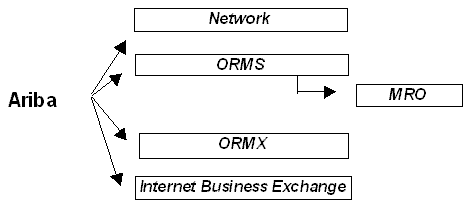
No information is provided about MRO, except that it is included in the ORMS package. ORMX is the version of ORMS built to be used in a Service Provider environment, i.e. a subscription service managed by a provider, which allows even small companies to connect with online suppliers. Network is the platform for e-commerce, while Internet Business Exchange is a system that allows the creation of customer-specific e-communities.
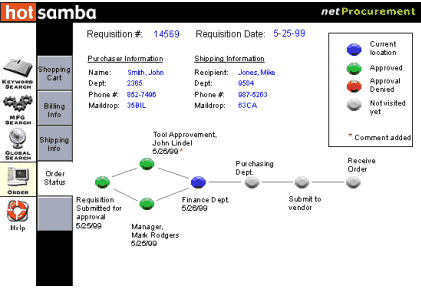
HotSamba, with NetProcurement, offers a product designed for the heavy machinery industry. It is expressly stated that the solutions are designed and implemented in a long-term partnership with the customer. This application has a multi-supplier catalog and a system for consolidating purchases. It also provides analytical information on inventory and supply situation. A keyword search engine allows searching the database by both manufacturer and item.
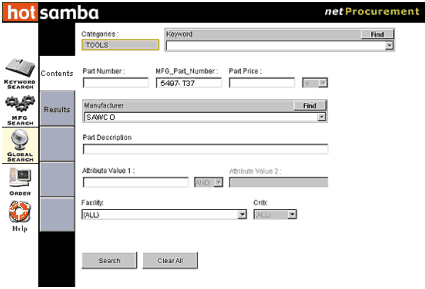
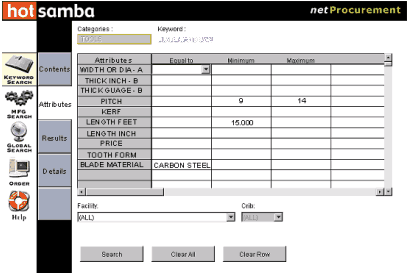 If only some characteristics of the product are known to the operator, the system allows you to choose from all the items contained in the database that possess those attributes.
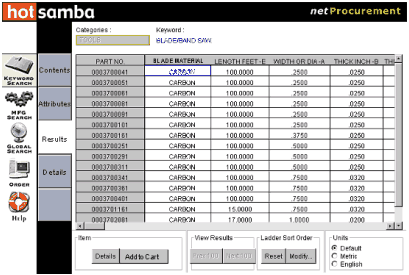
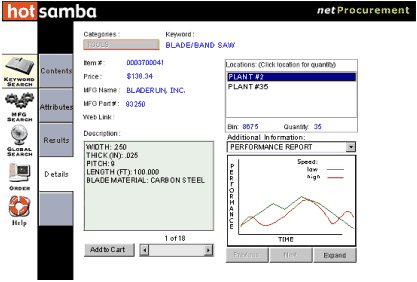
NetProcurement provides images, including three-dimensional ones, of the items, as well as performance diagrams and drawings.
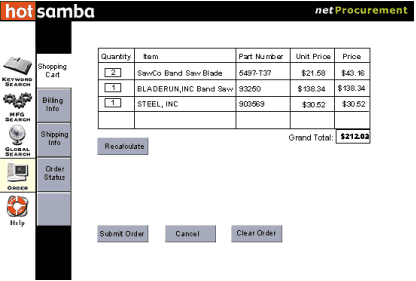 The system can be set to the company's purchasing and decision-making process, so as to make the order status visible at any time.
3rd: The outsourcing of supplies according to Unitec
3.1. The outsourcing of supplies
3.1. The outsourcing of supplies
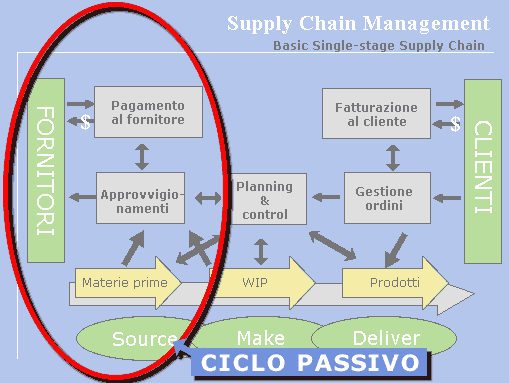
Supply Chain Management is the management of processes and material, information and financial flows from suppliers to customers, even within the company itself. This chain can be broken down into four distinct management processes: planning, procurement, production and delivery.
Source: Unitec
The procurement phase represents the passive cycle of the chain and concerns the sourcing, ordering and expediting procedures of supplies. These procedures presuppose:
- a profound knowledge of the various reference markets on the part of buyers;
- an imposing amount of administrative work, determined by the ever-increasing complexity of the procedures and the interferences that frequently arise;
- a structure and a procedure that generate huge fixed costs for supplies which, as in the case of non-production goods, often have a very low unit value.
The new areas in which industrial companies find themselves operating are characterized by the now reached maturity of the markets and the predominance of the technological factor. The heightened competition has strengthened the position taken by the efficiency of business processes as a key factor and has led companies to focus their activities on the core business.
Outsourcing or the outsourcing of non-strategic activities is becoming the characterizing element of the action of successful companies. For some time now, companies have understood that direct control of the entire supply chain inevitably leads to inefficiencies and losses of profitability. The choice of outsourcing allows you to concentrate management skills on the activities with the highest added value, entrusting the others to specialized operators.
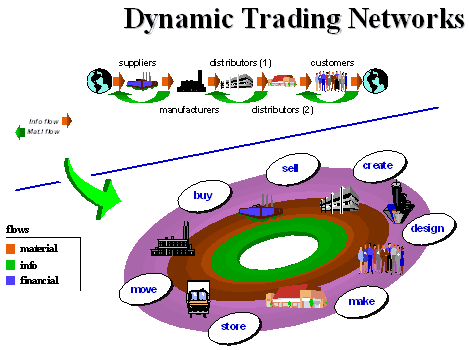
New business models are therefore emerging. Companies tend to outsource, establishing relationships with partners specialized in both extended supply chain processes and the internal ones of the traditional company. The so-called Dynamic Trading Networks are being formed.
Source: Atos/Unitec
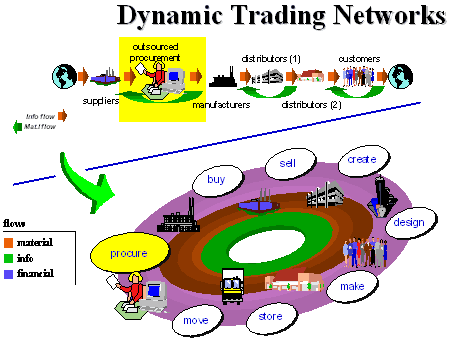
The coordination of activities between companies is therefore assuming growing importance. The need to avoid process breakdowns in the face of the need to shorten the order-to-delivery cycle imposes a change in management flows. We are moving from the current sequential model to one characterized by dynamic exchanges between supply chain participants. Unitec operates in this innovative context. This integrated supply services company positions itself as a partner for procurement and administrative outsourcing.
Source: Atos/Unitec
The application of the integrated supply concept, together with the exploitation of the communication and information technology tools made available, allows Unitec to completely and efficiently manage the supply processes in outsourcing.
Unitec, in addition to the traditional procurement functions (sourcing, ordering and expediting), offers the payment service, relieving the customer, through the issuing of a single invoice, from the management of the numerous payments relating to a multi-supplier supply.
Unitec mainly operates in a niche sector, that of non-production and MRO (maintenance, repairs and operations) supplies for the automotive industry. Even so specialized, the Unitec system adapts to the needs of any company, thanks to the modular introduction of outsourcing and computerized workflow management.
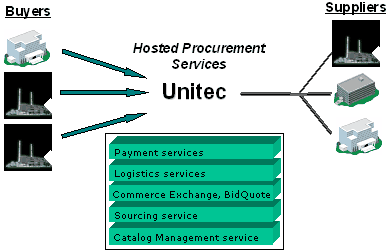
It's no secret that businesses are moving towards using the Internet for supply management. Unitec is also developing its business through Internet-based technologies.
3.2. E-procurement
3.2. E-procurement
The success of electronic commerce provides companies with new models, both for managing internal demand processes and for collaboration with key suppliers. New market models depend on two factors:
- Transaction control. It varies between two extremes: in a seller centric environment it is the buyers who must connect to the seller's website to carry out the transaction. Conversely, if market power is in the hands of buyers, sellers participate in a "reverse" market in which they must deliver their electronic catalogs to customers.
- Rank of competition. The level of competition or collaboration that characterizes a market depends on the type of good treated. For fungible assets, spot transactions generate a very competitive market. Decisions are made on price and availability. Alternatively, in a collaborative environment, sellers and customers establish long-term relationships, through long-term contracts, co-makership relationships and mutual exchange of information.
The combinations of these two factors determine various B2B e-commerce models.
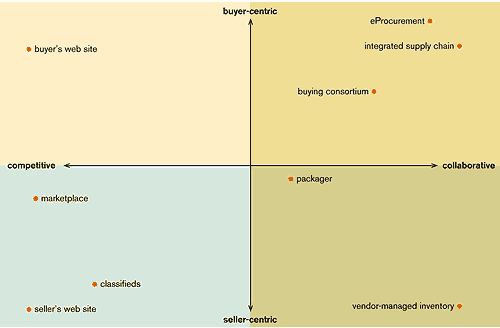
Source: Andersen Consulting
Companies can adopt one of the above-mentioned models depending on the type of good to be supplied.
E-procurement is proving to be the most efficient model for the procurement of non-production goods. This type of goods, in fact, together with temporary services not directed towards production, generate a share of total costs of around 25%. Again according to an estimate made by Andersen Consulting, e-procurement allows you to achieve savings of 10% to 25% on annual spending compared to the traditional strategic sourcing model, depending on the degree of fragmentation that the procurement process has across the company structure.
E-procurement is a collaborative model in which the buyer is in control of the transaction. Buyers negotiate in advance with preferred sellers to create catalogs on the basis of which the former guarantee to make subsequent purchases. Catalogs include product descriptions, delivery times and the negotiated price of each item. Information on all items is collected in a unified catalog, which usually resides on the buyer's intranet and can be used by any purchasing agent. Alternatively, catalogs can be maintained on supplier sites. With this centralized catalog, buyers can see agreements with preferred suppliers, make requests for quotations, forward these requests for approval and place their orders electronically. These electronic transactions can be integrated into the accounting and management systems of the companies involved and carried out according to their procedures and standards.
E-Procurement: Process flow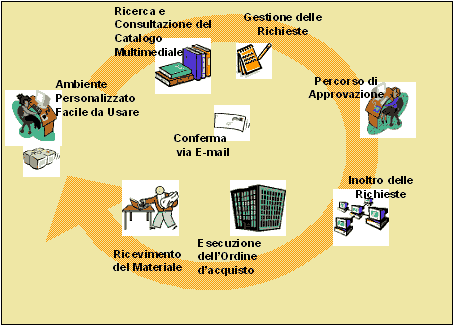
Source: Baan
The advantages provided by e-procurement are numerous:
each employee can benefit from the conditions agreed with the suppliers by their purchasing office; the integration between the e-procurement website and the buyer's internal systems allows financial control and tracking to be carried out more effectively; demand aggregation allows obtaining further price concessions from suppliers; the purchasing office staff, in addition to Order Fulfillment, can dedicate themselves more to Internal Customer Management and Supplier Relationship Management activities.
This model also offers benefits on the supplier side, such as an increase in sales volume, a reduction in operating and sales costs, better demand forecasting and an improvement in the relationship with the customer.
The advantages of e-procurement are amplified in the case of outsourcing of supplies. Unitec was one of the first Outsourcing Providers to apply this model. With the creation of NetSourcing, the first application site dedicated to industrial procurement, Unitec presents itself as a specialized operator in Outsourced Internet Procurement Automation.
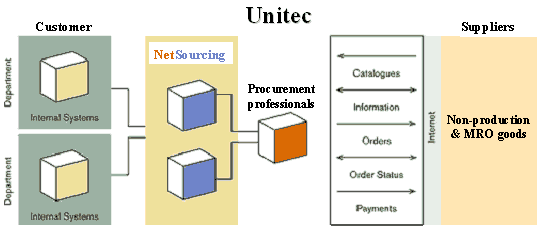
What makes NetSourcing unique and distinguishes it from other procurement automation systems is the integrated supply service provided by Unitec. Thanks to a database of over 2,000 suppliers, with more than 30,000 items and the dedicated platform created by its technicians, Unitec can present itself as the sole interlocutor for the online supply of industrial spare parts.
The platform on which NetSourcing is based allows you to easily combine Unitec's suppliers with those of the customer in the database used in the e-procurement process, in order to join, also from this aspect, the customer's procurement system with Unitec services. Inside, NetSourcing contains various applications: search by manufacturer and item, order issuing, reporting, tracking (requests and orders issued, offers, delivery notes and invoices received, order status) and warehouse. The latter lends itself to very interesting developments. The concepts of "inter-company warehouse", i.e. sharing of warehouses by companies operating in the same industrial sector, of "virtual warehouse" resulting from the sharing of resources by companies operating in the same industrial district or from forms of Consortium Purchasing, certainly constitute innovative forms of e-business. Furthermore, thanks to the flexibility of the platform, NetSourcing can be proposed as an online quoting application or used as a portal for e-procurement in various sectors. NetSourcing can also be considered as a tool for e-procurement, separate from the Unitec service.
3.3. The market for e-procurement tools
3.3. The market for e-procurement tools
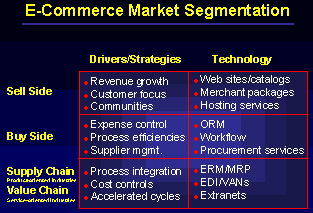
To date, e-commerce has been focused on the sell-side. There are numerous applications dedicated to managing online sales. The offer of each company application manufacturer, both traditional and "new provider", contains at least one specification. This market has now reached a level close to saturation.
Source: iCommerce.com
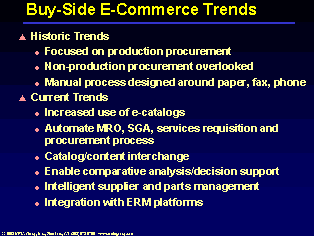
Buy-side applications are fewer in number, but they are having a greater impact on business processes. The Internet is radically transforming the way businesses source. This process was traditionally based on the predominance of the purchasing department and a myriad of letters, faxes and telephone calls. Dedicated Internet-based applications allow you to place the order directly from the function and/or department where the need arises, reducing hand-offs and the consequent administrative costs. With these Internet-based solutions, today it is also possible for small/medium-sized businesses, which do not have complex and expensive EDI connection systems, to obtain supplies in real time from suppliers.
Source: iCommerce.com
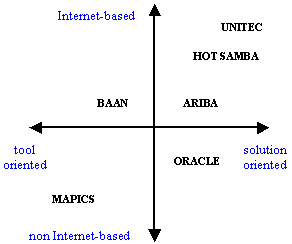
All software houses offer Internet-based solutions for almost all business functions. In recent times, innovations are concentrating on the market of e-procurement tools. NetSourcing by Unitec is characterized by being an e-procurement application based entirely on Internet technology, unlike many other products which, although presented as Internet-based solutions, in reality are not.
Most suppliers offer a horizontal offering, with applications that can be used by companies belonging to any industry. ERP vendors have studied new applications that allow their platform, adapted to customer needs, to perform some function via the Internet. NetSourcing, on the other hand, is a "solution oriented" product, i.e. created for the procurement of MRO and non-production goods.
The following diagram shows the positioning of six manufacturers (see Chapter 2) on the procurement applications market. On the ordinate axis, a distinction has been made between those based on Internet technology and those with other types of structures. On the x-axis, "solution oriented" means products specifically designed for MRO and non-production goods supplies for electronic-mechanical components; "tool oriented" products can instead be used in companies in all industrial sectors.
4th: Industrial districts are betting on electronic commerce
The industrial district is made up of a territorial concentration of small-medium enterprises with accentuated specialization in the manufacturing sectors, which, by virtue of the relationships between them and the role played by the external environment in the transmission of specific know-how and the values of industrial work, are able to produce efficiently and compete on the markets with larger companies.
The production structure of our country is characterized by the large presence of small and medium-sized companies. In Italy there are 68 businesses per thousand inhabitants, compared to 35 in France, 37 in Germany and 46 in the United Kingdom. Small businesses are the true protagonists of our districts. The sectors of specialization mainly concern personal and household goods (fashion, furniture and food products) and capital goods for the production of these (specialised machinery). The advantages that make this production model successful derive from the production specialization and division of labor that take place at a local level, within the same sector. The strong attention to the local system coexists with an equally strong international opening. Suffice it to remember that Italy holds 54% of the world market for ceramic tiles, 32% of jewellery, 31% of machinery for wood and ceramics, 30% of wool and silk fabrics, 29% of chairs, 28% of leather footwear, 27% of bags, 22% of eyeglass frames and so on, and that the districts generate around a third of Italian exports [ICE 1997 and 1998].
This production model, until recently typical of the Italian reality, is spreading in the manufacturing industry on a global scale. The current trends show, in fact, an increasingly globalized entrepreneurial fabric, but, at the same time, increasingly localized and oriented towards relationships between companies. These relationships are evolving from hierarchical structures towards more flexible forms capable of better coping with environmental and market changes. A significant example is France, which has numerous important district realities, such as: Lille, Roubaix-Turcoing, Mazamet for the textile sector; Oyonnax, Creteil and Saint-Cloude for glasses; The Vallée de l'Arve for mechanics; Cholet for footwear, Vimeau for taps; Limoges for ceramics; Cannes and Antibes for perfumes; Thiers for cutlery; Besancon and Morteau for watchmaking and others. Even in Spain and, outside of Europe, in Japan, district realities or in any case territorial organizational forms attributable to this model can be found.
We often ask ourselves how many industrial districts there are in Italy. The answer cannot be univocal, a lot depends on the definition used. In fact, depending on the parameters chosen (geographical, legal or economic) the result of the estimate varies significantly. In 1992 Censis and the Tagliacarne Institute published research with a list of 187 districts, while shortly afterwards F. Sforzi presented the results of a survey carried out with Istat which identified 199 districts. There are more empirical maps built based on the notoriety of the districts and the availability of data on their consistency. Among the best known are: Biella for the wool industry, the Carpi district in the knitwear and clothing sectors and the Lumezzane district for valves and housewares.
| CONNECTING ROD | ||||
| sector | businesses | employees | turnover in billions | export |
| Total industry/craft | 4,983 | 43,578 | ||
| Textile | 2,000 | 28,000 | 6,500 | 30% |
| Textile machinery | 200 | 2,500 | 500 | 50% |
| CARPI | ||||
| sector | businesses | employees | turnover in billions | export |
| Total industry/craft | 4,700 | 21,300 | ||
| Knitwear and packaging | 2,250 | 9,750 | 2,100 | 36% |
| Textiles-clothing | 500 | 3,400 | ||
| LUMEZZANE | ||||
| sector | businesses | employees | turnover in billions | export |
| Total industry/craft | 1,173 | 8,551 | ||
| Taps and household goods | 600 | 4,500 | 1,200 | 60% |
| Knitwear, foundries, moulds | 573 | 4,051 | ||
After years of favorable economic conditions, the situation of industrial districts is evolving rapidly. The liberalization of world trade, the processes of production internationalization and market globalization are a fact and this new reality can constitute a serious threat, especially for certain sectors such as the textile and clothing sector. The example of the Carpi district is significant. The current situation is characterized by new turmoil among subcontracting companies, especially in the knitwear sector, while the weight of final companies has been declining for some time. The processes are carried out in small series and have a high fashion content, in the sense of breadth of the ranges and variability of the models. The limited series of processing batches and the absence of effective workload scheduling tools are putting pressure on the productivity and profit margins of many manufacturers, particularly those linked to processing. Even if the relationships between clients and subcontractors tend to be stable and long-lasting, the production chain is jagged and this sometimes makes relationships within the supply chain problematic.
To ensure a level of service that makes it less interesting for clients to use subcontractors outside the district, it is necessary to create "new district tools". Other European companies, in terms of size attributable to the small and medium-sized enterprise sector, are trying to make the most of innovative communication services with the aim of supporting their core business. According to the "Fair" report (a report on IT that a consortium of researchers draws up every year for the European Union), these companies mainly belong to three groups:
- small and medium-sized enterprises in the high-tech and media sectors, driven by the attraction between their Internet business and new market developments;
- cyber businesses exploiting the opportunities offered by electronic commerce in the service sectors;
- small and medium-sized enterprises integrated within the supply chain of large companies driven to innovate by pressure from their main customers
In Italy, the adoption of PCs and Internet connections by small companies, especially those with fewer than 50 employees, is still very low. According to the "Third report on the computerization of Biella's industry" produced by the Industrial Union and the Biella IT Forum, in 1988 there were 52 PCs connected to a local network, now there are 2,730. The average incidence of IT expenses on company turnover is 1.55%. However, 61.4% of companies declare themselves not satisfied with their computerization.
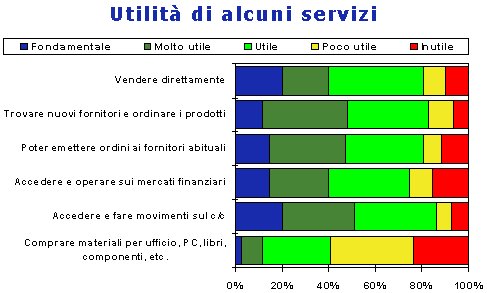
The industrial districts of our country must move towards electronic commerce, especially in its B2B forms, creating the so-called "virtual districts". The idea is to use the Internet and modern technologies to allow SMEs a better supply of raw materials. The results of a research on expectations regarding new technologies, carried out by Mate and Assintel on a sample of entrepreneurs, confirms this.
Source: Mate/Assintel
For example, in the textile sector, the productivity of small and medium-sized enterprises can be increased by strengthening the ability to quickly satisfy demand. Often SMEs, increasingly pressured by short production cycle times and fashion, have shortages or an overabundance of yarns, or find semi-finished products in the warehouse that are no longer usable due to forecasting errors, changes in the product mix, excessive dimensions of the minimum purchase lots. Hence the need to have a rapid and reliable tool to put companies directly in touch and allow them to speed up procurement times.
5th: Year 2003: the Virtual Logistics Platform
5.1. the Virtual Logistics Platform (simulation)
We are in 2003, our industrial district, specialized in the marble-granite sector, is equipped with a fully operational virtual warehouse. The warehouse management of company materials is entrusted to the Service Provider. The logistically interconnected companies of the district benefit from the transversal structure of the industrial system. The system guarantees the individual company 100% availability of materials, with an 80% reduction in warehouse stocks and a rotation 5 times greater than traditional management.
| year | consumption in Lit | MP stock in Lit | stock/delivery | MP rotation |
| 1999 | 811,800,000 | 706,266,000 | 87% | 1.15 |
| 2003 | 1,578,164,700 | 274,600,658 | 17.4% | 5.75 |
| variation 99/03 | - | -459,659,062 | -80% | +5 |
The adoption of the virtual warehouse was the response of the "marble district" to the negative economic situation of the sector that began in 1998. The crisis, due to the concomitance of some structural changes in the market, forced the district companies to change their way of operating. The rapid transition from the traditional cooperation model to the industrial district model based on virtual networks has allowed the reversal of the negative trend.
The increased competitiveness of companies, mostly due to the significant reduction in warehouse costs, has allowed the entire marble district to regain market segments. The virtual warehouse represented, for the companies in the district, the innovative element, which brought the increase in efficiency necessary to compete with the production of those countries which were able to benefit from the favorable variations in the exchange rate or the availability of low-cost labour.
The progressive increases in turnover in the four-year period 2000/2003 of the sample company demonstrate this:
| year | turnover | var. (n-1999) | export | var.(n-1999) |
| 1998 | 1,914,011,000 | -11.9% | 967.831.380 | -13.1% |
| 1999 | 1,711,126,000 | 0% | 855.562.940 | 0% |
| 2000 | 1,803,526,000 | 5.4% | 862.085.428 | 0.8% |
| 2001 | 2,127,452,000 | 24.3% | 1,002,029,900 | 17.1% |
| 2002 | 2,697,000,000 | 57.6% | 1,248,711,000 | 46.0% |
| 2003 | 3,322,452,000 | 94.2% | 1,801,227,400 | 110.5% |
Furthermore, the adoption of the virtual warehouse has made it possible to:
- eliminate management overheads;
- make use of negotiating and organizational synergies;
- take advantage of scale discounts multiplied according to the large purchase volumes generated;
- guarantee better availability of supplies with an increase in quality standards;
- minimize structural costs.
The table below illustrates the current warehouse situation of a sample company belonging to the district and the evolution of the data from the year of adoption of the virtual warehouse until today.
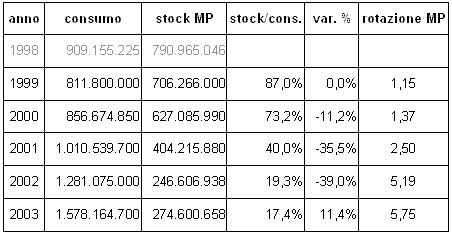
The data relating to the years 1998 and 1999 reported in this example are truthful, as they are a re-elaboration of data released by "Internazionale Marmi Macchine Carrara S.p.A." on Istat statistics relating to import/export of the Apuan-Versilia district and the province of Massa-Carrara.
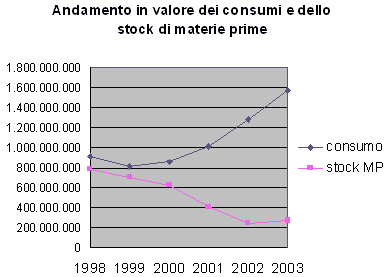
The consumption of materials, i.e. the cost of purchasing and/or producing the product sold, has increased, in absolute value, over the years as a function of increases in sales. Given this, the virtual warehouse has made it possible to drastically reduce the average value of the stock of materials contained in the warehouse. The value "immobilized" in the warehouse by the sample company went from 706,266,000 Lit in 1999 (equal to 87% of consumption) to 274,600,658 Lit this year (17.4%).
The reduction in stock implied the minimization of warehouse management costs and the increase in material rotation by as much as 5 times, with a clear gain in terms of profitability and quality.
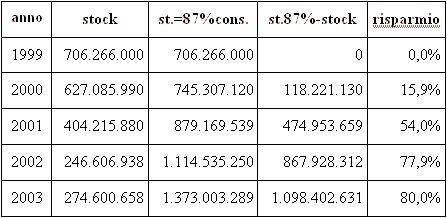
The savings are even more evident if we compare the theoretical warehouse (87% of consumption), i.e. the one managed with traditional methods, with the actual warehouse.
5.2. The basis of the results
5.2. The basis of the results
These performances determined by the adoption of the district virtual warehouse are easily explained using the following model.
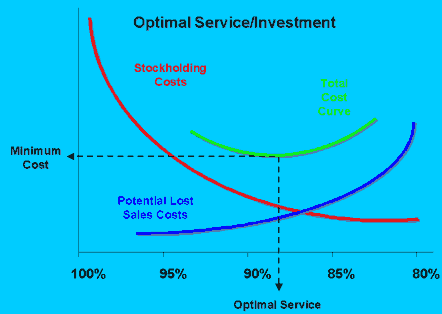
The objective pursued by all Inventory Management policies is to reduce the investment in inventory without compromising the availability of materials. Some factors such as the variability of demand, the quality of materials, delivery times and customer satisfaction contribute to further complicating the situation. The danger involved in an excessively risky inventory reduction policy is the potential loss of orders.
The graph shows the warehouse management cost curve (Stockholding Costs), which increases as we approach 100% availability of materials. The curve of potential costs for lost orders (Potential Lost Sales Costs) has a trend that is almost the mirror image of the previous one, as lower warehouse availability means a greater possibility of losing orders due to the impossibility of respecting the required Lead Time.
The optimal choice will be the quantity determined by the minimum point of the total cost curve, determined by the sum of the other two (in the graph a stock equal to 87% of consumption). The adoption of the virtual warehouse allows the warehouse stock to be brought to very low levels compared to consumption, as the company, although not holding all the types of necessary materials (in this specific case marble-granite), has immediate availability via the system. In fact, the Provider will provide the material not available at that moment in the company warehouse, taking it from the warehouse of another company in the district or, possibly, from an external supplier.
This reduces the potential risk of losing orders; consequently in the graph, the Potential Lost Sales Cost curve will lower towards the x-axis.
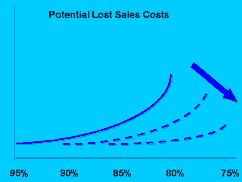
The reduction in the need for the individual company to promptly meet warehouse needs leads to a reduction in the specific company structure and therefore a reduction in the related management costs. The warehouse cost curve will therefore also tend to fall.
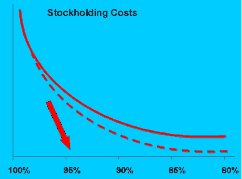
The combination of the movements of the two curves involves a parallel shift of the total cost curve to the right, i.e. towards lower levels of stock contained in the individual company warehouse.
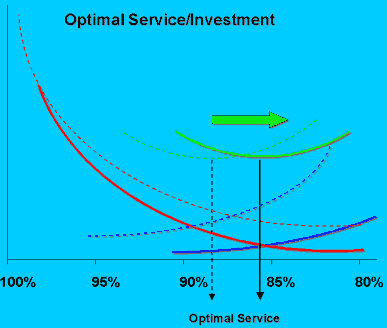
In this way, the capital invested in the warehouse is reduced, with the related advantages in terms of profitability, without compromising company efficiency. In addition to this, the system allows a reduction in warehouse levels, a reduction in purchases in emergency situations, a reduction in lost orders and the consequent improvement in customer satisfaction.
5.3. Year 1999
Let's now see how all this was possible. Let's go back to the year 1999.
| The starting scenario |
|
The industrial district we are talking about specializes in the marble and granite sector. The companies operating there keep in their warehouses several blocks of raw marble and granite, both local and exotic, ready to be worked. The activity of companies is inextricably linked to the presence of blocks in warehouses. In fact, the quality of a marble/granite type can vary from one block to another. For this reason, the customer is asked to choose the block of raw material from which the purchased products will be obtained. These warehouses have a fairly similar composition to each other. For obvious cost reasons, both purchase and storage, no company keeps all the types of marble/granite required. Most of the stocks are made up of the most commonly used types of raw materials, while some particular types are only present in some warehouses depending on the entrepreneur's choices. |
| The objective |
|
It is natural to think that enormous savings can be achieved by sharing, in an organized way, the resources available in the area. There is spontaneous sharing of resources, but neither coordinated nor organised. Each bears the costs of its own facilities alone, even if similar ones exist in the same industrial area. The objective therefore becomes the reduction of stocks of identical marble/granite present in all warehouses. A company will not have all types of raw materials physically present in its warehouse, but it must still have immediate availability. |
| The idea |
| An external company, the Service Provider, after inventorying the stocks, absorbs the data relating to the warehouses of the individual participants. Once the system has been activated, it is the Provider who, through advanced IT systems and dedicated management procedures, manages the warehouses by calculating the needs of the companies and the levels of redundancy of raw materials within the district. If a company in the district does not have the requested marble/granite in stock, it contacts the Provider who provides supplies from another internal warehouse or, possibly, from an external supplier. |
| The actions |
|
To create the virtual district warehouse it was necessary to solve two starting problems:
The second problem was solved directly by the Provider, integrating the companies' data without altering their information systems. The Provider itself subsequently implemented the system in successive phases. In the first period of adoption, the first accesses by participating companies were detected. Based on these, the Provider has created the mathematical algorithms and procedures necessary for optimal flow management. The subsequent study of inventories was aimed at defining company consumption and analyzing warehouse dynamics. The results of this study led to the proposal of a plan for the reduction of inventories, in order to optimize the system. The plan was accepted and adopted. Virtual warehouse implementation phases:
|
| Resolving an attitude |
| Operational experience has highlighted a problem of speculation in the system by some companies in the district. It was found that some operators, given the advantages induced by the virtual warehouse (service and reduction of the warehouse), did not fulfill their obligations (renewal of the warehouse and mutual exchange). The problem was resolved by entrusting the Provider with the management of changes in stocks in the individual company warehouses. It is the Provider who determines the contents of the warehouse, in terms of quality and quality, and forces the company to adapt under penalty of exclusion. |
| The result |
|
The company that sells a batch of materials present in its warehouse receives a service rate from the requesting company, in addition to the value of the materials. In this way, stocks become a dynamic and profitable investment. The company warehouse no longer represents an inactive investment. With the virtual district warehouse, inventories no longer block large amounts of capital, as the quantities contained in the individual warehouse are minimized and their rotation is multiplied. |



