


À l'intérieur
Nouvelle thèse sur le cas Unitec présentée près de l'université de Turin récompensée par la meilleure note. La thèse en langue italienne est disponible au format zip dans la zone de téléchargement
Faculté d'économie "Commerce extérieur"
Superviseur
Allemand Fasano
Diplômé
Roberta Smaila
LA FOURNITURE INTÉGRÉE DANS LES ACHATS :
Affaire Unitec
Résumé
Prémisse
Les scènes économiques et sociales de la fin du siècle déterminent dans les entreprises du monde entier une profonde révision organisationnelle et managériale dont il est nécessaire d'agir pour pouvoir s'adapter et "exploiter" les effets, qui pourraient être trouvés de grande capacité.
Au cours des quarante dernières années, le système économique italien s'est également caractérisé par de profonds processus de restructuration dans les configurations organisationnelles des entreprises, dans les structures productives, dans les processus de travail et dans les relations entre entreprises.
Jusqu'aux années soixante et soixante-dix, le marché était en forte expansion et pour les entreprises le facteur stratégique était dans la capacité de répondre avec suffisamment de quantité à la haute question. On a commencé à douter de la validité d'un tel système productif, organisé selon des critères rigides et hiérarchiques, dans les années 80, c'est-à-dire lorsque les marchés étaient désormais saturés et les consommateurs ne se plaisaient pas plus que les produits "génériques", mais ils attendaient de produire le plus possible de supporteurs avec leurs exigences, en un mot "personnalisés".
Dans ces années on a donc aidé au passage d'entreprises nombreuses verticales aux terziarisations poussées. Les entreprises ont en effet allégé leur structure, ayant comme modèle de référence la production au plus juste¹. De cela s'est réalisé la nécessité d'apprendre à gérer les relations avec les nouvelles unités productives, qui se trouvaient de plus en plus fréquemment à l'extérieur de l'entreprise (sous-fournisseurs²) et devant donc diffuser non seulement la culture de la qualité totale à l'intérieur mais aussi à l'extérieur, vers qui se trouvent les sous-fournisseurs. Cette nouvelle façon de voir "l'entreprise système", impliquait un changement dans la subdivision des tâches, les entreprises commençaient en effet à confier des activités déterminées à d'autres entreprises, "en profitant" pour mettre à profit la spécialisation et l'expérience de ces dernières et pouvoir ainsi se concentrer complètement sur le "Core business³".
Confier des tâches déterminées à des entreprises spécialisées signifie une réduction des coûts pour l'entreprise productrice, puisque les entreprises qui exercent systématiquement cette activité la développeront mieux que celles qui le faisaient occasionnellement.
Les entreprises, jusqu'à nos jours, sont obligées de créer un produit doté de bonne qualité et de l'offrir à un bon prix puisque la concurrence s'est désormais renforcée dans tous les domaines. Au cours de la dernière décennie, des barrières considérées comme insurmontables sont en effet tombées une fois, permettant ainsi aux entreprises des pays émergents de l'Extrême-Orient (Corée, Chine, Malaisie), de l'Europe de l'Est et de l'Amérique du Sud de faire office de concurrent des entreprises italiennes.
Dans un contexte aussi hautement compétitif, les entreprises sont donc appelées à affronter des changements radicaux et inattendus dans un climat dominé par une profonde incertitude. La capacité à repenser les processus de production et l'architecture organisationnelle et la capacité à renouveler uniquement le patrimoine de connaissances deviennent les éléments fondamentaux pour obtenir un avantage compétitif de support.
Pour tel but, un instrument de dernière génération, qu'utilisent déjà beaucoup d'entreprises, est la fourniture intégrée 4 , qui ne critique pas particulièrement leur permet de transférer à l'extérieur l'activité de fourniture de ces actifs ou pour laquelle les entreprises ne décident pas des compétences techniques nécessaires. Il en découle donc une nouvelle approche stratégique avec laquelle les entreprises font face aux achats. La concentration des investissements et des efforts organisationnels sur les activités que l'entreprise réalise le mieux des concurrents, concourt en effet, à garantir un rendement plus grand de l'emploi des ressources propres.
En renforçant ses propres compétences distinctives, l'entreprise élève des barrières pour protéger l'avantage compétitif des risques d'érosion d'une partie de ses mises en œuvre ou de nouveaux concurrents. L'autre côté transférer l'activité à des fournisseurs spécialisés signifie pour vous bénéficier des investissements, des capacités d'innovation, des capacités particulières d'autres entreprises, sans avoir à faire face aux coûts nécessaires pour s'adapter à la concurrence.
Notes 1 : Une nouvelle façon de raisonner pour augmenter la flexibilité de l'entreprise à travers une repensation de tout le flux de création de valeur, depuis la planification jusqu'à la gestion des commandes.
Notes 2 : Entreprises qui exécutent le travail de tiers pour le compte ou réalisent des produits sur un commis de magasin. Notes 3 : Activité liée à l'objet métier et à forte valeur ajoutée Remarques 4 : Source : Unitec GmbH
1. L'ÉVOLUTION DES ACHATS
1.1. Définition des « achats » et des « fournitures »
1.1. Définition des « achats » et des « fournitures »
La technologie a transformé la scène économique mondiale, marquant un changement à une vitesse qui va probablement se poursuivre. Le développement des transports et des communications a provoqué l'augmentation des marchés. La question de l'offre à niveau mondial est en cause, en créant une vitrine unique à l'intérieur de laquelle la concurrence est extrêmement élevée. Ceci a impliqué la modification des stratégies commerciales et par conséquent une évolution du secteur s'est produite avec le temps également. On recherche constamment une diminution des coûts et on essaie de les rendre aussi le plus flexibles possible, en contenant les coûts fixes 5 en faveur des coûts variables 6 , pour pouvoir ainsi s'adapter au cours des transactions. La réduction des coûts fixes implique, d'une part le contrôle de la dimension totale des organisations, en éliminant les structures qui ne sont pas directement en relation avec le Core business ou avec le maintien du savoir-faire du 7 et de l'autre l'achat auprès d'organisations externes des biens et services préalablement produits à l'intérieur (par exemple d'un travail organique fixe à un travail tantique, de la production interne des services à l'achat de tels services). Tableau 1.1, d'extension puisque la gestion des achats ne peut en aucun cas être déplacée de la stratégie commerciale mais bien est une descendance logique et d'extension de son évolution dans le temps.
| Stade d'évolution. | Tâche principale. |
| Achats. | Pour réaliser l'achat dans des conditions optimales. |
| Fournitures. | Assurer la disponibilité de ravitaillement en fonction des exigences de données en profitant de toutes les potentialités du service. |
Tab.1.1 Stade d'évolution des achats
1°stadio : Les achats.
On peut remarquer qu'au début on parlait d'achats simples. L'indication de ce qu'il faut acquérir provenait évidemment de la question intérieure et souvent celui qui générait la question jouait un rôle "technique", dans la mesure où il définissait ce dont il avait besoin, les caractéristiques essentielles du bien et pouvait donc imposer également des liens avec les choix sur le marché. Dans de nombreux cas, le pétitionnaire a donc interagi directement avec le marché de l'offre et a relégué la fonction acquise dans le rôle de pur exécuteur testamentaire. De cette façon, ils n'ont pas profité de toutes les potentialités d'une fonction spécialisée dans l'activité commerciale, avec le risque qui a pénalisé l'organisation en termes soit économique que managérial.
2° étape : Approvisionnements.
Par la suite on parle d'approvisionnements et dans cette phase la gestion des sources devient un facteur stratégique de garantie de résultats, de réduction des coûts (à travers la rationalisation des relations et la réduction de leur nombre) et d'adaptation des performances aux exigences opérationnelles et qualitatives de l'entreprise. Dans le système d'approvisionnement, l'objectif se déplace donc de la gestion opérationnelle du processus d'achat à la gestion stratégique des sources d'approvisionnement, avec pour conséquence le renforcement de la relation avec les fournisseurs. Le tableau 1.2, met en évidence ainsi que la fonction acquise avec le passage des années et l'évolution des scènes économiques, a changé les buts propres et modifié la vision propre des paramètres ramenés. Il ne s'agit pas plus d'achats que d'un service ou d'une simple fonction mais d'un véritable et juste processus. Les "fournisseurs" une fois par heure sont davantage perçus comme des collaborateurs/partenaires avec lesquels créer des relations de collaboration mutuelle plus longues et stables. Pour autant qu'il concerne les finalités, nous pouvons remarquer qu'au début les achats étaient concentrés sur vous seul dans la recherche d'un produit avec un bon rapport qualité/prix, par la suite l'attention se déplace sur le coût total qui naît en déplaçant toute la machine bureaucratique, pour réussir à voir l'achat comme vrai et juste un investissement. Évidemment, c'est pour pouvoir établir des relations stables et durables, que pour pouvoir observer les coûts d'un processus entier, que l'entreprise a besoin d'un temps plus long, donc un horizon à court terme n'est pas plus suffisant.
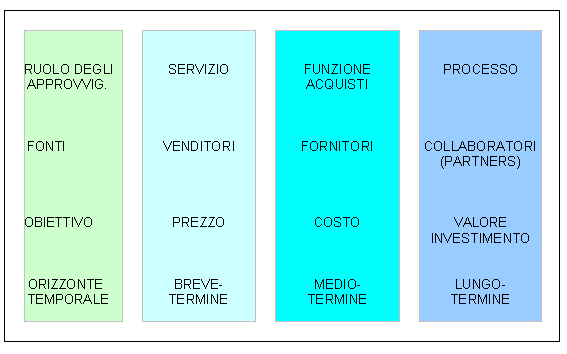
Fig 1,2 évolution des approvisionnements.
Notes 5 : Coûts dont le montant ne dépend pas du service ou du volume des ventes. Ils sont en fait une constante. Notes 6 : S On l'a lorsqu'il existe une proportionnalité dirigée entre tout en coût et quantité produite. Notes 7 : Avec des connaissances, des instruments et des ressources à la disposition d'une entreprise.
1.2. Conditions de fourniture.
1.2. Conditions de fourniture.
Chaque organisation s'insère à l'intérieur d'un cycle économique, produisant des biens et des services et acquérant de l'extérieur des matériaux, des biens et des services pour les transformer dans les processus de production ou pour les utiliser à l'intérieur afin de maintenir le degré de fonctionnalité nécessaire. Les achats ont une influence sur les performances économiques, le fonctionnement des institutions financières de l'organisation à travers quatre facteurs principaux :
- Le prix payé, qui contribue directement ou indirectement à la détermination du coût des biens et services produits.
- La qualité en entrée, qui se reflétera soit sur la qualité de la même production que sur son coût, à travers les rendus, les rebuts, les retouches et les garanties.
- Les délais d'approvisionnement qui influencent le Time to market de la production et déterminent les niveaux d'approvisionnement à maintenir.
- Modalités de paiement et niveau des fournitures.
Ils affectent la capacité générale de l'entreprise à être compétitive dans le système économique dans lequel elle opère et donc l'attente de l'organisation dans les comparaisons du système d'approvisionnement est qu'elle satisfasse à trois exigences de caractère général :
- L'économisation, c'est-à-dire le contrôle des coûts à travers la recherche des meilleures conditions de transaction que d'achat sur le marché.
- L'efficacité, c'est-à-dire la capacité de gouverner le marché de l'offre en obtenant des niveaux de qualité, prestations et services tels accessoires pour optimiser l'emploi des actifs/services vous acquiert, en réduisant ou en annulant l'incidence des déchets, rendus, contestés.
- L'efficacité, c'est-à-dire des délais de réponse à la question tels qu'ils ne constituent pas un facteur pénalisant pour le cycle opérationnel, en diminuant les coûts internes.
1.3. Commercialisation d'achat.
1.3. Commercialisation d'achat.
Un nouveau concept qui est apparu ces dernières années dans le domaine des achats est le soi-disant marketing d'achat à grande échelle. Avec ce terme on s'entend avec des actions tendancielles obtenant de justes arrangements d'acquisition des ressources tels avantages pour mettre la propre entreprise dans des conditions de compétitivité par rapport aux entreprises concurrentes 8 . La transposition de la méthodologie de définition du plan marketing aux achats et comprend l'étude systématique de l'atmosphère d'approvisionnement des marchés et des produits et des fournisseurs. Il s'agit d'une activité structurée, non occasionnelle, de nature itéractive, qui a pour objet la surveillance des marchés fournisseurs. Le marketing d'achat influence au moins en second lieu le maintien des relations en évoluant avec les fournisseurs selon deux modalités différentes :
Rôle de filtre, dans quelle mesure dans la phase de définition des stratégies d'achat se façonne comme activité propédeutique à la création d'une relation évolutive et de longue durée
Rôle du retour d'expérience, dans la mesure où l'analyse du marché permet de vous faire une idée des nouvelles normes étrangères.
Le marketing d'achat s'inspire donc de la stratégie commerciale et procède à la définition et à la réalisation de la stratégie d'achat, s'articulant en 4 étapes séquentielles :
Analyse de l'atmosphère d'approvisionnement. Analyse des opportunités et des risques. Définitions des stratégies d'achat. Définition du Procure.mix.
La première phase concerne l'analyse qui les acclimate, au but de caractériser les opportunités et les risques hérités de l'interaction avec le marché de l'offre ; cette phase s'avère préliminaire à l'évaluation des options de stratégie d'achat, également dans l'optique d'évaluation de faire ou d'acheter. La formulation d'une telle stratégie jaillit de la combinaison cohérente de la combinaison des leviers décisionnels (produit, prix, sources et relations).
Notes 8 : Source : Adaci de Turin.
1.4. Il s’agit de la stratégie commerciale d’achat.
1.4. Il s’agit de la stratégie commerciale d’achat.
1° phase : analyse de l'atmosphère d'approvisionnement. Chaque domaine est le résultat de l'équilibre entre diverses forces concurrentielles qui agissent sur les prix, les coûts et les investissements dont le changement détermine dans le temps le profit du domaine. La concurrence dans un domaine s'étend pour porter le taux de rendement de celui qui les a investis vers un taux limite, défini à partir des conditions de concurrence parfaite. Les entreprises pour se révéler compétitives et ne pas risquer de sortir du marché, devront essayer d'avoir un rendu pas inférieur à ce seuil limite, même celui qui investit dans un domaine pas inférieur de rendu de puces, à partir du moment où il a la possibilité d'investir dans d'autres domaines.
L'économiste de Porter caractérise cinq facteurs compétitifs qui démontrent que la concurrence dans un domaine va au-delà du comportement des concurrents individuels. La rivalité entre les entreprises, les concurrents, les clients, les fournisseurs, les produits de substitution possibles et les revenus des nouvelles mises à niveau des concurrents détermine en effet l'intensité de la concurrence. L'attrait du domaine étroitement lié est donc vers le profit qui est le fruit de l'évolution dans le temps des rapports de force des facteurs proposés ci-dessous en détail.- Une nouvelle menace est entrée. Les entreprises qui entrent dans un secteur ont comme objectif de conquérir des parts de marché aux pertes des entreprises désormais matures du secteur. Habituellement, ils mènent une politique de pénétration, basée sur des prix de vente très bas qui couvrent les coûts de production en offrant une marge bénéficiaire beaucoup plus basse. Ceci oblige donc les entreprises présentes dans le secteur à devoir baisser aussi les prix de vente ou à offrir le bien au prix habituel en garantissant une qualité ou un meilleur service.
- Intensité de la compétition. Les entreprises mettent en œuvre toutes les stratégies possibles en permanence pour dépasser la concurrence et maintenir intactes leurs propres parts de marché. Les entreprises sont défiées en effet dans des batailles de prix, des campagnes promotionnelles, des lancements de nouveaux produits qui obligent évidemment toutes les entreprises du secteur à agir en conséquence, pour ne pas courir le risque de sortir, au bout d'une année, du marché.
- Concurrence des produits substitutifs. Les entreprises ne sont pas en concurrence seulement avec les entreprises du même secteur, mais aussi avec les fabricants de produits qui vous sont succédés, mais ces actifs qui ont également les mêmes caractéristiques ne peuvent cependant pas satisfaire le même besoin, et donc s'ils sont offerts à un prix avantageux, ils pourraient également attirer l'attention du client.
- Pouvoir contractuel des clients. Les clients sont une force indirecte qui alimente la concurrence entre les entreprises. Les entreprises en effet aussi, pour ne pas perdre des parts de marché, tentent de satisfaire les exigences des clients qui ont l'habitude d'apprécier les réductions de prix, la bonne qualité du produit et le service offert. Ceci pour toujours satisfaire le client augmente la concurrence entre les entreprises qui sont obligées d'être toujours compétitives en réduisant également leur pourcentage de profit.
- Pouvoir contractuel des fournisseurs. Les fournisseurs avec leurs prix de vente conditionnent très le parcours de leurs entreprises clients et de l'ensemble du secteur. Ils peuvent mettre en pratique des augmentations ou des réductions de prix qui se refléteront sur le prix final du bien, mettant ainsi aussi en grave danger la compétitivité de l'entreprise finale.
2° phase : analyse des opportunités et des risques.
L'une des méthodologies actuellement les plus diffuses pour l'évaluation de domaines et de phénomènes est l'analyse SWOT 9 . Le domaine ou les conditions objet de l'évaluation, en effet, doivent faire l'objet d'études approfondies dans le but de mettre en lumière toutes leurs caractéristiques, structurelles et conjoncturelles, et de mettre en évidence d'éventuelles relations et synergies avec d'autres propositions et situations. Pour faire cela il ne suffit pas de connaître en détail le thème spécifique mais il devient nécessaire la pleine connaissance du contexte à l'intérieur duquel celui-ci se situe. Une fois rassemblées toutes les informations jugées nécessaires pour la définition d'un tableau, le plus complet possible, du thème spécifique et du contexte dans lequel celui-ci se place, il est possible de procéder à l'évaluation. Grâce à l'analyse SWOT, il est possible de mettre en évidence les points de force et de faiblesse dans le but de faire émerger ceux qui sont pensés capables de favoriser, ou d'entraver ou de retarder, la poursuite des objets qui vous sont déterminés. Plus spécifiquement, dans l'analyse SWOT, les facteurs endogènes et exogènes sont distingués. La terminologie usuelle distingue les facteurs endogènes entre points de force et points de faiblesse et ceux exogènes entre opportunités et risques. Entre tous sont considérés d'abord ces variables qui font partie intégrante du même système, sur lesquelles il est possible de participer pour poursuivre l'objet préfixé à vous. Entre les secondes, par contre, les variables externes au système qui peuvent le conditionner sont positives et négatives. Dans ce dernier cas, il n'est pas possible d'intervenir directement sur le phénomène mais il est opportun de prédisposer des structures de contrôle qui caractérisent les agents exogènes et d'en analyser l'évolution afin d'empêcher les événements qui vous sont refusés et de profiter de ceux qui vous sont positifs. Les facteurs possibles à considérer sont les suivants :
- Dimension et tendance d'augmentation des volumes d'achat de la propre entreprise et des concurrents.
- Structure concurrentielle (en termes de quotas et de concentrations) du marché d'offre et du marché de débouché sur lequel l'entreprise est en concurrence.
- Structures de coût, profit des produits.
- Présence de barrières à l'entrée du terrain.
3° phase : définition de la stratégie d'achat.
Pour fonctionner efficacement dans un environnement d'approvisionnement nécessaire, il est nécessaire que la stratégie d'achat soit fortement intégrée à la stratégie commerciale. Trois facteurs concourent à rendre cette prise en main nécessaire à l’intégration :
- La concurrence élevée dans laquelle les entreprises opèrent
- L'atmosphère d'approvisionnement des entreprises devient toujours plus dynamique.
- Le changement de la nature et des étendues de la fonction s'acquiert.
On a identifié trois stratégies possibles qui varient en fonction du poids contractuel que possède l'entreprise dans les négociations commerciales.
- Elevé au pouvoir contractuel de l'entreprise. Dans cette situation, l'entreprise se trouve dans une position de force qui lui permet de concentrer l'offre même vers de petits fournisseurs, de plus son pouvoir d'achat est très fort. Ce seront en effet les fournisseurs qui devront s'adapter aux exigences de l'entreprise cliente pour ne pas risquer de la perdre. En étant le sujet le plus fortement, l'entreprise a la possibilité de demander des réductions de prix, d'obliger le fournisseur à titre d'exemple à se doter de structures logistiques adéquates et d'entreprendre des programmes d'amélioration du produit. Dans cette situation donc l'entreprise s'orientera vers une politique d'achat, mais ne produira pas le matériel dans ses propres usines pour l'acquérir de tiers, en essayant de maintenir possible les approvisionnements plus bas, en diminuant ainsi les coûts logistiques et en obligeant le fournisseur à des livraisons fréquentes.
- Equilibre dans le pouvoir contractuel. Dans cette situation il y a par contre un juste équilibre, qui met les deux parties en face sur la même lentement contractuelle. Dans ce cas, l'entreprise essaie de réduire le cercle des fournisseurs entre ceux qui vous font le plus confiance et le volume des livraisons est avancé mais a la fonction de "porter". Pour autant qu'il s'agisse du choix entre acheter et fabriquer, il s'agit d'une estimation du temps par seconde de la situation.
- Elevé pour pouvoir contractuel du fournisseur. Dans cette situation par contre l'entreprise se trouve dans une position substantielle de désavantage, qu'elle implique un faible pouvoir contractuel qui oblige l'entreprise à adopter une politique de marque, c'est-à-dire qu'elle passe de l'achat du produit fini à l'achat des matières premières, en organisant une production interne avec des programmes dirigés vers le contrôle de la qualité et son amélioration. Un autre objectif est la recherche continue de vous fournir des produits alternés de manière à différencier le parc, en diminuant leur pouvoir contractuel.
4° phase : Définition du Procure.mix.
Les leviers décisionnels d'achat (procurement mix) dérivent des leviers de marketing appelés 4P (prix, produit, promotion, destination). Le marketing d'achat transfère donc les concepts propres du marketing aux achats, en proposant de définir le mélange le plus opportun entre :
- Produit à acquérir (décisions relatives aux matériaux et aux technologies).
- Prix à accepter (pour définir les aspects commerciaux des fournitures).
- Sources d'achat (évaluation du nombre de fournisseurs, des marchés).
- Relations à entreprendre avec le fournisseur (tipologie contractuelle, procédures de coordination, contrôle.).
Ici de suite les quatre leviers seront traités dans le détail, aussitôt cités :
- Le produit. Le levier produit peut être défini en termes de matériau ou de technologie utilisé pour la production. Un même produit peut s'introduire sur le marché constitué de diverses typologies de matériel, auxquelles correspondent diverses performances, différents niveaux qualitatifs, différentes facilités de travail et il peut donc s'avérer plus ou moins rentable. Le produit est donc un levier d'achat directement impactant sur la qualité du fini, l'usinabilité et les coûts de production. De la même manière, la technologie utilisée pour réaliser le produit a un impact sur la compatibilité et la qualité du processus de production, au-delà du niveau technologique du produit fini. Ce dernier a une importance stratégique particulière surtout si l'on poursuit une stratégie de différenciation tournée vers l'innovation et l'amélioration du produit.
- Le prix. Le prix du levier a un impact dirigé sur le coût du produit et il existe différentes approches pour sa détermination en fonction des différentes typologies d'achat. Les produits génériques 10 généralement sont cotés sur le marché, tandis que par contre produits spécifiques ils exigent une cotation de la part du fournisseur qui peut varier en relation acquise avec la quantité et la difficulté de trouver sur le marché. Diverses par contre la détermination du prix s'il se fait en présence d'un fournisseur unique ou plus fournisseur : dans le premier cas il aura recours à la négociation, mais à la négociation vis-à-vis des termes de fourniture, selon le cas ils seront pris en considérations offertes plus de prix, avec le choix du plus convenable.
- Sources d'achat. Les sources d'achat sont le levier correspondant au canal distributif du marketing traditionnel : c'est dans cette phase qu'il faut déterminer le canal le plus approprié à utiliser pour pouvoir approvisionner le produit. La première étape à réaliser est celle d'estimer le nombre de fournisseurs et de décider donc si utiliser un fournisseur unique, ou réduire le parc en fournissant simplement ou au contraire choix d'augmenter le nombre de fournisseurs d'actifs qui vous sont alternés. Par la suite, le risque d'approvisionnement sera analysé et après évaluation des performances réalisées par les fournisseurs en fonction des paramètres.
- Relations à entreprendre avec le fournisseur. Sur la base de la sélection des sources d'achat sera alors déterminé le dernier levier des sources d'achat : le choix qui est des relations à établir avec le fournisseur. Les modalités relationnelles peuvent être regroupées en trois classes : traditionnelles qui se basent sur des relations classiques de marché, intégrées où un accord particulier qui est stipulé prend en considération la synchronisation des flux d'approvisionnement et évolutive qui prévoit une véritable et juste relation de partenariat. Sur la base de ces trois typologies peuvent être définies diverses typologies contractuelles, par exemple des contrats ouverts ou traditionnels, pour convenir de procédures de coordination afin de définir les variations de prix et de montant et de définir d'éventuelles modalités de restitutions de concours qui vous sont rendues.
Notes 9 : procédure de type logique, mutuato de l'économie d'entreprise, qui concourt à rendre les collectes d'informations systématiques et fruitières sur un thème spécifique et fournit des informations fondamentales pour la définition politique et les lignes de participation. Notes 10 : Connaît également les matières premières.
1.5. De nouveaux horizons pour les entreprises aujourd'hui.
1.5. De nouveaux horizons pour les entreprises aujourd'hui.
Ces dernières années, les constructeurs automobiles italiens et français avaient demandé à leurs fournisseurs (entre lesquels les principales sociétés multinationales) une réduction de coûts de 15% sur un arc de 3 ans. Une réduction des coûts propres n'est pas pensable mais sans innover dans tous les domaines et notamment dans les achats, qui pèsent au-delà de 50% du total du chiffre d'affaires. Aujourd'hui donc les entreprises manufacturières du monde entier voient à nouveau les modalités avec lesquelles elles achètent des membres et des services. Et, peut-être avant la crise pétrolière des années soixante-dix et successives carences de matériaux, cette orientation est devenue une priorité pour le sommet. Dans le but de réduire les délais, de répondre plus rapidement à leurs clients et à leurs exigences, d'améliorer la qualité et en même temps d'augmenter l'efficacité, les entreprises leaders ont commencé à gérer leurs canaux d'approvisionnement avec des modalités absolument nouvelles. En repensant souvent aussi les frontières des "entreprises propres", elles ont introduit deux éléments importants dans la gestion des approvisionnements des organisations :
- La production, de plus en plus souvent, à des livraisons nulles, cela implique la réduction des livraisons possibles diminuées, cela à son tour suppose le découragement des délais de livraison et de gestion, avec des livraisons plus fréquentes et un bon niveau de qualité des acquis (« le zéro défaut »), pour augmenter ainsi la flexibilité de production (loto unitaire) et réduire les immobilisations financières et les coûts de fonctionnement des livraisons.
- La terziarizzazione des services déterminés ou des se fait, pour alléger l'organisation, la rendre flexible, réduire les coûts fixes en faveur de ceux variables. Ceci implique une intégration plus complexe entre le marché de la question et celui de l'offre, et par conséquent, la modification du rôle et des modalités d'exploitation des approvisionnements.
Cette nouvelle vision est davantage centrée sur la recherche, la sélection et la gestion des fournisseurs qui participent au processus d'achat. L'objectif principal est d'identifier un approvisionnement stable, en diminuant les délais d'approvisionnement et les prix, et en maximisant les performances, à travers un système adapté de gestion de la sélection et de négociation. Tout cela devient nécessaire suite à la constatation que la valeur ajoutée a progressivement diminué au cours des quatre dernières décennies tandis que, dans la même période, un fort besoin de spécialisation s'est manifesté dans nos usines. En passant le manager, ils s'étaient confiés, pour le passé de l'entreprise, à l'intégration verticale. Aujourd'hui, la complexité des produits et la compétitivité des marchés ont conduit les entreprises à rétrécir leur sphère d'activité pour se concentrer sur un ensemble limité de compétences clés. Pour faire en sorte qu'ils aient fait confiance à des partenaires qui possédaient des compétences particulières ou qu'ils avaient accès au marché. En 1990, le coût moyen des matériaux, des membres et des services acquis par toutes les entreprises des fabricants américains était de plus de 75 % de la valeur de leurs produits. En 1960, il était de 40 %, en 1945 de 35 %. Cette augmentation du coût des produits vous amène à l'extérieur et a pour but de pousser l'attention de la direction sur les activités d'approvisionnement. Que cela pousse les entreprises à travailler dans cette direction, c'est donc la naissance de nouvelles nécessités. Les entreprises qui regardent principalement dans cette direction sont les entreprises qui pour la gestion de l'information à l'intérieur de leur entreprise utilisent des systèmes ERP. Dans les pages suivantes, ils vous traitent exactement de tels systèmes en détail, en mettant en évidence les caractéristiques positives et surtout leur influence sur le domaine des achats, ce qui nous intéresse davantage.
1.6. Systèmes ERP : Signaux.
1.6. Systèmes ERP : Signaux.
Pour "Business Informative System" ils conviennent "avec des hommes d'affaires, des équipements et des procédures dont la tâche est celle de produire l'information qui sert pour opérer dans l'entreprise et la gérer". En résumé pratique de toutes les informations importantes utilisées dans l'entreprise, jointes à l'infrastructure informatique (matériel, logiciel et réseaux) nécessaire pour les gérer et aux personnes qui les utilisent pour le développement de leur propre activité.
Dans un tel contexte donc avec l'acronyme E.R.P. (Enterprise Resource Planning) s'engage à identifier les systèmes de gestion intégrés, c'est-à-dire un total de logiciels d'applications intégrés, que les informations importantes de l'entreprise dans une seule base vous donnent toutes centralisées et que les variétés d'activité de l'entreprise concourent à gérer de manière coordonnée. Pour être quelles flexibilités d'architecture vous considérez, de tels systèmes ERP doivent posséder des caractéristiques, une atmosphère de personnalisation efficace, diverses installations de câble, des disponibilités en langues et localisations, la possibilité de modéliser des structures d'entreprise complexes, une large gamme de modèles de contrôle de gestion de construction facile et totalement intégrés. Acronyme E.R.P. (Enterprise Resource Planning) a été inventé au début des années 90 pour désigner les nouveaux systèmes de gestion intégrés pour les entreprises manufacturières qui étaient une évolution des produits antérieurs construits sur les célèbres modèles comme MRP (Material Requirement Planning) et MRP II (Manufacturing Resource Planning). La naissance de tels systèmes au cours de ces années n’est pas un cas sûr. Les entreprises ont en effet commencé à avoir l'exigence d'une évolution du système qui leur permette de gérer les activités commerciales de manière efficace et transparente en évitant toute perte possible de temps et de ressources pour la gestion de l'information. Les entreprises évoluaient et le faisaient rapidement, il se produisait en fait une nouvelle ouverture vers l'extérieur. Les entreprises ne se contentaient pas plus que de vendre et d'acheter des actifs produits dans la propre zone, elles ont donc commencé à essayer des fournisseurs et des clients nationaux. Même ces barrières, autrefois considérées comme insurmontables, ont commencé à devenir des espèces labili lorsque l'idée d'un marché européen et d'une seule monnaie s'est présentée. Il arrive aux années 2000 et il trouve une consolidation dans les relations avec son propre partenaire européen, on commence à voir le monde comme un seul grand marché, dans lequel il n'y avait pas de frontières et d'obstacles au libre commerce. On a donc commencé à parler de mondialisation. Comme on peut le comprendre, la taille du travail et les informations à traiter et à gérer ont augmenté de façon vertigineuse. Depuis la confirmation, il est certain que la répartition des attachés dans les différentes unités d'affaires est sûre. Il y a trente ans, il y avait en proportion 4 ouvriers et 1 employé. Une heure au lieu de 4 emplois vous correspond à 1 seul ouvrier. Tout cela a certainement dû à l'augmentation de l'information à gérer, mais aussi parce que la direction qualifiée s'est convertie en un des principaux objets de l'entreprise.1.6.1. En tant que système, l'ERP fonctionne.
L'ERP est défini comme « une architecture logicielle qui facilite la circulation de l'information entre toutes les fonctions internes de la société que sont la fabrication humaine, la logistique, la finance et les ressources ». Les ERP sont des logiciels conçus pour automatiser les "routines organisationnelles" et pour modéliser les processus stratégiques de l'entreprise, depuis la finance jusqu'aux ventes, dans le but de réaliser l'intégration de l'information possédée à l'intérieur des entreprises, et le partage des mêmes entre l'entreprise et ses partenaires. Les applications ERP, en effet, réduisent les coûts de coordination des transactions, c'est-à-dire diminuent le coût de « gouvernement » des interdépendances, mais n'en modifient pas la nature. En bref l'avantage des systèmes ERP est que pour permettre la réalisation de connexions entre les différents il est fait de la chaîne de valeur à des coûts inférieurs et plus rapidement des systèmes informés traditionnels, en concourant à acquérir un avantage concurrentiel de support dans les comparaisons des concurrents qui n'utilisent pas tels systèmes ou qui ne vous implémentent pas correctement. De plus, les systèmes ERP contribuent à codifier remarquablement la connaissance, en réduisant les coûts de sa diffusion à l'intérieur de l'entreprise. Le système ERP fonctionne à travers une base de données commune située au cœur (au centre) du même système. Une telle base de données interagit avec toutes les applications, de manière à garantir l'absence de redondance entre celles-ci et l'intégrité du système susmentionné. Avec ces systèmes, on a une "intégration du système d'information d'entreprise péché dès sa conception", c'est-à-dire que le système d'information naît déjà intégré soit sous le profil logique-organisationnel, soit sous le profil logiciel et matériel. Planifié depuis l'origine intégration de toutes les fonctions d'affaires dans un système unitaire, sans duplication d'arcs et sans activité de réinsertion qu'ils vous donnent. Un système ERP est composé de plusieurs modules chacun qui surchargent les informations des différentes divisions métiers. Il existe des modules qui fonctionnent pour chaque "business unit" métier, à titre d'exemple un module pour les ventes, un pour les achats, un pour la finance, les ressources humaines et donc via.
1.6.2. Les avantages vous découlent de l'adoption de systèmes ERP.
1.6.2. Les avantages vous découlent de l'adoption de systèmes ERP.
En étant partie intégrante d'une solution informatique que toutes les fonctions d'affaires, les systèmes ERP concourent au moins potentiellement à chaque sujet (), indépendamment du niveau hiérarchique dans lequel se trouve, une égale visibilité des processus d'affaires. Cela est possible grâce aux bases de données relationnelles aromatisées, qui permettent d'avoir une organisation plus transparente et "governabile", grâce à la possibilité de pouvoir décider en temps réel de l'information nécessaire et toujours fiable. Avec les systèmes ERP, on évite donc, par rapport aux systèmes traditionnels, les désalignements qui vous sont signalés, qui peuvent être vérifiés, entre les diverses fonctions commerciales. Avec un tel système, ils évitent également les différences de dons selon le "codifiche" qui rendaient problématique, voire tout à fait impossible, le transfert de dons entre les différentes applications. Un système informatif intégré comme celui ERP, au-delà de concourir à une "interconnexion informative totale" pour permettre à chaque opérateur est une vision transparente de tous les processus d'affaires, que la possibilité de travailler sur ils vous donnent de manière fiable et vous aligne, toujours cela affecte la qualité du travail et sur la qualité du processus décisionnel, en réduisant c'est l'incertitude qui les acclimate est celle relationnelle. L'existence d'une base de données commune et, par conséquent, de données uniques et aromatisées, permet de prendre des décisions dans un contexte de plus grande certitude. Il devient possible en effet, grâce à des analyses opportunes de donner, d'augmenter le degré de prévision des événements qui auront lieu. Les applications ERP réduisent les coûts de coordination intraziendali et inter-entreprises, elles favorisent en particulier :
L'intégration entre les différents se fait dans la chaîne de valeur. La majeure intégration les travaille, en permettant une meilleure intégration des activités opérationnelles. La division et la coordination du travail. Intégration des systèmes de contrôle et de programmation. Intégration cognitive lors de la phase de développement de l'application.
Le premier des points cités en matière d'intégration des différentes est constitué de la chaîne de valeur, c'est-à-dire la capacité des flux informés à relier les unités organisationnelles opérationnelles, afin d'améliorer le niveau de service de l'entreprise. Dans de telles optiques, des économies dans les temps et les coûts de transmission de l'information entre les unités organisationnelles se réalisent donc, non plus gérées comme des unités isolées, mais fortement concentrées au sein d'une "chaîne de valeur 11". Les temps et les coûts des processus décisionnels s'avèrent proches : une forte intégration des activités stratégiques et opérationnelles contribue à améliorer la convergence des contributions des différents sujets dans plusieurs des processus décisionnels. La plus grande intégration qui les fonctionne est réalisable grâce à la diffusion de langages communs et a été aromatisée, c'est-à-dire au "test ualizzazione des processus opérés", qui concourt à une communication plus fluide et par conséquent, à une plus grande capacité de coordination entre les différentes unités organisationnelles. De cette dérive une amélioration dans les temps de transmission de l'information entre les unités organisationnelles puisque la codifie de l'information concourt à un transfert plus facile dans le temps et dans l'espace. L'augmentation du degré d'utilité de l'information et le pourcentage de son utilisation : la textualisation des procès d'affaires avec la diffusion de langues que tu as goûtées, favorise la production d'informations "importantes" et d'utilisation facile et opportune ; Le processus de division et coordination du travail est facilité par les systèmes de coordination et de communication (e-mail, logiciel de grupware et workflow, possibilités de réaliser Intranet ad hoc) souvent inclus dans les applications ERP. Tels systèmes permettent une gestion simplifiée du travail en équipe et en soutiennent également la création indépendamment du positionnement physique des sujets, en recourant également à la modalité de télélavoro. Les systèmes de planification et de contrôle vous influencent profondément depuis l'adoption de systèmes ERP qui améliorent la quantité et la qualité de l'information disponible pour le système décisionnel, disponibilité qui influence fortement aussi les choix de centralisation/décentralisation sur lesquels présupposés ils vous pensent et vous réalisent les ordres organisationnels. De tels systèmes exigent dans tous leurs aspects (planification, augmentation, modification/personnalisation) une collaboration approfondie entre les clients et les techniciens/planificateurs.
1.6.3. Les coûts découlent de l'adoption de systèmes ERP.
1.6.3. Les coûts découlent de l'adoption de systèmes ERP.
L'adoption d'un système ERP est une décision très complexe, qui exige une évaluation minutieuse des coûts - bénéfices qui y sont associés et dont la définition implique l'implication de nombreuses compétences qui vont du conseil directionnel et organisationnel pour la définition du modèle d'affaires de référence, jusqu'à l'optimisation des choix de matrice technologique. Le moment le plus critique des systèmes ERP est celui de la "implémentation", dans la mesure où il exige une totale maturation des procédures d'affaires, non seulement du point de vue des flux qui vous sont informés, mais aussi de leur formulation "organisationnelle". Exigeant des changements organisationnels remarquables, dans la phase d'implémentation de systèmes ERP, nous nous trouvons souvent confrontés à de fortes résistances organisationnelles. C'est pourquoi il est nécessaire qu'il y ait un soutien clair de la direction de l'entreprise dans les comparaisons du plan, une forte implication des clients, l'apport de ressources et de compétences externes et le professionnalisme élevé des figures internes et externes impliquées. Le coût d'un système est extrêmement variable, il dépend de divers facteurs dont la dimension de la société, le nombre de clients, le nombre de modules acquis et en outre le coût de mise en œuvre pour vous. De l'analyse du marché nous avons constaté que le prix du logiciel commence peut osciller entre 8.000 et 25.000 pour le client dont 70-80 % il est constitué du même Processus de reingegnerizzazione de l'Entreprise. Comme on peut le comprendre bien qu'ils soient adaptés et adaptables à n'importe quelle situation et n'importe quel type d'entreprise, le coût d'achat élevé exclut la possibilité d'adoption du système ERP à toutes ces petites entreprises et de taille moyenne, habituellement à caractère familier ou de toute façon constituées d'un nombre limité d'associés. Ceux-ci en effet ayant aussi une structure petite, grâce à leur dimension, s'avèrent cependant avoir encore de grandes inefficacités dues juste à une mauvaise gestion de l'information. Un tel logiciel permet en effet un contrôle et une gestion de l'information en temps réel et rapide : toutes les informations en effet sont ramenées dans le système, l'opérateur n'aura donc pas besoin ni d'enregistrer ni de contrôler les documents dans des classeurs apposés sur vous, puisque les documents seront numérisés et insérés dans des dossiers appropriés, tandis qu'ils vous seront ramenés notamment des masques. Avec de tels systèmes en effet les entreprises pourraient se diriger en fait vers obtenir la certification d'entreprise sans papier. Pour autant qu'il s'agisse du discours des certifications, les entreprises soutenues par tels systèmes d'approvisionnement ne pourraient pas courir aussi le risque de ne pas être considérées comme caractérisées par les propres entreprises clientes ; surtout à l'époque où tous les fournisseurs qu'il codifie des plus grandes et importantes entreprises doivent avoir une certification qui démontre la qualité et l'efficacité de la gestion d'entreprise.
1.6.4. Les limites des systèmes ERP.
1.6.4. Les limites des systèmes ERP.
Les plus grandes limites trouvées dans de tels systèmes ERP sont certainement les coûts d'exploitation élevés et ceux qui ne sont pas faciles, comme on le croyait plutôt, l'intrusion ou l'annulation éventuelle des offres. De tels systèmes ont en effet la faiblesse de ne pas pouvoir éventuellement annuler une donnée plus nécessaire à la gestion de l'entreprise, car elle hériterait d'un autre profit, puisque de cette façon se perdraient les deux. C'est pourquoi de très nombreux tronçons de société, pour ne pas perdre ils vous donnent et d'éventuels passages utiles pour tenir vous donnent tous collectés au cours de la vie dans le système. En théorie, la disponibilité d'une grande masse d'informations devrait constituer un avantage, mais souvent ce n'est pas le cas : en effet il est de plus en plus difficile de distinguer dans les moyens pour vous donner par rapport à chaque aspect minimum de l'opérativité de l'entreprise, ceux qui intéressent le dirigeant pour prendre une décision importante au moment opportun. Ne pas pouvoir, comme déjà souligné, annuler ce qu'ils vous donnent dans le système a amené beaucoup d'entreprises à continuer à insérer toujours de nouveaux dons dans le système, sans devenir un compte qui surchargeait beaucoup qu'un jour de tels systèmes vous soient informés et les entreprises se sont trouvées d'un jour à l'autre devoir changer leurs propres systèmes de gestion.
1.6.5. Influence des systèmes ERP sur les approvisionnements.
Dans les pages antérieures on a rapporté des notes sur les systèmes ERP, en mettant en évidence les côtés positifs et les bénéfices qu'ils ont portés dans la structure corporative. Grâce à tel soutien, il a pu obtenir une gestion efficace et efficiente de l'information soit à l'intérieur, c'est-à-dire entre unité et unité, qu'avec l'extérieur, c'est-à-dire avec tous les sujets de la chaîne productive, approvisionnement et clients. Tels systèmes ont permis une forte rationalisation des temps de travail, permettant ainsi un passage rapide entre tous les sujets, en effet les informations arrivent en temps réel en fonction des exigences effectives de l'entreprise. L'entreprise en effet, à travers de tels systèmes directement, une fois reçue la commande de la part du client, transmet les propres exigences de matériel à celui qui vient de le fournir. Si nous voulions concentrer notre attention sur un exemple réel, nous pourrions considérer un exemple concessionnel, qui une fois reçu la commande d'une partie du client, grâce à de tels systèmes communique l'information au fabricant, qui à son tour envoie automatiquement sa demande à ses différents fournisseurs. C'est-à-dire qu'il demandera au fournisseur To, 5 roues, au fournisseur B 2 litres de vernis, au fournisseur C volant. Ces revendications sont réglées par des accords conclus, c'est-à-dire par des accords conclus préalablement entre le chef d'entreprise et tous les autres. De tels accords établissent toutes les conditions du contrat, c'est pourquoi les parties n'ont pas besoin d'être négociées de temps en temps. Un tel système pourrait donc s'avérer parfait, mais malheureusement ils peuvent être introduits des exigences d'approvisionnement non prévues, qui ont lieu très rarement et pas avec continuité dans le temps. De telles livraisons sont nécessaires à l'entretien des infrastructures commerciales et peuvent avoir lieu à tout moment, alors la panne d'une machine n'est malheureusement pas toujours prévisible. C'est pourquoi les entreprises pour résoudre tels inconvénients sont obligées d'essayer de nouveaux fournisseurs, alors ces pièces ne vous sont pas habituellement acquises, de s'occuper des prix et des délais de livraison pour ensuite les codifier. Une telle activité n'implique qu'une dépense excessive de temps et d'argent. Un tel codage en effet, d'après les études réalisées par des entreprises importantes comme Unitec, Lufthansa.., les contrats font pour empiler les coûts à un chiffre égal à 1200 euro en plus de cette nécessité de gérer le temps il y a longtemps pour glisser de loin les termes de livraison, quand par contre pour tel matériel la ponctualité est d'obligation alors il peut y avoir aussi des problèmes de lignes et de productions fermes. Une alternative à une telle bureaucratie serait de pouvoir émettre des ordres sans passer pour le système, ce qu'on appelle le non-conformiste des ordres. De tels ordres peuvent donner l'illusion de jeûner complètement la bureaucratie, en la sautant, mais malheureusement cette porte ne fait que perdre le contrôle total sur la gestion des ordres. De tels ordres viennent vous appeler. Parce que c'est un ordre de "affaire désagréable" dont seulement celui qui connaît l'existence l'a émis, parce que dans le système il ne se passe rien.
1.7. Intégration des fournitures.
1.7. Intégration des fournitures.
Les exigences des entreprises telles qu'elles ont pu comprendre sont en train de changer : à la recherche du meilleur prix, imprimé sur les relations qu'elles négocient, elles se fondent sur la force contractuelle, sans parler du maintien d'un possible nombre élevé de plus d'approvisionnements alternés, dans le but d'alimenter la concurrence, le développement de chaînes fournisseur-client empreintes de relations de comakership avec un nombre limité de fournisseurs fiables sur les approvisionnements stratégiques et le développement restant d'une relation d'externalisation est remplacé par un seul fournisseur pour fournitures. À la tendance à profiter au maximum des fournisseurs, à ne pas accepter des liens de longue durée et à effectuer des achats pour des commandes uniques, en mettant toujours en concurrence, à chaque commande, des fournisseurs alternés, le développement informatif de réseau commun et c.d. les commandes ouvertes sont remplacées (contrats photo ou contrats de fourniture), dans le cadre de relations de co-fabrication à long terme et d'externalisation il vous oriente vers l'obtention d'économies sur une longue période. En ligne avec l'approche stratégique analysée, le rôle du fournisseur muet est également radicalement. Ses tâches principales ne consistent pas plus à essayer d'obtenir le prix le plus bas pour chaque commande, en activant la concurrence entre fournisseurs dans le but d'optimiser le budget anniversaire : il devra, de manière plus cohérente avec les nouvelles philosophies managériales, coordonner et faire croître les fournisseurs en les intégrant dans le système d'affaires et optimiser les achats aux coûts totaux à long terme. Le devoir d'« acheteur » tend à se caractériser et à se spécialiser bien moins qu'il ne l'est actuellement. Le rôle sera, en fait, le plus total et disparu, s'étendant de la qualité, à la technologie, à la gestion. Il s'agit généralement d'un rôle destiné à être couvert à partir de photos d'entreprises qui sont en relation directe avec leurs fournisseurs (comme à l'intérieur de l'entreprise, où les acheteurs ne sont pas nécessaires pour gérer les relations entre les unités). La relation fournisseur-client est en évolution rapide et substantielle. Les développements stratégiques en action dans les entreprises industrielles se trouvent en effet sur la relation "fournisseur-vendeur" avec l'inspiration logique. La tendance à réduire le nombre des fournisseurs constitue une évolution qui peut être interprétée diverses clés de lecture seconde. Avant eux, qu'il trace le modèle délimité, il consiste dans la nécessité d'entretenir des relations commerciales avec un nombre moindre d'interlocuteurs, dans le but d'établir avec eux des relations commerciales plus serrées et de réduire les coûts de transaction. La seconde, provoquée par la diffusion du comakership, provient de l'impossibilité de faire coexister une telle philosophie avec la présence de nombreux fournisseurs alternés à vous. L'externalisation des approvisionnements est placée dans une alternative en ce qui concerne la distinction mentionnée ci-dessus entre les fournisseurs secondaires primaires et les fournisseurs. Dans les comparaisons du comakership, il se place, au contraire, dans une position complémentaire. L'externalisation en cause, la distinction claire entre fournisseurs stratégiques et non stratégiques repose en fait sur une seule. Les relations avec le premier devront nécessairement être entretenues du client en première personne. Le concept de comakership est tout à fait adapté à cette classe de fournisseurs. Les relations avec les seconds, au contraire, pourraient être entièrement déléguées à un seul fournisseur, obtenant ainsi le résultat de pouvoir parler avec un seul ultérieur "fournisseur principal". Ils réduisent donc drastiquement le nombre des fournisseurs, mais évidemment cela ne réduira ni le nombre de fournisseurs ni le quantitatif des actifs qui vous sont confiés, puisque ces actifs vous seront essayés et gérés à partir de la fourniture, permettant à l'entreprise de partenariat avec un sujet unique, qu'elle portera à une réduction substantielle de l'information à gérer. Une des solutions possibles qu'Unitec offre à ses clients est celle de l'approvisionnement intégré. Qu'un seul fournisseur se substitue à la myriade de fournisseurs de classe B et C, qu'une meilleure gestion permettra, comme illustré dans les pages suivantes, de tels approvisionnements.
1.8. L'approvisionnement intégré.
L'offre représente un aspect très important du cycle économique des affaires. Souvent, l'attention se concentre presque exclusivement sur les prix des marchandises qui vous intéressent chez les fournisseurs, sans considérer, ou sous-estimer, la quantité de ressources de l'entreprise qui sont "brûlées" au cours d'un quelconque processus d'approvisionnement et qui sont beaucoup plus que ce qu'on peut imaginer. Jusqu'à présent, en effet, l'attention n'est pas particulière au courrier, aux coûts qui jaillissent en faisant déplacer toute la machine bureaucratique. Chaque fois, en effet, qu'une agence commerciale est activée pour quelque raison que ce soit, elle génère des coûts, en particulier si des interférences se produisent, ce qui peut également amener à refaire la même procédure plusieurs fois. En mettant ces considérations en relation avec le nombre d'agences impliquées dans une procédure de fourniture, il devrait s'avérer plutôt évident que, pour estimer correctement le coût du processus de fourniture, il n'est pas possible de limiter les propres considérations au prix unique qui apparaît dans la facture envoyée par le fournisseur. Le coût total du produit acquis est composé de plusieurs voix et le prix peut également être bien inférieur en termes de montant. En particulier, cela vaut pour ces produits définis "non stratégiques" pour une entreprise - dans la mesure où ils ne vous emploient pas directement dans les activités connexes Core business de l'entreprise - mais que pour la même ils s'avèrent indispensables, comme par exemple les réciprocités ou certains types de fournitures. Dans tel cas, pour diminuer le coût de fourniture, plutôt que de se diriger vers le prix - pour lequel la marge de réductions éventuelles apparaît en effet limitée -, il convient de se concentrer sur la réduction des autres voix qui en composent le coût total : c'est exactement ce qui se passe avec la fourniture intégrée de fournitures. Online de principe projet d'un système qui permet de joindre les nombreuses petites demandes de fourniture de l'entreprise cliente vers une entreprise qui s'occupe de fourniture intégrée, qui s'occupera de toutes les procédures et opérations nécessaires pour faire parvenir les marchandises souhaitées au moment souhaité et avec un document unique, venant de l'entreprise cédée à la fourniture intégrée. D'une part, donc, les coûts de chaque fourniture de n. sont réduits à 1, l'autre partie permet à l'entreprise qui propose la fourniture de gagner juste la marge pour "coût zéro" pour le client. Avec l'offre intégrée, les entreprises ont les processus d'affaires internes beaucoup plus simples, évitant les interférences procédurales internes et externes, elles peuvent transformer les coûts fixes en proportion variable aux exigences du moment. L'offre intégrée est née pour gérer de manière particulière des approvisionnements qui ne sont pas stratégiques pour l'entreprise - actifs des emballages B et C, à faible coût, non stratégiques dans la mesure où leur gestion depuis une partie d'un fournisseur introduit de plus grandes marges d'économie. Il s'agit d'actifs en nature dont le prix est relativement casso mais dont le coût total d'achat s'avère particulièrement élevé. Ceci parce que l'entreprise, pour pouvoir acquérir de tels actifs, prédispose et dispose des mêmes structures opérationnelles et de gestion qui activeraient pour l'achat d'actifs de première importance pour l'entreprise. En bref donc l'achat de biens de type non stratégique s'avère coûteux, pas beaucoup pour le prix, mais surtout parce que les ressources de l'entreprise dans l'activité d'achat sont "gaspillées" pour lesquelles il y a une nette disproportion entre la valeur du bien acquis et le coût des procédures mises en œuvre pour l'obtenir. De plus, étant elle-même généralement composée de petits morceaux, l'entreprise ne pouvait pas réaliser d'économies d'échelle pour réduire les coûts. Aussi le simple achat d'un boulon peut coûter de 10 à 100 et, dépend exactement, de comment il vient choisi, de comment il est commandé, de comment est contrôlé le transport et de comment il est stocké. Grâce à l'alimentation intégrée, plusieurs processus deviennent donc compacts et les coûts sont réduits en faveur de l'efficacité.
1.9. Evolution de la relation avec les fournisseurs.
1.9. Evolution de la relation avec les fournisseurs.
On constate une évolution dans les relations avec les fournisseurs au cours des dernières années : d'une vision du fournisseur entendu comme une "pression adverse" avec l'objectif principal du prix minimal possible à un fournisseur considéré comme un "partenaire avec qui collaborer" pour tenter l'optimisation du système global "client - approvisionnement". Cette évolution a placé au centre de l'attention le fournisseur, le transformant en un élément de base pour l'obtention de l'avantage compétitif et pour cette raison il est nécessaire d'établir des relations de confiance mutuelle, de caractériser les zones de collaboration et de définir des contrats qui puissent garantir à la fois le maintien de la compétitivité dans le temps. Les conséquences immédiates de cette nouvelle vision sont :
- diminution des approvisionnements totaux
- meilleur échange d’informations entre client et fournisseur
- plus grand voisinage
- processus de « certification progressive » du fournisseur conséquent à une sélection minutieuse et un contrôle continu des paramètres de performance.
Du point de vue de la typologie des relations d'offre, les classes se répartissent en trois « bandes » de référence (), en fonction du degré de développement du comakership18. Partant du principe que dans une situation de départ, les fournisseurs, placent tous en III la classe, se recrutent pour décider avec qui d'entre eux se transporter d'abord en classe II puis en classe I. Évidemment, il existe à l'avance des situations d'approvisionnement en classe III et II, et cela en fonction de la capacité d'approvisionner une entreprise à influencer uniquement le parc, et ce pour des considérations d'opportunité (également économiques) liées à une analyse ABC du parc uniquement.
Notes 18 : Stratégie tournée vers les fournisseurs dans lesquels on tente une amélioration qui a dû aux synergies de la connexion.
1.9.1. fournisseur "normal"
L'entreprise cliente caractérise sur le marché tous les fournisseurs possibles sur la base de listes détaillées qualitatives minimales acceptables, qu'elle caractérise et ensuite juge appropriée pour la fourniture, en choisissant ceux qui peuvent garantir les prix inférieurs. Les fournisseurs en gèrent 2-3 en même temps pour pouvoir disposer de sources alternatives pour pouvoir mettre en concurrence sur les prix les différents fournisseurs. De plus ils ne se communiquent pas sur les exigences prévues pour le futur et encore moins donnent des garanties au fournisseur sur les futures livraisons. Si cela se fait seulement et afin d'exercer une certaine pression psychologique. Ces approvisionnements sont en outre garantis comme qualité en solo à travers la société d'un contrat avec d'éventuels pénitenciers ; la possibilité d'effectuer uniquement des échantillonnages statistiques ou tout à fait "passage libre" est un risque assumé unilatéralement par l'entreprise client sur la base de données historiques ou de faibles critiques du membre en jeu. Enfin, le fournisseur n'a été estimé que sur sa production et donc les risques liés au fait qu'il n'existe pas de connaissance puisqu'il peut garantir dans le temps de telles performances. On ne sait pas grand chose des processus du fournisseur qui sont à « risquer » en ce qui concerne la garantie de qualité et la capacité à répondre aux changements dans les programmes. Et c'est pour toutes ces raisons qu'il est nécessaire de fournir des services d'approvisionnement d'urgence en tels matériels.
1.9.2 fournisseur « intégré ».
Le fournisseur, dans cette classe, ne viendra pas en concurrence avec chaque nécessité d'achat, les conditions de la relation en fait sont révisées chaque année sur la base des résultats de la commercialisation d'achat: lorsqu'un fournisseur alternatif se trouve intéressant, il ne lance pas la substitution, mais il est tenté de récupérer le fournisseur intégré en l'aidant à rattraper le niveau du concurrent. Le prix vient comme exemple garni de mécanismes automatiques d'oscillation (en couplant le prix aux oscillations du coût des matières premières et du travail ou en se référant au prix moyen de ce marché d'offre). Le fournisseur intégré connaît l'étendue de ses livraisons et donc les fonctions que doivent remplir ses produits. L'objectif est donc la garantie de la certification souscrite une fois pour toutes et des documents relatifs qui vous constituent alors en réalité sans coût ni bureaucratie. Au regard du point précédent le fournisseur assume toutes les responsabilités sur les conséquences d'éventuelles non conformités du produit fourni. L'Union européenne promeut également ce principe en insérant des exigences de « traçabilité » dans la norme. Pratique un laissez-passer logique supprimant les contrôles à l'entrée avec tous les avantages économiques en termes d'approvisionnements et de délais. Suppression de la nécessité de tests, si le contexte de la relation est de type JIT, les approvisionnements peuvent s'adresser directement aux unités de production. Lorsqu'il est conjoint avec un fournisseur, il doit être un membre actif des stratégies de l'entreprise cliente. Le client a tout intérêt à ce que le fournisseur augmente continuellement ses capacités. Plus il est petit et plus il fait partie du client, plus le support sera de type conseil et managérial.
1.9.3 Fourniture du « partenaire ».
La fourniture de cadeaux dans une telle classe contribue à la mise au point du commun des affaires. Une considération importante à prendre en compte est que presque toujours la plus grande partie des « membres » d'un plan de l'entreprise cliente est basée et contenue sur les technologies des fournisseurs. Eh bien, lorsqu'un planificateur conçoit un produit, il réussit à prédéfinir même les technologies que devra utiliser le fournisseur, ce qui exige en fait un membre déjà défini. Pour séparer l'impossibilité d'une partie de ces planificateurs de connaître toutes les technologies des fournisseurs, tâches quelles opportunités de coût ou de fonction ils pardonnent lorsqu'ils ne sont pas impliqués dans la véritable connaissance de telles technologies. Impliquer les fournisseurs dans la planification constitue un avantage compétitif certes : dans nos entreprises, mais cela représente une évolution culturelle pas facile à obtenir. il est clair que cette intégration sur le produit peut se réaliser uniquement avec un nombre limité de fournisseurs sur lesquels on procède à une analyse et une évaluation minutieuse. c'est nécessaire en ce qui concerne parvenir à des accords stratégiques entre les directions des deux parties. L'approche la plus pratiquée et conseillée est cependant celle de développer des capacités de planification de "systèmes" à l'intérieur de l'entreprise cliente, en remettant aux fournisseurs le développement des membres. c'est une logique de la « société d'ingénierie ». Tous ont dit combien pour la planification des produits vaut aussi pour tous les aspects de l'affaire qu'ils joignent aux entreprises, et donc stratégies, marchés, arrangements, ressources.
1.10. Comptabilisation des centres de coûts et analyse A.B.C.
1.10. Comptabilisation des centres de coûts et analyse A.B.C.
Aujourd'hui encore, une attention particulière se concentre sur les centres d'analyse mieux connus comme centres de coûts. Jusqu'à quelque temps fait dans les comptabilités industrielles, les coûts étaient directement attribués aux produits sans les filtrer aux centres d'imputation dans lesquels ils avaient eu origine. L'utilisation des centres, désormais très répandus et utilisés, est particulièrement utile pour les raisons suivantes :
- Imputation corrigée des coûts, notamment indirects, aux produits individuels ;
- Un plus grand contrôle et une responsabilisation des différents domaines d'activité.
- Disponibilités à vous offrir dans les processus décisionnels sur les unités opérationnelles individuelles.
Un tel calcul est exécuté afin de comprendre principalement quelles activités doivent être réalisées au juste intérieur et lesquelles par contre doivent être confiées à des tiers. Jusqu'à présent, tous les coûts étaient imputés à tous les produits. Avec un tel système, pour chaque produit livré, vous calculez les coûts qui sont effectivement pris en charge. Pour calculer ces coûts, ils sont pris en considération les coûts directs 11 et les coûts indirects 12 qui sont ensuite décomposés et attribués uniquement aux produits pour lesquels la production a été efficacement soutenue par ces coûts. La décomposition du coût se produit à travers la méthode de la division proportionnelle qui se base sur le concept de centre ; un coût indirect ne peut en effet pas être attribué au produit qui l'a supporté, et donc il est attribué à son centre d'appartenance. Le centre constitue une entité indépendante reconnaissable univoca et à l'intérieur de la structure de l'entreprise 13 . Chaque produit reçoit un coût de quota communiqué à un centre proportionnellement à l'utilisation qu'il a faite du centre. L'usure du centre peut être basée sur un quelconque critère de référence :
- Nombre d'heures travaillées.
- Nombre de quantités produites.
- Machine à voyager dans le temps.
- Mètres carrés du local.
Dans le but de calculer le « coût réel » attribuable à un produit, une approche diffuse est l'Activity Based Costing 14 . Ceci trouve en considération la motivation suivante précise : entre le produit et la consommation de certaines ressources il n'y a pas de lien direct. Ce n'est donc pas le produit qui génère directement les coûts et il ne peut donc pas être le seul objet de calcul sur lequel imputer directement tous les coûts. Le produit, en effet, pour être obtenu et vendu exige qu'ils soient réalisés des activités et ce sont ces dernières qui consomment des ressources et génèrent des coûts. En cela, les activités uniques sont définissables comme celles d'actions ou de tâches élémentaires qui ont pour objectif de distribuer un service ou de produire indirectement un résultat tangible (semi-fini ou partie d'un produit) auquel il participe, directement ou, "fabricer" l'offre que l'entreprise propose à ses clients. L'analyse de la gestion d'activité permet de mieux comprendre quelles unités organisationnelles se passent à l'intérieur des fonctions et des correspondants et de discerner les liens entre les fonctions et de gérer l'entreprise comme elle s'organise. Vouloir le définir est logique que l'A.B.C. la deuxième caractérise l'introduction du processus de détermination du coût du produit, on peut indiquer ce qui suit :
- Définition des activités et de la relative lenteur des comptes, avec l'indication des centres de coût pour l'activité 15
- Attribution des coûts spécifiquement et objectivement attribuables aux différentes activités ; il est donc proposé de déterminer la quantification des ressources absorbées par les différentes activités à travers des indicateurs d'emploi des ressources16 en procédant à une de celles-ci.
- Détermination du coût des activités individuelles pour l'unité de détermination du coût 17 , divise le coût total de l'activité pour la valeur totale attribuée au déterminant du coût.
- Si cela est jugé nécessaire, on peut également procéder à la facturation pour répercuter, à travers un inducteur de coûts pré-choisi, les coûts des activités de support, ce qui permet de ne pas imputer directement au produit, aux activités de fabrication et de vente. Même si une telle imputation n’est pas acceptée par tous les économistes.
- Imputation des coûts totaux des activités individuelles aux produits, en multipliant le coût de l'unité d'inducteur de coûts par la valeur que l'inducteur de coûts assume en référence à l'objet de calcul du produit.
Cette analyse est désormais réalisée dans toutes les entreprises avec la possibilité de comprendre quelles activités il est préférable de réaliser à l'intérieur et de réaliser donc une politique de marque et laquelle par contre est préférable de confier à des tiers. Les livraisons peuvent également être soumises à une telle analyse, il y aura donc des actifs qu'il convient de produire et des actifs qu'il est préférable d'acquérir auprès de sujets tiers. Dans ce cas, l'approvisionnement intégré devient une des opportunités qui se présentent aux entreprises pour ne pas s'occuper directement de cet approvisionnement, mais pour avoir cependant de bonnes économies de coûts.
Notes 11 : Legs à un produit ou à un vendeur de magasin de production, comme à titre d'exemple : les coûts supportés pour l'achat, les coûts de travail pour obtenir un produit fini. Notes 12 : Ils proviennent plutôt des frais de représentation et de commercialisation, des frais d'administration. Notes 13 : Chaque entreprise est donc constituée de plusieurs centres. Notes 14 : Analyse ABC. Notes 15 : Pool de coûts d'activité. Notes 16 : Pilote de ressources : ils peuvent être les heures de l'homme, les heures de la machine, les pourcentages que j'utilise. Notes 17 : Inducteur de coûts.
1.11. Spot des fournisseurs : loi de Pareto.
1.11. Spot des fournisseurs : loi de Pareto.
Chaque entreprise de fourniture possède un parc plus ou moins étendu, que dans le paragraphe précédent ils ont été subdivisés en fournisseurs "normaux", fournisseurs "intégrés" et fournisseurs "partenaires". Si nous avions de front une liste de fournisseurs avec lesquels une entreprise collabore, nous pourrions observer une prédominance de fournisseurs dits "normaux" qui vous donnent des heures, alors nous appelons fournisseurs SPOT: c'est-à-dire ces fournisseurs auxquels l'entreprise s'adresse sporadiquement pour des actifs de valeur raisonnable et des héritages pas étroitement liés au Core business. Dans cette compréhension, l'attention est placée sur la relation numérique que l'alliage intégré fournissant SPOT et fournisseurs - partenaire et de la fourniture intégrée peut faire partie dans un tel contexte. Lorsqu'on se trouve en présence de nombreux éléments, dont il faut estimer l'importance et les classer en fonction de leur poids, l'instrument à utiliser est le diagramme droit de l'économiste Vilfredo Pareto, qui en 1897 démontrait que dans une région italienne seulement peu de personnes possédaient une grande partie de la richesse de tout le territoire. Par analogie, le même Pareto et les philosophes et économistes à succès ont déclaré que dans n'importe quel système (politique, économique, social.) Les éléments importants pour les fins du comportement du système sont effectivement peu nombreux et que tous les autres font nombre. Le principe est le même que celui de la soi-disant "loi 80/20" formulée par J.Juran en 1950, dans laquelle il indiquait avec 80 le "beaucoup" et 20 le "peu" de la loi antérieure de Pareto.
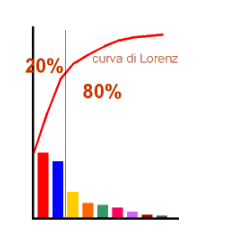
Figure 1,3 diagramme de Pareto.
Le diagramme de Pareto est la combinaison d'un histogramme et d'une courbe qui permet d'estimer à coup d'oeil quels sont les éléments importants et combien ils enregistrent. Lorsque la courbe s'aplatit les éléments eux-mêmes sont peu importants, lorsqu'elle augmente on se retrouve face à des éléments importants. Dans le domaine économique, divers exemples sont possibles :
- Avec 20% des produits d'une entreprise manufacturière multiproduite, 80% du chiffre d'affaires est réalisé.
- 20% des membres d'un produit, constituent 80% de sa valeur.
- 20% des clients réalisent 80% du chiffre d'affaires.
La direction, à la suite de cette considération, a compris qu'il était possible d'appliquer la même loi également pour le domaine acquis et pour la quantité dérivée suivante :
"20% des fournisseurs, procuration à l'entreprise 80% de la valeur des fournitures", Par conséquent nous aurons que 80% des fournisseurs fournissent un simple 20%".
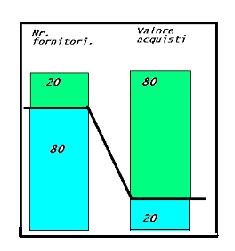
Fig. 1.4 : Relation graphique approvisionnement/achats.
Dans le schéma rapporté ci-dessus, nous pouvons observer précédemment combien expliqué dans la "loi de Pareto", dans laquelle il est expliqué comme 20% de l'offre totale même fournit 80% du total de combien vient acquis. Pour vérifier et confirmer telle théorie, on réalise généralement une analyse croisée entre le Nr. des fournisseurs et du chiffre d'affaires et une autre entre le code article et le chiffre d'affaires. Nous pourrons ainsi définir ce pourcentage d'actifs, comme médecins-chefs pour l'entreprise et les cataloguer comme actifs stratégiques, pour lesquels l'entreprise a intérêt à gérer directement. Les 20 % restants des actifs sont fournis par le plus grand nombre de fournisseurs, soit 80 % et ils traitent ces actifs à faible coût et ne les considèrent pas stratégiques. Gérer la formation ainsi nourrie des fournisseurs pour l'entreprise se traduit par une grande perte de forces et d'argent. De cela on déduit que l'entreprise doit concentrer toutes les ressources disponibles sur le premier groupe d'actifs et confier l'achat de selon groupe d'actifs à des entreprises spécialisées dans l'approvisionnement intégré. Puisqu'il s'agira seulement de ce dernier de contacter les différents fournisseurs, éventuellement d'en essayer aussi du nouveau, et de livrer les différents matériels à l'entreprise pétitionnaire, avec une conséquente diminution des coûts comme cela viendra plus en avant expliqué dans les pages.
1.12. L'analyse du portefeuille acquiert.
1.12. L'analyse du portefeuille acquiert.
Les politiques d'achat, tendant de manière généralisée à une intégration de plus en plus étroite avec le marché de l'offre, impliquent des changements profonds dans la gestion des relations et les systèmes de gestion et de contrôle économique des approvisionnements. La politique d'achat devra donc être différenciée en fonction du moment historique vécu de l'entreprise et des contingences internes (type d'entreprise, niveau de maturité des achats.) et externes (concurrence, caractéristiques du marché de l'offre.) variables dans le temps et fortement liées à la position concurrentielle de l'entreprise. Il n'est donc pas possible de définir des règles de comportement et de fixer des politiques d'achat valables de manière généralisée mais, dans le cadre d'inspirations communes, il est possible de définir des modalités d'analyse des achats au portefeuille qui fournissent les bases pour la construction d'un système personnalisé d'approvisionnement en gestion du parc. Le système s’articule en trois éléments principaux :
- Subdivision du portefeuille en classes de biens.
- Importance de l'analyse - repérire.
- Localisation du politique pour la classe.
1.12.1 Subdivision du portefeuille en classes de marchandises.
TTous les produits et services acquis devraient vous être regroupés en classes de biens, définis comme avec des produits et services qui pour leur semblables en termes de :
- Technologies réalisées
- Matières premières courantes
- Cycles constructifs
Ils peuvent être considérés comme des achats homogènes demandés à des fournisseurs potentiellement interchangeables et chaque classe suit une tendance commune évolutive et permet de définir une logique commune de gestion. La classe dépend du moment où l'entreprise décide d'acquérir le produit et du moment où le marché de l'offre introduit le client.
1.12.2 Importance de l'analyse - reperire.
Pour caractériser de manière simple l'indice de critique d'une classe de biens, il est nécessaire d'en analyser deux déterminants en fonction de : l'importance relative sur le chiffre d'affaires d'achat et sa reperience sur le marché.
- L'importance est essentiellement déterminante sur le plan économique et dans quelle mesure il faut estimer le volume d'une classe de marchandises qui affecte le chiffre d'affaires des achats. En première approximation, on peut considérer de grande importance les classes qui facturent un quota moyen plus grand - égal au 2-5% du total des achats. Dans le cas d'achats très dispersés sur de nombreuses classes de marchandises, on peut considérer comme "haute" même une classe qui arrive à 1%. Après tout, l'évaluation d'une importance faible ou élevée est relative et donc valorisée au cas par cas.
- Avec le terme "reperibilità" on veut indiquer la facilité avec laquelle un produit peut être trouvé sur le marché. Le répertoire d'une classe est donc toujours déterminé à partir du nombre de fournisseurs renommés et vous permet de vous approvisionner.
Au-delà de déterminer si une classe a un reperire élevé ou faible, il est extrêmement intéressant d'estimer les causes de l'éventuel reperire de plaine, pour pouvoir remédier éventuellement aux mises en action correctives. Les principales causes peuvent être : les liens de marché, c'est-à-dire les oligopoles et les monopoles, les liens découlant de choix commerciaux précis, les liens politiques, etc. Une manière synthétique et pratique pour représenter graphiquement le portefeuille acquis d'une entreprise, donc comme surgi de l'analyse importance - reperire, s'obtient en insérant les classes de biens dans une matrice à deux façons dans lesquelles les colonnes représentent le reperire (haut - bas) et les lignes l'importance (haut - bas). Un tel tableau, rapporté dans la Fig. 1,5, est communément appelé "matrice de Kraljic" du nom de celui qui l'a utilisé pour la première fois comme instrument de marketing. il faut seulement préciser que le répertoire et l'importance peuvent être modifiés dans le temps en fonction des changements de scène de marché et/ou de changements internes à l'entreprise.
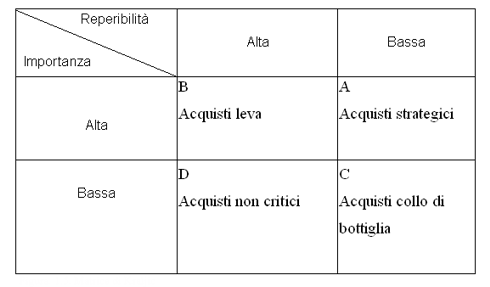
Chiffre. 1.5. Matrice de Kraljic
Sur la base de ces variables, quatre classes d'articles peuvent être caractérisées :
- A - Articles stratégiques : matériaux rares et de grande valeur, sont les matériaux les plus critiques pourquoi les plus importants pour nous pour l'entreprise et se situent pour vous sur des marchés à haut risque.
- B - Levier Articles : rédaction de matériel important pour l'entreprise, mais vous place sur des marchés peu risqués.
- C - Articles non critiques à notre égard : ils vous caractérisent en bas de l'impact sur l'entreprise et vous placent dans des marchés d'approvisionnement stables.
- D - Articles soumis à des limitations : articles avec un impact commercial très bas, mais avec des livraisons à risque.
1.12.3 Localisation de la classe politique.
Dans le tableau ramené, on peut observer les caractéristiques particulières des quadrants uniques.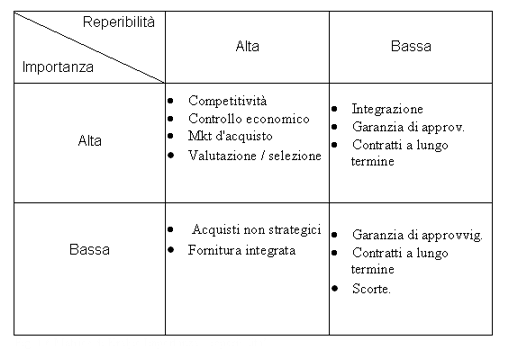
Fig. 1.6 Matrice d'importance de Kraljic - reperire.
Entre les quatre quadrants celui auquel s'adresse l'offre intégrée est celui qui se distingue de la lettre C : importance basse - reperire élevé.
Quadrant c : faible importance – haut reperire.
C'est le quadrant des achats qui ne nous critique pas. L'horizon contractuel est généralement de court-moyen terme et la connaissance des fournisseurs découle normalement de l'histoire et/ou des catalogues plus que de l'évaluation dirigée, normalement non réalisée. L'objectif principal est de garantir une chaîne d'alimentation et pour cela il y a un contrôle précis des délais d'approvisionnement afin d'éviter les ruptures de stock. Ils élaborent généralement des pièces de valeur modeste que les entreprises, pour rattraper une efficacité dans leurs travaux, ont décidé de confier à un nombre limité de fournisseurs qui fournissent tous les matériels, même si de différentes marches.1.13 Motivations à la base de l'offre intégrée.
Bien sûr, la plus importante des raisons de caractère tactique qui incitent à recourir à l'offre intégrée est liée à la nécessité de réduire ou au moins de contenir sous contrôle l'augmentation des coûts d'approvisionnement. Grâce aux économies d'échelle, que seule l'entreprise seule ne pourrait pas avancer, et à d'autres avantages liés à la spécialisation du fournisseur, l'entreprise pourra obtenir des prix plus avantageux, sans avoir mais consommé des ressources propres. En outre, les entreprises qui essaient d'accomplir toutes les fonctions en juste, peuvent engager des dépenses excessives et imprévues de recherche, développement et gestion des nombreuses relations avec les fournisseurs et telles dépenses elles devront nécessairement être transférées sur le client final sous forme d'augmentations de prix qui rendent les produits de l'entreprise moins attractifs sur le marché. D'une enquête récente, il ressort que 75 % des machines adoptées dans les entreprises italiennes sont d'origine allemande, dans le cas donc de substitution de quelque partie, l'entreprise pourrait recourir à l'approvisionnement intégré, parce qu'elle ne possède pas les ressources internes justes nécessaires en termes de capacités professionnelles spécifiques pour traiter avec des fournisseurs étrangers, et se confier à un fournisseur avec une expérience avec le pays étranger aura des avantages et aucun gaspillage d'argent. Le personnel affecté aux achats aura donc la possibilité de se concentrer sur ces achats qu'il considère comme stratégiques sans se soucier davantage des autres.
2. LES FRAIS D'APPROVISIONNEMENT
2.1. Coût total des marchandises.
Prémisse
L'objet de ceci sera l'étude des coûts opérationnels des processus d'approvisionnement, c'est-à-dire de ces coûts qu'une entreprise doit supporter pour acquérir le matériel nécessaire à son activité. Les coûts sont indépendants de la valeur du bien, c'est-à-dire qu'il vient acquis une vie simple qu'une machine entière, les coûts pour déplacer toute la machine bureaucratique seront les mêmes.
2.1. Coût total des marchandises.
Pour le coût total convient le récapitulatif des coûts logistiques et de ces accessoires, des coûts des structures, de la gestion des achats et du prix des marchandises. Les coûts logistiques sont les coûts liés à la coordination et au mouvement physique des personnes et des biens, depuis le moment de la livraison jusqu'à celui de leur emploi. Les frais accessoires, sont tous ces frais secondaires à l'achat du bien ; les frais d'assurance, les frais de douane, ceux de J'en emballe en sont un exemple.
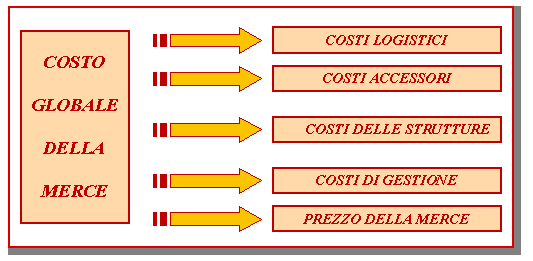
Fig. 2.1 : La composition du coût total d'un bien acquis. [Unitec GmbH, 2000]
Dans le coût total d'un bien, les coûts des infrastructures physiques doivent également être pris en compte. Un facteur particulièrement important est certainement le coût de détention d'un entrepôt, où se trouvent les stocks de marchandises. Ce coût dépendra évidemment du nombre et des particularités des actifs qu'il vous acquiert. Il est évident que telle dépense variera selon le deuxième type d'entreprise : un entrepôt construit pour 3.000 stocks séparés de témoins automobiles, exigera des caractéristiques et des dimensions diverses de celui dans lequel se conservent les jeux alimentaires périssables. Enfin, d'une grande importance, il s'avère que la voix de tout ce qui concerne les coûts d'exploitation des fournitures, les procédures et les structures organisationnelles aptes à acquérir et à gérer les livraisons des actifs nécessaires à l'entreprise. Les dépenses du personnel de chaque unité impliquée, les dépenses des communications et les coûts des systèmes informés vous rentrent à l'intérieur. Pour le prix des marchandises, on s'entend, évidemment, sur la valeur d'achat des marchandises.
2.2 La gestion des approvisionnements : introduction.
L'objectif des enquêtes réalisées auprès de l'entreprise championne chez vous a été double. Il est intentionnel en premier lieu de comprendre et d'analyser en profondeur la dynamique organisationnelle interne qui se met en mouvement pour gérer les approvisionnements, en mettant en évidence les flux qui vous sont communiqués et en définissant le temps qui s'avère normalement nécessaire pour gérer les approvisionnements. Par la suite, ils ont l'intention de quantifier les hypothétiques réductions de temps obtenables pour les mêmes activités des mêmes unités avec l'adoption de l'instrument de l'offre intégrée. Les agences commerciales de l'entreprise, impliquées dans le processus de gestion des approvisionnements se révèlent au nombre de quatre : l'unité logistique, les métiers, l'administratif et celui du central téléphonique - secrétariat. Un tel but a été pris en considération seulement ce type de fournitures, stratégiques ou non, pour lesquelles chaque agence doit disposer d'une certaine autonomie de choix et de budget sans qu'il y ait quelque nécessité d'impliquer la direction pour obtenir des autorisations particulières par exemple. Le temps et les procédures des agences de temps en temps vous ont été analysés, ont dû opposer non seulement les activités typiques et les interférences les plus communes (désorganisation des procédures, délais de livraison non respectés), mais aussi ce type d'interférences qui se manifestent transversalement aux sujets opérationnels dans l'entreprise, dans la mesure où elles sont liées à des erreurs ou des problèmes liés à l'utilisation des instruments de travail (problèmes de PC, fax, erreurs du personnel). Il s'avère que dans ce sens, vous l'avez compris, en raison des infinies variables qui peuvent différencier une entreprise d'une autre, ils n'ont pas la prétention d'être considérés comme parfaitement étendus à la vérité de toutes les entreprises, ni les projections faites doivent être considérées précises à la seconde près, dans la mesure où l'objectif d'une telle recherche est d'être simplement un témoignage et une démonstration absolument indicative, mais réaliste, de combien l'offre intégrée peut enregistrer positivement dans la gestion des approvisionnements.
2.3. La gestion des approvisionnements : les enquêtes.
2.3. La gestion des approvisionnements : les enquêtes.
Les enquêtes que vous exécutez vous-même sont relativement basées sur des fournitures de type "standard pour vous" à l'activité commerciale, c'est-à-dire pour lesquelles chaque agence doit disposer d'une certaine autonomie de choix et de budget sans qu'il y ait quelque nécessité d'impliquer la direction pour obtenir des listes détaillées d'autorisations. Pour délimiter le champ d'action d'une telle expertise, on n'a donc pas inclus le type de fournitures pour lesquelles sont nécessaires des procédures spécifiques d'approbation de la part de la direction, dans la mesure où elles dépassent l'activité normale, par rapport à laquelle chaque agence commerciale peut agir avec une certaine autonomie. Pour rendre le relevé le plus proche possible de la vérité commerciale, on a pris en considération soit les activités véritables et propres - celles-là, c'est-à-dire qu'en bref, elles représentent le noyau des activités réalisées -, que les interférences directement liées à l'activité, que celles "transversales", qui se produisent, c'est-à-dire indépendamment de l'activité réalisée puisque liées à la structure organisationnelle ou aux instruments à travers lesquels on travaille. Tableau 2.2. rapporté dans la page suivante, revient tous les mouvements quotidiens vous concernant les approvisionnements de matières premières, semi-finis, produits finis et échanges encore, qu'il représente la base sur laquelle ils ont été puis vous calcule les délais moyens par unité. Comme on peut facilement observer, l'entreprise championne des jours demande et reçoit environ 10 offres de prix de ses fournisseurs, dont seulement 7 viendront alors mais changées dans l'ordre. Ce scostamento de valeurs entre le nombre d'estimations et de commandes, dérive de la nécessité pour l'entreprise de vérifier et d'écrémer les meilleures proposées disponibles. La considération que l'externalisation de la gestion des approvisionnements, en la confiant à un prestataire externe, les valeurs qui vous sont indiquées dans le tableau serait réduite à 1, avec les conséquences faciles imaginables qui s'avèrent immédiates sur les coûts directs et indirects et l'efficacité de l'entreprise que cela entraînerait.
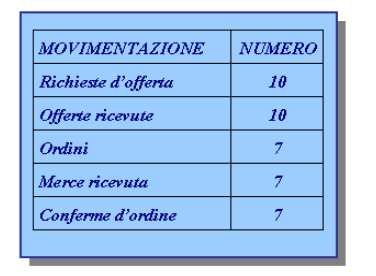
Onglet 2.2 : Movimentazione moyenne quotidienne dans le cycle des approvisionnements.
Dans le tableau 2.3, on a par contre trouvé les fréquences moyennes et le type de moyens que vous utilisez de l'entreprise dans les processus d'approvisionnement. L'utilisation insuffisante des technologies Internet pour les communications avec les fournisseurs (e-mail, fax, fusil automatique) est particulièrement intéressante. On peut remarquer en effet que l'entreprise pour envoyer ses propres demandes d'offre a utilisé le fax principalement manuel, bien qu'elle soit dotée d'un logiciel système pour la gestion "sans papier" de l'entreprise. Ceci laisse penser que peut-être la chaîne d'approvisionnement dans laquelle l'entreprise en question trouve à opérer, n'est pas suffisamment intégrée commercialement, pour laquelle j'utilise des logiciels de systèmes pour les connexions avec les fournisseurs, ne se révèle pas suffisamment développée. Gérer le passage de l'information à travers des systèmes traditionnels comme le téléphone, le fax et le courrier, s'avère plus coûteux que ce que cela pourrait être si on utilisait des technologies à l'avant-garde comme Internet, puisqu'il y aura une diminution des coûts directs, un passage d'information plus rapide et sûr, des interférences moindres et du matériel papier mineur à gérer. Il est probable qu'un tel instrument sera utilisé principalement dans le cas où le projet de loi du Parlement visant à donner à l'e-mail la même valeur qu'une lettre recommandée sera approuvé.
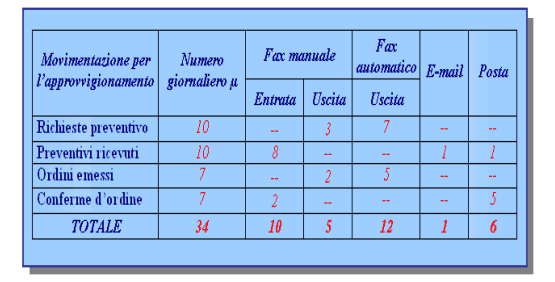
Languette. 2.3 : Les médias vous utilisent dans un cycle quotidien de livraisons de l'entreprise.
2.4. Enquête sur les temps de gestion d'un processus d'approvisionnement.
2.4. Enquête sur les temps de gestion d'un processus d'approvisionnement.
Pour l'étude des temps, nécessaire pour réaliser un processus d'approvisionnement, on a compilé d'Unitec GmbH un module approprié, dans lequel un tel processus est micro décomposé en beaucoup d'activité, ce qui à l'apparence pourrait sembler aussi peu banal et compte, mais qu'en revanche dans leur complexe ils portent le processus pour rattraper des temps beaucoup cela vous élève. Ces micro-activités ont été regroupées en sept grandes activités qui, en fin de compte, représentent les étapes d'un tel processus. Le premier groupe est composé de tous ces devoirs qui ont comme objectif final celui d'émettre celui demandé d'approvisionnement vers les possibles fournisseurs. La localisation des fournisseurs possibles exige des temps longs surtout beaucoup si celui dont l'entreprise a besoin est du matériel qu'elle n'a jamais acquis avant. Les spécifications seront données dans l'ordre dans les pages suivantes. La deuxième étape groupe par contre toutes ces activités nécessaires pour la gestion des demandes d'offre, c'est-à-dire expédition dans les délais express des demandes et prochaine constante d'invite pour avoir des délais rapides de réponse de la part d'une partie des fournisseurs. Poichè surtout quand vous avez besoin d'actifs relatifs au maintien des systèmes, il peut arriver qu'il y ait des lignes et des productions fermes, et pour ne pas avoir ainsi un choc de la production, il s'avère indispensable d'avoir le matériel demandé dans un jour. L'étape de tiers regroupe par contre toutes les activités de gestion des offerts, depuis leur collecte jusqu'au prochain contrôle de ceux qu'ils vous donnent et par conséquent choisi de qui offre le matériel au prix le plus compétitif. Les activités du quatrième groupe sont réalisées en ayant comme objectif l'expédition de la commande au fournisseur, avec une éventuelle confirmation de la commande. Ces quatre premières étapes, s'effectuent principalement à partir de l'unité commerciale ou du bureau qu'elle acquiert et on pourrait les définir comme les activités nécessaires pour organiser l'approvisionnement. Le cinquième passage représente plutôt la gestion du matériel acquis. Après toute cette série de passages de documents entre une entreprise et l'autre, la marchandise arrive dans l'entrepôt où elle arrive contrôlée du affecté à la logistique confrontée à vous remettre les documents qui l'accompagnent. Par la suite ils communiqueront aux autres agences l'arrivée du jeu des marchandises et donc il y aura l'insertion du cadeau dans le système. Le processus se terminera évidemment par la réception de la facture et le paiement relatif des marchandises de la part de l'unité administrative. Les temps collectés et ramenés dans le Tab. 2,4 sont aliquotes et calculent de manière à vous en finir avec le début de l'opération suivante. Dans une telle mesure, les éventuelles interférences ont été comptées aussi tout ce qu'elles peuvent être vérifiées ; c'est-à-dire n'importe quel événement qui va interférer avec la linéarité d'un processus, qui porte les retards et les inefficacités à l'intérieur.
| À l'émission demandée de fourniture. |
| Activité | Heure |
| 1- Besoins de vérification de la fourniture | 5' |
| 2- Accès au système de communication responsable de l'agence. | 5' |
| 3- Compilation demandée. | 4' 30" |
| 4- Vérification et approbation demandée. | 5' 25" |
| 5- Envoyer les acquisitions au bureau. | 6'40" |
| 5-a Aller au fax. | 1'40" |
| 5-b Écrivez le numéro. | 1' |
| 5-c Connexion et déconnexion. | 2' |
| 5-d Attendre la confirmation. | 1' |
| Archives 5-e. | 3' |
| 6- Réception et évaluation des demandes. | 10' |
| En cas de nouveau fournisseur : | |
| 7-a Rechercher parmi les différentes sources | 15' |
| 7-b Code du fournisseur. | 8' |
| Dans le cas d'un fournisseur déjà présent dans le système : | |
| 7-c Approché le système : recherche article et fournisseur éventuel. | 20' |
| 8- Formalisation de la demande | 4' |
| 9- Invite de l'unité logistique au bureau qu'elle acquiert par courrier. | 2'40" |
| 10 Invite de l'unité logistique au bureau qu'elle acquiert par fax. | 5' |
| 11 Invite de l'unité logistique au bureau qu'elle acquiert par téléphone. | 5' 20" |
| Temps partiel | 82' 15" |
| Interférences temporelles : | 30' |
| Temps total pour l'émission demandée : | 118' 15" |
| B- La direction a exigé des estimations. |
| Activité | Heure |
| 12- Expédition demandée à offrir aux fournisseurs. | 8' 40" |
| 12-a Aller au fax. | 1'40" |
| 12-b Écrivez le numéro. | 1' |
| 12-c Connexion et déconnexion. | 2' |
| 12-d Attendre la confirmation. | 1' |
| 12-eArchives. | 3' |
| 13- Accès au système : demande "inevase". | 5' |
| 14- Presser la liste des fournisseurs qui n'ont toujours pas répondu. | 2' |
| 15- 1* Fourniture rapide afin d'obtenir les devis par fax. | 8' 40" |
| 15-a Aller au fax. | 1'40" |
| 15-b Écrivez le numéro. | 1' |
| 15-c Connexion et déconnexion. | 2' |
| 15-j Assister à la confirmation. | 1' |
| 15-eArchives. | 3' |
| 16- 2 * Invite afin d'obtenir les estimations par courrier. | 5' |
| 17- 3 * Invite afin d'obtenir les devis par téléphone. | 6' |
| Temps partiel : | 35' 20" |
| Interférences temporelles : | 16 ' |
| Temps nécessaire à la gestion du devis total : | 51' 20" |
| Gestion c proposée. |
| Activité | Heure |
| 18- Réception des devis. | 10' |
| 19- Accès au système. | 5' |
| 20- Analyse proposée. | 20' |
| 21- Contrôler la correspondance des offres qui vous sont adressées. | 5' |
| 22- Prix d'expertise et modalités de livraison. | 5' |
| 23- Contact avec les fournisseurs afin de négocier le devis reçu | 20' |
| 24- L'insertion des offres vous est offerte dans le système. | 5' |
| 25- L'exactitude de la vérification vous est donnée. | 5' |
| 26- Comparazione avec les autres proposés | 10' |
| 27- Sélection de l'offre. | 5' |
| 28- Éventuelles clarifications ultérieures avec le fournisseur. | 10' |
| 29- Expédition offerte pour approbation technique. | 8' |
| 30- Évaluation technique de l'offre. | 10' |
| 31- L'approbation technique d'expédition au bureau est acquise. | 8' |
| 32- Agrément technique de réception. | 2' |
| 33- Enregistrement de ceux proposés | 2' |
| Temps partiel | 130 ' |
| Interférences temporelles : | 30' |
| Temps offert en gestion totale : | 160 ' |
| D- Gestion des commandes. |
| Activité | Heure |
| 34- Préparation de la commande. | 5' |
| 35- Appuyez sur la commande. | 2' |
| 36- Entreprise d'agrément. | 3' |
| 37- Expédition par fax ou courrier de la commande | 8' |
| 38- 1 * Inviter les fournisseurs à confirmer la commande par fax. | 8' |
| 39- 2 * Inviter les fournisseurs à confirmer la commande par courrier. | 5' |
| 40- 3 * Inviter les fournisseurs à confirmer la commande par téléphone. | 6' |
| 40- Confirmations de commande de réception | 3' |
| 41- Contrôler la confirmation de la commande. | 4' |
| 42- La modernisation vous donne du système. | 5' |
| 43- Enregistrement des confirmations de commande. | 5' |
| Temps partiel : | 54' |
| Interférences temporelles : | 30' |
| Temps total des ordres de gestion | 84 ' |
| Et contrôle de l'arrivée des marchandises. |
| Activité | Heure |
| 44- Aller en entrepôt | 5' |
| 45- Accepter le colis | 6' |
| 46- Stock et contrôle. | 7' |
| 47- Temps pour prendre les Archives. | 2' |
| 48- Rechercher des commandes. | 5' |
| 49- Comparazione des offres qui vous sont proposées. | 3' |
| 50- Éventuelles clarifications avec le bureau d'acquisition | 5' |
| 51- Bulle d'enregistrement. | 5' |
| 52- Enregistrement des documents. | 5' |
| 53- Accès au système. | 3' |
| 54- L'enregistrement vous donne la marchandise. | 5' |
| 55- Enregistrement des confirmations de commande. | 5' |
| Temps partiel : | 56' |
| Interférences temporelles : | 60 ' |
| Contrôle total des délais jusqu'à l'arrivée des marchandises : | 116 ' |
| F- Réception de la facture du fournisseur. |
| Activité | Heure |
| 56- Collecte du courrier aux revenus. | 5' |
| 57- Déplacement. | 15' |
| 58- Le contrôle vous remet en facture avec ceux rapportés dans le système. | 5' |
| 59- Le contrôle vous remet en facture avec ceux ramenés dans la bulle. | 7' |
| S'ils vous donnent ils correspondent : | |
| 60- Accès au système. | 5' |
| 61- Enregistrement du donne de la facture. | 6' |
| S'ils vous donnent ils ne correspondent pas : | |
| 62-a Appel téléphonique au fournisseur pour des précisions. | 7' |
| 63-b Communication au bureau acquiert du requérant. | 3' |
| 64- Modifications éventuelles des enregistrements. | 4' |
| Temps partiel : | 57' |
| Interférences temporelles : | 30' |
| Délai total de réception de la facture : | 87' |
| G- Paiement de la facture. |
| Activité | Heure |
| 65- Accès au système. | 5' |
| 66- Vérification de la situation des paiements à l'expiration. | 10' |
| 67- Appuyez sur la liste des paiements en expiration. | 2' |
| 68- Accès au système | 5' |
| 69- Préparation de l'ordre de paiement pour la banque. | 5' |
| 70- Presser l'ordre de paiement | 2' |
| 71- Approbation du paiement. | 5' |
| 72- Enveloppe et affranchissement. | 1' |
| 73- Positionnement en "mail en évasion". | 2' |
| Temps partiel : | 37' |
| Interférences temporelles : | 20' |
| Délai total de réception de la facture : | 57' |
Tab.2.4 Enquête sur les temps de gestion d'un processus d'approvisionnement.
Dans les pages suivantes, nous expliquerons les principales activités qui composent le processus d'approvisionnement.
2.5. Émissions demandées pour l'approvisionnement.
2.5. Émissions demandées pour l'approvisionnement.
A-1. Vérification fournissant la nécessité. La nécessité d'approvisionnement des unités productives résulte du système à travers lequel l'entreprise est gérée : dans celui-ci en effet sont ramenés les niveaux optimaux d'approvisionnement qui sont effectivement disponibles soit des matières premières et des semi-finis pour la production, soit des marchandises de type B et C (low cost pas stratégique 19 ). Quotidiennement en effet ils viennent vous effectuent cinq vérifications des affectés à l'unité logistique des niveaux actuels de marchandises en entrepôt.
A-2 et 3. Accès au système, compilation et expédition de la communication concernant la nécessité au responsable de l'agence. Après avoir effectué un des cinq contrôles quotidiens, si l'entrepôt devait déclarer que la quantité d'un matériel a déjà rattrapé presque l'approvisionnement d'urgence, après avoir vérifié aussi la quantité qui est ramenée dans le système, il enverra une communication à l'organisme compétent. La demande détaillée devra évidemment être grande, puisque la personne du bureau qui achète pour la dernière fois la demande recevra, n'étant pas un technicien, n'aura pas les compétences pour pouvoir seule élaborer tel document de manière correcte et précise. Donc au-delà du montant, l'entrepôt devra indiquer les caractéristiques techniques, en indiquant également tous les codes en sa possession.
À 4. Vérification et approbation demandée, je transmets au bureau acquiert. Surtout s'il s'agit d'une grande entreprise de dimensions, la procédure bureaucratique s'allonge, comme dans le cas de nous considéré. Comme le magasinier peut lui-même être observé depuis la table, en fait, il n'envoie pas directement sa demande au bureau d'acquisition, mais les demandes viennent se joindre à l'agence spécialisée pour ce matériel. Il s'agira donc d'un pour les électriciens matériels pour les mécaniciens et donc au deuxième de la nature du bien, l'entrepôt enverra sa demande à une agence diverse. Une telle agence donc après avoir contrôlé telle demande l'envoie au bureau acquiert, qui à son tour se tournera vers le fournisseur compétent.
A-5. Réception et évaluation des demandes. Toutes les demandes d'approvisionnement sont donc envoyées aux affectés de l'unité commerciale. Il pourrait sembler que ces personnes accomplissent un travail secondaire purement exécutoire, c'est-à-dire envoyer simplement les demandes déjà prêtes aux fournisseurs. Une telle unité a par contre une touche de fonction : les chargés ont en effet la tâche de se connecter et de gérer dans le temps les relations qui s'échangent dans la ligne productive à monter avec les fournisseurs et avec les clients. En bref, elle peut être définie comme le centre de promotion et de gestion des transactions, sans parler de l'interface de l'entreprise dans les relations qui s'établissent avec des sujets externes. Juste pour les raisons aussitôt citées, l'unité les échange, elle les retrouve toujours au centre des échanges d'informations avec toutes les autres unités. Après avoir reçu telles demandes, le contrôle assigné qu'ils vous donnent les ramène et vérifie s'il y a une couverture budgétaire adaptée. Comme n'importe quelle entreprise, même l'entreprise championne a besoin d'une immense gamme de matériel, vient vous chercher des articles dans les archives ERP. Pendant ce contrôle dans le système, l'opérateur comprendra s'il s'agit d'un matériel déjà préalablement acquis ou s'il est avant le moment où une telle vérification de nécessité :
- Une fois compris ce projet d'achat déjà effectué antérieurement et caractérisé type et quantité de marchandises à fournir, ils viennent préparer les demandes de devis pour ces fournisseurs, puis dans les passages de fournitures ils nous ont offert le matériel avec une bonne qualité à un bon prix.
- Dans le cas où par contre il s'est avéré qu'il n'a jamais été préalablement acquis ou qu'il a même été convenu un élargissement d'approvisionnement du parc, même si tel cas s'avère mais être très rare puisqu'une telle recherche exigerait du temps ultérieur, on procède justement à la recherche de nouvelles sources d'approvisionnement. Une telle recherche s'effectue principalement sur catalogue et, dernièrement, également via Internet. Dans cette phase ils viennent prendre les premiers contacts dans lesquels on commence à parler des conditions de paiement, des conditions de livraison dans le cas d'une commande. Comme on peut facilement comprendre codifier un nouveau fournisseur dans le simple portefeuille, la dispersion temporelle implique fortement et un allongement des délais de livraison.
A-8. Formaliser la demande d'offre. Après avoir donc recherché le fournisseur et l'article dans le système, la demande arrive publication imprimée et signée des personnes compétentes pour ce matériel après quoi la demande de devis est envoyée à tous les fournisseurs appropriés pour ce type de fourniture. Pour réaliser les activités, les assignés ont besoin d'au moins 08h 20' 40 "par semaine pour élaborer et envoyer, en moyenne, 50 demandes de devis à la semaine 20".
À 9. Invite de l'unité logistique au bureau qu'il acquiert. Dans le cas où les fournitures en entrepôt continuent à baisser et le bureau qu'il acquiert n'a pas encore fait connaissance nulle par rapport à l'agence préalable, l'assigné à l'entrepôt émettra une communication d'invite dans les comparaisons de la commission commerciale. D'abord la demande sera faite par courrier, ensuite par fax et si un jour n'a pas encore été obtenu, une réponse sera accélérée par téléphone.
Notes 19 : Es. papier et cartouches d'encre d'impression pour, réciprocités plusieurs Notes 20 : Cela représente environ 10 minutes pour ceux
2.5.1. On a constaté des interférences dans les émissions de demande d'approvisionnement : 1ª phase.
Il s'agit de problèmes banals et communs, qui ne proviennent pas d'un poids excessif, mais qui provoquent certainement une dispersion élevée de temps et de ressources. En ce qui concerne l'envoi de fax, ces activités sont généralement réalisées à travers le fax manuel, ce qui malheureusement fait perdre beaucoup de temps au personnel, car il peut arriver que le fax de celui qui doit recevoir soit occupé ou qu'il manque du papier et qu'il doive le mettre ou qu'il y ait des problèmes de réseau et donc via. Ils peuvent aussi être des problèmes dus à des surcharges momentanées du système qui déterminent un ralentissement dans l'approche des pages souhaitées. Compris lorsque plus d'opérateurs s'en servent dans le même moment et comme on peut l'imaginer, esquisse d'un problème qui regarde indifféremment toutes les unités; évidemment l'unité les commercialise, en l'utilisant principalement dans la phase de gestion des approvisionnements, à partir des enquêtes que vous réalisez, il s'avère souffrir davantage, à titre d'exemple, de l'unité logistique. À côté des interférences liées à l'utilisation des instruments de travail, il en existe d'autres qui peuvent surgir à tout moment et qui sont liées à des erreurs du personnel. Il peut arriver en effet que le responsable de l'entrepôt en introduisant les codes vous donne des erreurs de système en l'obligeant à procéder à l'insertion d'une nouvelle série de codes ou nom. En outre, ils ont été ajoutés environ 10 minutes à la journée comme temps employé pour pouvoir déjà disposer les cols en entrepôt au cas où ultérieur il y aurait de l'espace pour une nouvelle livraison, et cela devient donc un réaménagement de la disposition des cols nécessaire.
2.6. La direction a exigé des estimations.
B-12. Expédition demandée d'offrir aux fournisseurs. La demande après avoir été préparée et signée par qui de compétence, elle est envoyée par fax aux fournisseurs qui vous ont été jugés appropriés. Aussi dans cette phase peuvent se produire les retards qu'a dû avoir l'utilisation du fax, les conséquences toujours de prendre la ligne, l'attente d'ouverture de session successive assistée et de confirmation de la réception.
B-15. Solliciter les fournisseurs afin d'obtenir les devis. Afin de rendre le processus d'approvisionnement le plus rapide possible, il est nécessaire d'avoir des délais de réponse de la part d'une partie des fournisseurs, très courts. Pour cette raison, une fois envoyée la demande de devis, si la réponse n'a pas encore été obtenue, après un délai déterminé, il commence à accélérer les fournisseurs pour l'envoyer. On a calculé que cela implique une dépense de temps, pour l'unité qui les traite, égale à environ trois heures et moyens par semaine. Une telle invitation lui arrive avant pour le courrier puis pour le fax et enfin s'il n'a pas encore obtenu de réponse, le fournisseur se contacte directement.
2.6.1. On a trouvé des interférences dans la gestion demandée du devis : 2ª phase.
Aussi pour cette phase les principaux problèmes sont les héritages de l'utilisation du fax, puisque devoir attendre chaque tour quelques minutes pour évaluer que l'envoi est allé à bon port est fait pour ralentir les activités puisque tel instrument se caractérise par le fait d'envoyer des documents lentement et avec beaucoup de difficultés.
2.7. Gestion des offres.
2.7. Gestion des offres.
D-18, Réception des devis. Une fois reçus les devis que vous souhaitez, ceux-ci viennent enregistrer - de manière à vous tenir modernisé les archives qu'ils vous remettent - et vous confronter soit aux devis précédents qu'à tous les devis des autres fournisseurs concurrents. Cela ne réussit pas toujours pour tous les articles ; généralement pour les produits déjà acquis à d'autres moments, ils nous sont confiés aux fournisseurs habituels, moins de mutations négatives dans les conditions d'achat ne se remarquent pas - dans les vérifications avec des devis antérieurs -, dans ce cas nous nous adressons à de nouveaux fournisseurs, pour qu'ils puissent offrir de meilleures conditions. Le résultat est que pour environ 10 estimations quotidiennes, environ 7 sont les commandes effectivement demandées. Ce type d'opérations nécessite environ 04h 36' 05" hebdomadaires.
J-23. Contact avec les fournisseurs afin de négocier le devis reçu. On essaie souvent d'améliorer les conditions en interagissant directement avec le fournisseur. Il s'agit pour la plupart de tenter d'obtenir des réductions de prix ultérieures, ou d'anticiper la date de livraison et généralement les conversations se font par téléphone. Il s'agit même de négociations qui arrivent assez fréquemment - pour 10 réceptions de devis, dans 6 cas le fournisseur se contacte -, le temps que vous consacrez chaque semaine est donc élevé : très 3 heures et 9 minutes.
J-27. Sélection de l'offre. Après l'enregistrement et avoir pris contact avec les fournisseurs afin d'obtenir de meilleures conditions de vente, les différents devis viendront vous comparer entre eux et viendront choisis lesquels à parité de qualité et délais de livraison auront le moindre coût.
J-30. Évaluation technique de l’offre et approbation de l’expédition. Le bureau acquéreur aura évidemment pu évaluer l'offre uniquement du point de vue économique, pour lequel l'offre reçue est envoyée en copie au bureau technique, dans le but d'évaluer si le produit offert possède les mêmes caractéristiques techniques que le matériel demandé. Cela pourrait réussir mais que les informations rapportées dans le tableau ne sont pas suffisantes pour déterminer ce que le technicien demandera ou directement au fournisseur ou de passage pour le bureau il acquiert des cartes ou vous donnera des techniques pour pouvoir être sûr du matériel qu'ils acquièrent.
2.7.1.Interférences trouvées dans la gestion des proposés : 3ª phase.
Il peut arriver qu'entre les nombreuses estimations obtenues, on en figure certaines qui vous donnent du type ou de la quantité de marchandise ou la date de livraison elles se trompent. Dans ces cas, ils viennent immédiatement vous contacter avec les fournisseurs afin de corriger les erreurs apparues. Dans la plupart des cas, il s'agit d'erreurs banales qui, sans entraîner de modifications significatives des termes de la fourniture proposée, suffisent pour remplacer directement l'information erronée dans le système, sans qu'il y ait nécessité de l'envoi d'un nouveau devis. Plus très rarement des brouillons que des erreurs qui, au lieu de cela, changent les fins. Dans ce cas, il est demandé expressément l'élaboration et l'envoi d'un nouveau devis. Le temps trouvé moyen hebdomadaire pour ces opérations est d'environ 22 minutes.
2.8. Gestion des commandes.
D-34. Préparation des commandes. La préparation des commandes se fait toujours à travers le système informatique et après avoir été signés par le directeur de tels documents d'achats qui arrivent, ils sont généralement envoyés au fournisseur avec le fax. Cette phase nécessite des hebdomadaires de 05h 27' 15" d'ailleurs ces documents devront alors aussi être des archives.
D-38. Inviter les fournisseurs à confirmer la commande. Pour pouvoir procéder en cas d'urgence et surtout pour avoir la certitude que les délais de livraison vous arriveront en respectant les fournisseurs, il est nécessaire de la confirmation de commande qui est généralement tardive à arriver.
J-40. Confirmations de commande de réception. La réception et l'enregistrement dans le système des confirmations d'acceptation des commandes nécessitent près d'une heure par semaine. La plupart des fournisseurs envoient ces documents par courrier ordinaire, pour lesquels il peut arriver tout à fait ultérieurement qu'ils arrivent peu avant l'arrivée de la marchandise ou bien. L'importance des confirmations de commande réside dans la possibilité de vérifier qu'elles vous sont remises concernant la marchandise rangée, mais, à ce stade du processus de livraison, il y a très rarement des erreurs ou des incompréhensions, pour lesquelles l'importance du document reste limitée à la seule valeur de preuve juridique. Les moyens postaux sont utilisés par les fournisseurs pour l'envoi des confirmations de commande, bien que ce ne soit pas un moyen express pour faire circuler l'information.
D-43. Enregistrement des confirmations de commande. Une fois enregistrées depuis l'unité de négociation dans le système, les confirmations d'ordres reviennent au central téléphonique-secrétariat de l'unité qui se charge de leur enregistrement. Le temps nécessaire au magazine hebdomadaire est de 31' 30 "à la semaine.
2.8.1. Interférences constatées dans la gestion des commandes : 4ª phase.
Comme on a souvent compris que les délais promis dans la confirmation de commande alors au moment de la livraison ne vous arrivent pas, il est nécessaire de mettre en œuvre des mesures de précaution afin de contrôler les livraisons et d'éviter ainsi des retards inutiles et inefficaces. Une fois par jour, il arrive en effet reçu de l'unité commerciale une liste contenant les noms des fournisseurs qui sont en retard de livraison et ils vous donnent des jeux de marchandises de référence. Cette liste est contrôlée par le croisement des donneurs en possession de l'unité logistique, si nécessaire, levée et restituée à l'unité qu'ils commercialisent. Dans le but de maintenir la base de livraison modernisée, ils effectuent chaque jour 4 contrôles sur l'état de livraison des fournisseurs, de manière à pouvoir prévenir d'éventuels retards ou erreurs. Ces opérations nécessitent un total de 01h 24' 25" magazine hebdomadaire. Entre les interférences auxquelles se trouve confrontée l'unité logistique, les promptes informations aux fournisseurs pour des livraisons qui arrivent en retard, demandent toujours beaucoup de temps. Ceux-ci viennent directement de l'unité logistique afin de ne pas augmenter la taille du travail de l'unité commerciale, car cette agence possède cependant les compétences et vous les donne pour pouvoir fonctionner. Pour le premier le prompt, habituellement, les moyens les plus utilisés sont le fax. Pour partir selon la demande, cependant, il est préférable d'utiliser le téléphone, dans la mesure où il permet de parler directement avec la personne intéressée et d'obtenir ainsi vous trouvez plus express. On pourrait penser qu'une telle activité se réalise en rasage mais malheureusement ce n'est pas le cas, moyen en effet 2 livraisons sur 7 sont en retard 14 et parmi celles-ci, la moitié demande des accélérations ultérieures et des explications jusqu'à un troisième degré d'invite. Les motivations des retards qui se sont révélées les plus fréquentes ont été :
- Erreurs d'appréciation des fournisseurs sur la disponibilité ou la capacité à produire à l'unité les demandes lors du devis.
- Erreurs dans la transmission des conditions de livraison, telles que pour porter le fournisseur de l'entreprise au bloc et le total partiel ou de l'opération.
- Erreur et interférence interne du fournisseur ou du transporteur (par exemple erreur du personnel dans la retransmission de la commande, erreur sur la date de livraison).
- Erreurs et interférences dans la relation fournisseur-transporteur (difficulté dans la transmission des données corrigées, erreurs d'interprétation dans les dates, problèmes dans les accords contractuels).
- Erreur du transporteur dans la livraison car en possession ils vous donnent tort.
Notes 14 : En valeur pourcentage 28,56%
2.9. Contrôle à l'arrivée des marchandises.
2.9. Contrôle à l'arrivée des marchandises.
E-46. Stockage et contrôle. Ce contrôle est exécuté par les affectés de l'unité logistique, qui accomplissent les tâches délicates nécessaires au fonctionnement de l'entreprise. Les affectés de telle unité ont en effet la tâche de recevoir les marchandises, de contrôler et de vérifier leur correspondance avec les documents de transport et l'ordre émis par l'unité en même temps de les échanger et de gérer la movimentazione d'entrepôt et de soigner la préparation des marchandises en évasion. Ce contrôle est composé d'une micro activité qui consiste à aller en entrepôt, à accepter le colis, à contrôler le stock, à signer le document de transport et à retourner sur place. Une fois à sa place, le assigné doit rechercher la commande contenue dans un des nombreux classeurs et se confronter à la bulle, avec la commande et la remise qui vous sont ramenées dans le système.
E-49. Comparazione de vous offre. La bulle de transport qui accompagne la marchandise, en fait après qu'elle soit contrôlée, est insérée dans le logiciel de gestion du système, de sorte que n'importe quel opérateur ait la possibilité de voir et de travailler avec nous. Celui-ci viendra cependant seulement enregistré dans un classeur approprié mais pour un fin fiscal, puisque tous pourront le trouver dans le système. Ici aussi, comme pour toutes les activités traitées ultérieurement, on a calculé un 5% comme "temps dispersé", que l'on va ajouter aux temps trouvés dans le but de maintenir les temps les plus adhérents à la vérité de la période moyenne.
2.9.1. Interférences constatées dans le contrôle des marchandises : phase 5ª.
Cela peut réussir, mais le résultat d'un tel contrôle est une question de différences. La marchandise livrée est erronée en termes de quantité ou de type. Dans ce cas l'unité logistique a pour tâche de contrôler les offres et d'informer l'unité commerciale et administrative, de la manière que la première puisse procéder dans les comparaisons des fournisseurs. La constatation de la mauvaise livraison dans le montant et le type de la marchandise, se fait à travers la vérification des données contenues dans la commande, dans la facture et dans la bulle de livraison présente dans le système et les délais nécessaires pour réaliser ces opérations sont de 12' 53 "à la semaine. Les marchandises livrées, à la suite du contrôle, pourraient également se révéler complètement endommagées en partie ou. Dans ce cas également, ils viennent informer l'employé qui vous est assigné de l'unité commerciale - administrative, pour pouvoir obtenir le remplacement de pièces. Les temps nécessaires pour réaliser ces opérations sont de 12' 10" par semaine. Afin de caractériser exactement le jeu de marchandises, la commande, le fournisseur et le transporteur de référence sont réexécutés au contrôle de remise dans le système.
2.10. Réception de la facture du fournisseur.
F-58. Le contrôle vous remet en facture avec ceux ramenés dans le système. Les factures sont généralement livrées par le transporteur avec la marchandise, mais le cas envoyé dans lequel la facture ne manque pas est différé et donc par courrier après la livraison de la marchandise. De manière généralisée les factures de courrier viennent directement prises et remises au bureau administratif, qui se charge d'effectuer une vérification croisée : elles viennent se confronter en effet vous sont remises dans le système avec celles de la facture, des devis reçus et des commandes qu'il vous envoie. Après une telle vérification, les fins de facture vous sont enregistrées dans le système, et les factures sont remises à l'unité central téléphonique-secrétariat pour l'enregistrement.
2.10.1. Interférences constatées dans la réception de la facture du fournisseur : phase 6ª.
Le contrôle des factures arrivées, peut mener à la découverte de données erronées ou manquantes ; il peut arriver en effet que les marchandises arrivées ne correspondent pas à ces exigences, ou qu'elles présentent des abrasions qui empêchent la compréhension claire des codes. Dans ce cas on procède en informant via le système l'unité qui les négocie, ce qui procède en exigeant au fournisseur roi-de vous envoyer tous les doutes, et, si nécessaire, d'émettre une nouvelle facture. Interférences de cette époque capitaine de rasage, avec une fréquence d'environ 2% concernant les factures arrivées ; en tout cas, le temps moyen nécessaire pour résoudre le problème s'élève à 8 minutes et signifie par semaine.
2.11. Paiement de la facture.
G-63. Préparation de l'ordre de paiement pour la banque. Une fois par jour, le responsable de l'unité administrative contrôle la situation des paiements en expiration et ensuite il imprime telle liste pour pouvoir plus facilement préparer et envoyer à la banque par courrier, les documents et les finalités pour le paiement des fournisseurs, en commençant par vous les remettre dans le système. Rédiger des opérations qui sont effectuées chaque jour, dans le but de vérifier le bon résultat des paiements, généralement en compte courant. C'est pour cela qu'il contacte la banque à laquelle l'entreprise est confiée, et il s'assure qu'il ne s'agit pas de problèmes de quelque type que ce soit. Si aucun problème ne se produit, le temps nécessaire pour ce type de contrôle est de 57' 45" hebdomadaire. Après l'enregistrement dans le système, une telle unité livrée au central téléphonique et les factures d'archives arrivent.
2.11.1. Interférences constatées dans le paiement des factures : phase 7ª
Aussi pour l'unité administrative on a enregistré des interférences dans le domaine des activités liées aux approvisionnements. il est possible que des problèmes surviennent qui empêchent l'exécution des paiements aux fournisseurs ; une telle situation peut être trouvée et résolue rapidement grâce aux contrôles que le bureau administratif prédispose chaque jour, ou bien la même banque peut s'activer et communiquer le problème. Dans la plupart des cas où cette vérification, la cause est due à des erreurs principales de transcription ou de communication du paiement, qui peuvent se révéler erronées ou incomplètes. De toute façon, la situation est normalement de situation simple, et demande peu plus de 17 minutes par semaine. D'autres interférences peuvent être vérifiées à la suite de l'utilisation de l'ordinateur et du système ERP, des erreurs de frappe et des corrections relatives et des problèmes de recherche de documents, que, dans le cas spécifique de l'administration, sont les factures. Cependant une telle incidence sur les activités réalisées s'avère plutôt faible. Les problèmes et les ralentissements de l'ordinateur se produisent avec une fréquence sûre aussi pour l'administration, en occupant plus d'une heure par semaine ; les erreurs de transcription ou de chiffre qui vous sont données et les informations qui vous sont apportées corrigées, par contre, demandent environ 47 minutes par semaine. En outre, on peut perdre beaucoup de temps à trouver des factures qui ne sont pas immédiatement caractérisées ; même si en apparence ce qui peut paraître d'une importance insuffisante, il suffit de quelques secondes pour chaque document traité afin de disperser des minutes précieuses pour les activités du bureau. Dans le cas concret, le temps dispersé pour cette raison est en moyenne d'environ 39 minutes par semaine.
3. CAS UNITEC
3.1. Bref historique.
3.1. Bref historique.
Unitec High Tech Industrieprodukte Vertriebs GmbH (Gesellschaft mit beschrankter Haftung) est une entreprise à responsabilité limitée dont le siège est à Augsbourg (Allemagne), qui travaille dans le domaine du commerce des membres industriels. L'entreprise est née à la fin des années 80 sur initiative d'un entrepreneur italien, Marino Vincenzo, puis après d'importantes expériences professionnelles dans le domaine des grands systèmes d'automatisation pour la construction de véhicules automobiles à niveau mondial, il est décidé de fonder Unitec pour offrir directement une assistance qualifiée en Allemagne à des entreprises du secteur métallurgiste et mécanique, électronique et de la distribution. M. Marino pensait en effet que les entreprises qui ont commencé à resserrer dans ces nouvelles années des relations commerciales avec des entreprises situées dans des marchés géographiquement éloignés auraient pu répondre aux problèmes de caractère opérationnel et managérial dans la logistique et les approvisionnements. Ils auraient couru le risque de trop fragmenter les approvisionnements et de ne pas réussir donc à coordonner les approvisionnements également d'un point de vue temporel. UNITEC, s'est donc placé comme mandataire d'un pays étranger acheteur de telles entreprises, qu'elles se sont révélées en réalité dépourvues de connaissances spécifiques du nouveau marché dans lequel ils allaient opérer. Au-delà de celui de type linguistique, il est devenu en effet indispensable de disposer de toute une série de ressources managériales utiles pour mettre en œuvre une intégration des processus opérés chez vous, logistiques et formés (les tâches aux diverses normes douanières nécessaires et pour les douanes des produits ne vous sont déjà acquises). UNITEC, a réalisé ainsi de nouveaux services, à haute valeur ajoutée, qui se sont révélés d'une extrême importance pour telles entreprises et ont décrété l'avènement d'une telle entreprise dans le secteur des services. Il a fallu par conséquent revoir et moderniser la structure organisationnelle, afin de répondre exactement aux sollicitations nouvelles et diverses auxquelles elle était subordonnée ; c'est dans cette phase qu'une attention particulière a été portée à l'efficacité des processus d'affaires. Grâce à cela, Unitec a acquis une plus grande compétitivité et a commencé à définir avec plus de précision les services de fourniture. Des expériences mûries en fait, se sont révélées évidentes comme, d'une manière généralisée, les procédures commerciales contenaient d'énormes gaspillages cachés, en particulier pour le soin de la gestion des approvisionnements et pour l'activité relative de bureau, qui, après tout, ne réussissent jamais à entrer en régime. Pour cela la fourniture intégrée comme méthode a été proposée aux entreprises clientes afin de vous procurer des avantages logistiques, des actes de gestion et des remarquables. Un ultérieur saut de qualité s'est réalisé dans la moitié des années 90 grâce à l'informatisation complète du flux de travail d'affaires : aujourd'hui Unitec dispose en effet d'un système logiciel ERP réalisé entièrement selon les exigences de l'entreprise, à travers lequel il réussit à gérer en temps réel tout le processus d'approvisionnement, en concourant à obtenir des économies continues sur la gestion de l'information, sans se limiter au matériel papier. Dans la seconde moitié des années '90, Unitec a abandonné le schéma organisationnel linéaire de type hiérarchique, non adapté pour supporter les rythmes d'augmentation des transactions, pour une structure matricielle, caractérisée par la division du personnel en équipe de travail. De cette façon, il est possible d'améliorer le degré d'efficacité avec lequel les activités arrivent à leur terme, en augmentant en même temps la motivation du personnel. Aujourd'hui, tout ce qui permet à l'entreprise de réaliser sa propre activité de manière innovante, à travers des processus sans papier et d'opérer dans ce domaine vous amène à l'avant-garde du marché qu'est l'e-procurement. La qualité des procédures Unitec est aujourd'hui reconnue, d'où elle vous certifie ISO 9000 et ISO 9001. Unitec est en outre membre actif du DIN (Deutsche Institut Normung), organisme qui opère à niveau mondial pour la définition des normes d'urgence, les génère en relation avec la construction et l'entretien des systèmes de production et à l'intérieur duquel UNITEC exerce un pouvoir décisionnel, à travers la formulation du seul scrutin. Cela garantit donc la qualité des produits qu'Unitec fournit à ses propres clients. Le choix de localiser l’entreprise uniquement dans une telle zone géographique n’a pas été accidentel. Au début des années '80, il y avait en effet une forte concentration d'entreprises dans le coeur de l'Allemagne, opérant principalement dans le secteur automobile (Mercedes, BMW, Porsche, Audios, Volkswagen, Grob, KuKa, MAN, Siemens..), spécialisées dans la production de composants et de produits à haut contenu technologique, par rapport auxquels les entreprises européennes s'intéressaient particulièrement en termes d'approvisionnement.
Figure n. 4.1 - Localisation géographique d'UNITEC GmbH (source www.unitec.it)
Aujourd'hui, c'est une entreprise internationale qui représente, probablement, le premier exemple d'externalisateur qui, pour la typologie et l'extension des services, applique les principes les plus avancés de la terziarizzazione des processus d'approvisionnement, sans parler de ceux de gestion de l'entrepôt et de la logistique. En particulier Unitec s'est spécialisée dans les services de fourniture intégrée des biens non productifs, comme par exemple pièces de réciprocité pour les systèmes de production d'immense typologie d'industries, de celle de l'automobile, à celle de la presse, de celle des électroménagers à cette chimie. Pour ces entreprises, Unitec introduit un point de référence quant à la confiance pour le développement des relations avec les entreprises étrangères. Unitec a en effet constitué une entreprise axée sur de tels services logistiques et formée pour vous innover afin de collaborer avec lesdites entreprises pour vous déléguer, tout ou partie, les activités nécessaires pour organiser tout le flux logistique et administratif des relations de sous-approvisionnement. De telles activités en effet, n'étant pas de type Core, auraient généré des coûts avancés de coordination interne par rapport à ceux du marché, en déléguant par contre à Unitec les mêmes activités, les entreprises clientes participaient activement à un réseau d'échanges animé avec des pays étrangers à des coûts contenus. Entre les clients les plus importants Audios peuvent être cités, Bmw, Porsche, Ford, Piaggio et Fiat (et les entreprises liées comme Iveco et Comau) pour l'industrie automobile, Man Roland, Mondadori pour l'industrie de presse, Saint Pellegrino, Zanussi, Siemens, Whirpool pour l'industrie des électroménagers, Michelin, ENICHEM, Goodyear, Procter & Pariez pour cette alchimie. Actuellement, les marchés de fourniture d'UNITEC ne sont pas seulement élargis à l'intérieur de l'Europe, grâce aussi à l'ouverture du seul marché qui a pour favori la libre circulation des marchandises qui réduit les risques liés aux taux de change avec l'introduction de l'euro, mais aussi à l'intérieur de l'international, où persistent certaines difficultés objectives pour les entreprises appartenant aux différents pays, surtout à cause des différentes langues parlées. Comme nous l'avons vu, les nouvelles technologies logicielles représentent les frontières modernes à explorer pour accroître la capacité compétitive ; juste pour pouvoir étudier et offrir à un instrument d'affaires un logiciel basé sur Internet pour e-procurement et workflow (le logiciel de gestion) qui vous personnalise sur les exigences des clients, est né depuis quelque année Unitec Services & Web, dont le centre est actuellement situé à Sabaudia, dans le Latium. Unitec S&W est indépendante en termes d'exploitation et de gestion par rapport à Unitec GmbH, mais la relation d'interéchange et d'interconnexion reste la plus étroite.
3.2. L'activité d'Unitec.
La mission d'Unitec GmbH peut être résumée dans la phrase qui suit : "Transformer les coûts fixes en variables et les réduire. Fournir des moyens pour la réingénierie des procédures d'approvisionnement. Soutenir l’amélioration continue de l’entreprise et la gestion de la qualité. Générer de chaque coût une valeur ajoutée. Rendre les clients libres de se consacrer totalement et sereinement au seul Core Business " 20 . De telles objections vous viennent à l'esprit « Réduire le nombre de fournisseurs, les gérer et les former. Intégrer les fournitures pour qu'une « » livraison remplace des centaines d'arrivées, de contrôles et d'opérations dans votre entrepôt. Et donc facturer "une" fois au mois au lieu de plusieurs fois. Regroupant les devises, les modalités et le nombre des paiements aux fournisseurs. Tout cela grâce à des personnes préparées et à la technologie informatique, interconnectant en effet nos clients avec des employés juniors à Internet (NetSourcing) et disponibles 24 heures sur 24 dans toutes les langues et depuis n'importe quelle partie du monde " 21 . Cela reprend les concepts qui vous illustrent déjà qu'ils sont à la base de l'externalisation des approvisionnements et de l'e-procurement. Le développement du concept d'externalisation pour Unitec, a clairement la typologie différente de provenir des exigences des clients, dont les diversités sont avant tout recherchées dans les contextes et les termes de concurrence auxquels ils doivent être confrontés. Juste pour essayer de répondre de la manière la plus précise et dirigée possible aux spécificités demandées, Unitec a développé l'idée de personnaliser ses propres services, en distinguant d'abord l'externalisation en "procédurale" et "administrative", et ensuite en les structurant à travers NetSourcing, l'instrument informatique d'Unitec.
Notes 20 : Ciapetti C.L., article publié sur www.unitec.it Notes 21 : R. Morelli, article publié sur www.unitec.it
3.3. L'externalisation « procédurale ».
L'externalisation "procédurale", elle a comme objectif premier celui de rendre les coûts d'exploitation des fournitures les plus flexibles possibles. D'après ce qu'ils vous donnent en possession d'Unitec, il ressort qu'une procédure normale de fourniture exige pas moins d'opérations enchaînées 50/60, qu'ils puissent réussir à impliquer jusqu'à une dizaine d'agences commerciales de plusieurs niveaux, depuis la direction jusqu'aux unités productives, pour un nombre de personnes qui se déplacent moyennement entre les dix et vingt unités. Comme nous l'avons déjà souligné précédemment, ces procédures s'avèrent donc coûteuses - en termes de ressources commerciales - pourquoi vous utilisez des actifs qui contribuent de manière dirigée à la valeur ajoutée produite par l'entreprise, c'est des actifs qui, mais indispensables, sont marginaux par rapport au Core business - des tâches par exemple, à une fourniture de néons ou d'ampoules électriques : dans ce cas nous parlons de "biens hors production". Chaque aperçu d'une procédure individuelle et l'évaluation des ressources impliquées font perdurer l'idée du coût élevé de la fourniture. Unitec, offre justement le support pour analyser de tels processus d'approvisionnement, et repenser les flux des activités connectées. La procédure d'externalisation est en effet une application de l'externalisation de base, caractérisée, précisément, par l'eternalizzazione d'une activité non stratégique, dont le contrôle reste mais interne à l'entreprise. L'effet d'une plus grande valeur ajoutée, comme on dit, dérive en grande partie de la flexibilité des coûts : les performances d'Unitec sont des sources de coûts pour l'entreprise lorsqu'elles sont demandées et pour plus, elles sont seulement facilement contrôlables à chaque instant. Transférer la gestion des approvisionnements à Unitec, qui de telle activité a fait la propre spécialisation, signifie recourir à des ressources externes pour élever les prestations de ces internes, dont l'objectif et le résultat final, est celui d'améliorer l'efficacité de l'entreprise à travers la découragement des gaspillages et la meilleure utilisation des ressources.
3.4. L'externalisation « administrative »
3.4. L'externalisation « administrative »
En partant du présupposé que le nombre des procédures d'un processus d'approvisionnement augmente en proportion du nombre de commandes qui deviennent nécessaires, Unitec se propose comme sous-traitant externe, en mesure de rationaliser et gérer les processus hérités des approvisionnements, à travers l'externalisation administrative, qui correspond au type d'externalisation le plus étendu. L'introduction de l'instrument de l'externalisation administrative, vise spécifiquement à réduire même les procédures internes d'administration et de contrôle que ces dernières, en fait, "gaspillent" des ressources et des moyens nombreux et précieux qui pourraient être employés dans d'autres moyens pour vous offrir plus de salaires et la récupération d'efficacité de ces secteurs d'affaires passe par leur simplification. Unitec, pour l'externalisation administrative, mais aussi pour l'externalisation procédurale, a développé une de ses applications modulaires faciles à introduire dans les structures d'entreprise existantes, façonnées sur les exigences de l'entreprise, dont la réalisation s'avère immédiatement trouvée et pour chaque module appliqué. Les modules prédisposés d'Unitec sont au nombre de trois, et conçus pour s'appliquer à vous dans un ordre séquentiel. Avec l'application du premier module la gestion des simples évasions des demandes d'approvisionnement est déplacée à Unitec sans que la propriété des marchandises soit transférée ; avec selon module, au service d'évasion des demandes d'approvisionnement, relatif à la gestion de la logistique et des activités administratives s'ajoute celui, qu'il présuppose le transfert de la propriété des marchandises ; le troisième module applicatif, étend l'externalisation à la gestion de l'entrepôt et à la banque de données d'articles. Les activités transférables sont endurées et il s'avère que vous êtes endurées de manière quantifiable. Grâce à l'exécution complète de l'externalisation administrative, les activités internes de l'administration et du contrôle sont réduites radicalement : le client doit seulement se rapporter à Unitec en communiquant la quantité et le type de marchandise souhaitée avec le délai de livraison et en recevant la marchandise demandée avec une seule facture et une seule bulle d'accompagnement à travers une seule livraison périodique (chaque jour, hebdomadaire, salaire à la seconde des exigences), ce qui permettra d'obtenir du fournisseur les prix unitaires compétitifs d'Unitec beaucoup, parce que, cette dernière, en coordination avec de les commandes de tous ses clients envers les fournisseurs, obtiendront des prix de vente très bas.
3.5. L'approvisionnement intégré.
Unitec applique les fondements de l'externalisation administrative à travers le système de « l'approvisionnement intégré ». Projet général en ligne d'un système qui permet de joindre les nombreuses petites demandes de fourniture de l'entreprise cliente vers Unitec qui s'occupe de toutes les procédures et de toutes les opérations nécessaires pour faire parvenir les marchandises souhaitées au moment souhaité et avec un seul document, au client. D'une part, donc, les coûts de chaque fourniture de n sont réduits à 1e de l'autre, ce qui permet à Unitec de gagner juste la marge jusqu'au « coût zéro » pour le client. En fait les économies obtenues sont nettement plus grandes des majorations appliquées sur les marchandises (voir figure 3,2). il est évident que plus le nombre de processus gérés avec l'offre intégrée est grand, plus les bénéfices dérivés de la récupération d'efficacité seront grands. Avec un tel système, Unitec permet en outre de simplifier les processus d'affaires internes, d'éliminer les interférences procédurales internes et externes, de transformer les coûts fixes en proportion variable aux exigences du moment. L'approvisionnement intégré d'Unitec, est né pour gérer de façon particulière des approvisionnements jugés non stratégiques pour l'entreprise, - actifs des enveloppes B et C, à faible coût non stratégique -, dans la mesure où leur gestion depuis partie d'un fournisseur introduit de plus grandes marges d'économie.
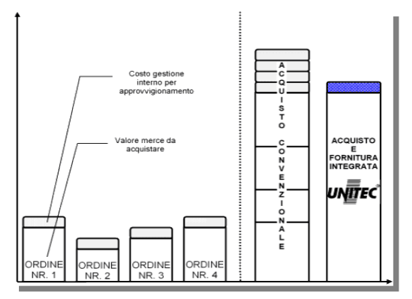
Fig. 3.2 : Comparaison des coûts d'exploitation avec et sans le support Unitec.
Il s'agit d'actifs en nature dont le prix est relativement bas, mais dont le coût total d'achat s'avère particulièrement élevé. Ceci parce que l'entreprise, pour pouvoir acquérir de tels actifs, prédispose et dispose de structures opérationnelles et de gestion optimisées et adaptées par contre pour l'achat de biens de type stratégique pour le seul Core business. En bref, donc, l'achat de biens de type non stratégique s'avère coûteux, non pas beaucoup pour le prix, mais surtout parce qu'ils proviennent de ressources commerciales consommées dans une activité d'achat pour laquelle l'entreprise n'est pas spécialisée ; cela signifie qu'il s'agit de créer une nette disproportion entre la valeur du bien acquis et le coût des procédures mises en œuvre pour l'obtenir. En outre, les grandes entreprises ont surtout l'habitude de réaliser des économies d'échelle, car de tels achats ne peuvent pas être réalisés à cause de l'acquisition de centaines d'actifs de divers types. Beaucoup d'entreprises internes pensent résoudre cette inefficacité avant d'essayer une politique d'internalisation qui est d'intervenir exclusivement à l'intérieur de la structure organisationnelle, mais le nombre de factures en entrée des fournisseurs ne peut être rationalisé ni de la part de l'administration, ni de celui qui émet les bons de commande, ni d'aucune autre agence commerciale. S'adresser au sous-traitant pour qu'il propose des solutions destinées aux procédures d'approvisionnement est seulement possible de "compatter" toutes les activités, permettant de réduire des centaines de factures à une seule, et de régler les délais de livraison.
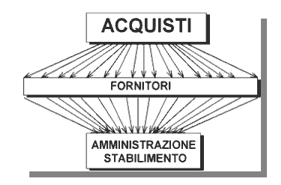
Fig. 3.3 : Avant l'adoption de l'offre intégrée.
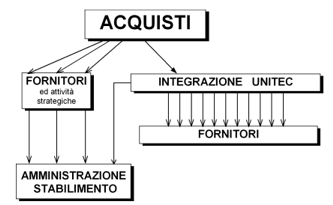
Fig. 3.4 : Après l'adoption de l'offre intégrée.
Comme on peut le constater en effet sur la figure 3.3 l'administration se révèle surchargée de travail, puisqu'elle doit s'occuper de tous les achats dont l'entreprise a besoin. Avec l'offre intégrée, comme on peut le constater par contre sur la figure suivante, 3.4 simplification effective des procédures de l'administration. Pour le client entreprise, mais ils ne changent pas les procédures de demande de fournitures. Simplement plutôt que de s'adresser à une centaine de fournisseurs, il fait référence au seul interlocuteur : Unitec. Les demandes pour des moyens non stratégiques sont envoyées à Unitec, qui les élabore en essayant de les fournir à l'intérieur de la base de distribution. Si le bien demandé s'avère urgent, le matériel est envoyé supporté avec une seule expédition, si au contraire il s'agit de matériel commandé avec un large paiement d'avance, l'Unitec, essaie d'offrir aussi un service intégré de livraison.
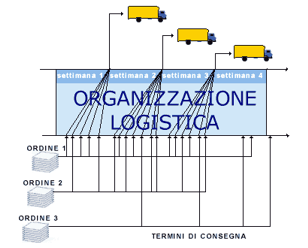
Fig. 3.5 : Aperçu temporel des livraisons avec Unitec. [Unitec GmbH, 2000]
Un autre grand avantage est représenté par la possibilité d'exécuter un paiement unique, dont les conditions viendront à vous convenir seules avec Unitec indépendamment des conditions d'approvisionnement établies par les fournisseurs uniques, puisque à telles conditions elle est subordonnée à Unitec et non au client final.
3.6. Les avantages vous corrèlent à l'approvisionnement intégré.
3.6. Les avantages vous corrèlent à l'approvisionnement intégré.
Selon les données actuellement disponibles, grâce à l'approvisionnement intégré, il est possible d'estimer une réduction des membres papier autour de 90%. En particulier, une entreprise cliente d'Unitec, au cours des premiers 16 mois au cours desquels ses approvisionnements ont été gérés à travers l'approvisionnement intégré, a réduit le nombre de bulles de 1321 à 85, avec une réduction égale au 93,56%, et le nombre de factures de 1000 à 40, avec une réduction égale au 96,00%. En résumé, nous pouvons dire que les coûts directs réduits pour vous concernent :
- Le domaine acquiert : grâce à l'unification et à la réduction des demandes et des commandes, des promptes, des traductions, etc.
- Le domaine administratif : en conséquence de pouvoir gérer une seule facture qui ne fait qu'amender plus de postes et plus de fournisseurs éventuellement aux transporteurs, et ainsi effectuer un seul paiement à un seul fournisseur (le fournisseur-approvisionnement).
- Le domaine logistique : une seule bulle de livraison, réduit et simplifie la réception des marchandises.
- L'enregistrement : la réduction du nombre des transactions (vos supports papier) entraîne une énorme diminution du volume physique des enregistrements et par conséquent elle rend l'accès aux documents plus simple et précis.
De plus, des optimisations ultérieures sont générées, indirectement : il s'agit d'une réduction de l'usage du téléphone et de tous les médias que ce soit à l'intérieur de l'entreprise ou à l'extérieur ; ils viennent vous optimiser les investissements des ressources vers le Core business ; cela améliore l'efficacité de la structure organisationnelle ; ils améliorent les flux logistiques grâce à une meilleure synergie avec les transporteurs qui livrent les marchandises. D'un intérêt particulier, ils vous seront également utiles dans le temps pour la gestion de l'entrepôt. La conséquence de l'eternalizzazione des approvisionnements positivement sur les indices de rotation des marchandises en stock: en pouvant reperir les marchandises de façon instantanée, il est possible de réduire la quantité d'approvisionnements soit des actifs stratégiques, celui des actifs non stratégiques qui sont présents dans l'entrepôt pour éventuellement pouvoir être habitués à se produire des situations imprévisibles (comme des pics inattendus de production ou des pannes aux systèmes) et que dans le temps ils peuvent se révéler inutilisables dans la mesure où ils sont obsolètes. ou dépérir. Un tel concept est représenté graphiquement sur les Fig. 3.6, 3,7 ici de suite ramenée.
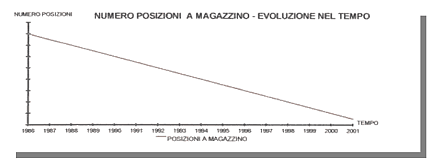
Fig. 3.6 : Evolution de la quantité de marchandises dans l'entrepôt d'une entreprise qui utilise le service d'approvisionnement intégré.
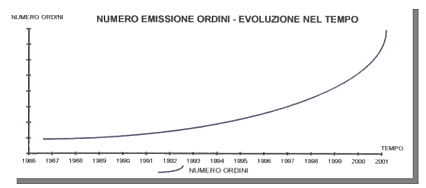
Fig. 3.7 : Déroulement de l'émission des ordres de fourniture intégrés dans le même intervalle de temps.
Dans la figure 3.7, le cours de la quantité de marchandises détenues en entrepôt est ramené, ce qui comme on peut l'observer à la suite de l'adoption de l'offre intégrée au fil des années devient de plus en plus faible, presque jusqu'à devenir nul. Sur la Fig. 3,8 est indiqué au contraire l'évolution du nombre d'émissions d'ordres, qui au fur et à mesure ils deviennent de plus en plus nombreux, mais la quantité matérielle devient toujours plus grande.
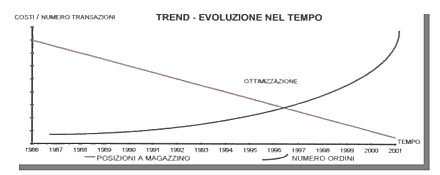
Fig. 3.8 : Relation entre le nombre de fournitures dans l'entrepôt et le montant des commandes de fourniture intégrée.
Dans le diagramme 3.8, l'accent est mis sur la relation dans le temps qui existe entre le nombre de commandes exécutées avec l'approvisionnement intégré et les fournitures d'entrepôt; il est évident que plus on revient à l'offre intégrée, plus les marchandises en stock tendent à diminuer. Naturellement le service de fourniture intégrée est "personnalisé" d'Unitec en fonction des exigences des propres clients, par exemple en convenant de la fréquence des arrivées des marchandises, ou des fréquences et des modalités de paiement, ou encore en sélectionnant les fournisseurs auprès desquels Unitec pourra s'adresser.
3.7. Exemple réel d'intégration des fournitures.
3.7. Exemple réel d'intégration des fournitures.
Dans le tableau 3.9 ramené dans les pages suivantes, est introduit un exemple réel d'intégration des fournitures dans le tableau réalisé de l'externalisation administrative d'Unitec pour un client. Le client a pu intégrer en fait 20 provenant notamment de 8 fournisseurs différents dans une seule demande, puis elle vient d'Unitec élaborée avec sélection successive des fournisseurs qui répondent aux exigences insérées du client entre les 3240 dans un simple logiciel d'agencement, en orientant éventuellement plus demandé - Anfragen - vers différents producteurs. Dans le cas où il faut procéder lui-même à la recherche d'un fournisseur particulier avec lequel Unitec n'a jamais traité, ils viennent utiliser des programmes spéciaux de recherche et de sélection. Reçu l'offre des fournisseurs demandés (Angebot), Unitec procède à l'évaluation des mêmes, en sélectionnant les meilleurs ; sur cette base, l'offre est préparée au client, en fournissant d'appliquer une marge de service. À ce stade, le client peut répondre positivement, en acceptant les conditions ou peut contacter Unitec pour des éclaircissements ou des demandes ultérieures, ou bien encore, refuser. Une fois reçue la confirmation d'une partie du client à travers la commande définitive, Unitec envoie ses propres commandes (Bestellungen) aux fournisseurs intéressés qui fournissent à livrer le montant demandé. Avant d'être envoyées à l'entreprise-client, les marchandises partent, si les commandes urgentes ne sont pas rassemblées près d'un entrepôt près de Monaco de Baviera - si elles sont composées de marchandises avec un poids avancé jusqu'à 50 Kg ou si un volume particulier, ou envoyées directement près du centre Unitec à Augsbourg. Dans les deux cas, chaque cou dont sont constitués les jeux de marchandises livrées, subit une série de soins de contrôles.
| 1 | Particulier 1 | Fournisseur 1 | 20 | 101,25 | set 1 |
| 2 | Particulier 2 | Fournisseur 1 | 4 | 42,50 | set 2 |
| 3 | Particulier 3 | Fournisseur 1 | 25 | 150,10 | set 2 |
| 4 | Particulier 4 | Fournisseur 2 | 1 | 510,00 | set 3 |
| 5 | Particulier 5 | Fournisseur 2 | 3 | 346,20 | set 1 |
| 6 | Particulier 6 | Fournisseur 3 | 10 | 22,30 | set 5 |
| 7 | Particulier 7 | Fournisseur 3 | 80 | 52,20 | set 1 |
| 8 | Particulier 8 | Fournisseur 3 | 2 | 315,00 | set 2 |
| 9 | Particulier 9 | Fournisseur 4 | 40 | 40,25 | set 3 |
| 10 | Particulier 10 | Fournisseur 4 | 35 | 15,25 | set 2 |
| 11 | Particulier 11 | Fournisseur 4 | 50 | 35,10 | set 3 |
| 12 | Particulier 12 | Fournisseur 5 | 40 | 220,30 | set 2 |
| 13 | Particulier 13 | Fournisseur 5 | 5 | 120,00 | set 7 |
| 14 | Particulier 14 | Fournisseur 5 | 3 | 210,00 | set 3 |
| 15 | Particulier 15 | Fournisseur 5 | 7 | 16,10 | set 2 |
| 16 | Particulier 16 | Fournisseur 6 | 100 | 150,00 | set 4 |
| 17 | Particulier 17 | Fournisseur 7 | 4 | 430,00 | set 5 |
| 18 | Particulier 18 | Fournisseur 7 | 30 | 215,00 | set 3 |
| 19 | Particulier 19 | Fournisseur 8 | 80 | 83,50 | set 2 |
| 20 | Particulier 20 | Fournisseur 8 | 20 | 25,20 | set 7 |
Onglet. 3.9 : Exemple réel de fourniture intégrée d'Unitec.
En particulier, il est vérifié : la correspondance entre les marchandises effectivement livrées et vous indique qu'elles sont rapportées sur le document d'accompagnement et la facture, chaque intégrité physique d'un seul cou, les articles et le montant de la marchandise livrée sont effectivement ceux exigés des fournisseurs. L'expédition des marchandises commandées au client s'effectue dans une seule solution, selon les accords pris, en journée, en semaine ou au cours du mois.
3.8. Il s'avère que vous disposez d'une alimentation intégrée.
En réalisant une commande intégrée, l'entreprise client a réussi à regrouper diverses particularités dans une seule commande, qui au lieu de 20 offres, 20 livraisons, 20 factures et bulles relatives recevra une simple copie pour chaque document. Cela a permis donc de réduire les transactions de 8 à 1, en termes de pourcentages a une réduction de 87,5%. Il est donc entendu que, comme les coûts du service prêté par Unitec, vous pouvez devenir vous-même maigre des économies directes réalisables - avec les achats de grandes quantités de produits pour différents clients Unitec, on s'assure des prix de fourniture de nombreux concurrents - que des améliorations de l'efficacité. Grâce aux commandes intégrées, donc, au-delà de ce qui a déjà été dit, une entreprise réussit à réduire considérablement aussi le nombre de fois où elle s'adresse normalement aux transporteurs, en remplaçant les petites et les livraisons - avec des coûts relativement élevés - par une quantité de marchandises, transportées à des prix proportionnellement plus contenus. Même en ce qui concerne les factures et les paiements, il doit tenir compte des accords pris entre Unitec et ses clients ; il peut s'agir en fait d'hebdomadaires ou de salaires ; dans ce dernier cas, l'entreprise cliente recevra au maximum 12 factures par an. Un rôle important dans l'externalisation administrative est couvert par les technologies de communication qui permettent à Unitec d'améliorer les temps de participation - généralement il est possible d'obtenir une réponse d'Unitec dans les 24 heures - et surtout d'offrir une série de services autrement impossibles.
4. FOURNITURES APRÈS L'UTILISATION DU FOURNITURE INTÉGRÉE
4.0. Prémisse
Prémisse.
Dans ce premier compris, sur la base des données exposées, on tente d'évaluer préalablement les conséquences, en termes de temps d'exploitation, qu'impliquerait pour l'entreprise championne, en resserrant un accord de fourniture intégré avec Unitec GmbH, en ce qui concerne les livraisons de "biens hors production" et d'actifs sporadiques. Malgré tout, ce sont des découvertes mais des valeurs d'interférences totales avancées à 40%, ce qui fait que l'activité de l'entreprise ralentit. Comme première conséquence les échanges commerciaux quotidiens de l'entreprise changeraient comme exposé dans le tableau 4.1.
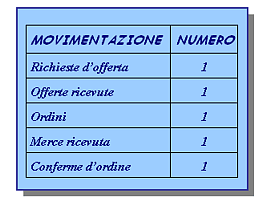
Languette. 4.1 : Dynamisation quotidienne de l'entreprise si elle adopte le système d'approvisionnement intégré.
Brouillon d'un changement radical : tous les animateurs trouvés à la semaine pour chaque voix, se réduisent à un. Cette vérification, pourquoi les procédures managériales, administratives et de contrôle des relations commerciales avec les fournisseurs ont été transférées à Unitec. Le seul sujet avec lequel l'entreprise devra interagir pour ses propres livraisons de "biens hors production" devient donc Unitec GmbH. Dans le tableau 4.2, ils mettent en évidence par contre les fréquences quotidiennes d'utilisation des médias qui vous emploient pour les approvisionnements après la ressource à l'approvisionnement intégré. En confrontant tel tableau avec celui ramené au sens précédent, une forte réduction de ceux-ci peut être constatée. Pour ce qui concerne le fax, c'est un manuel qui est un fusil automatique, car les procédures d'approvisionnement ne sont pas utilisées : l'envoi des demandes d'approvisionnement et des commandes et la réception de l'offre Unitec se font d'heure en heure via Internet. Le courrier à l'arrivée est relatif seulement à une confirmation de provenance de commande de Unitec, mais ne sera pas plus l'entreprise de devoir exiger des devis à chaque fournisseur, mais Unitec qui recherchera le plus de concurrence, évaluera les offerts reçus, en composant une offre unique qui sera envoyée au client pour l'approbation définitive.
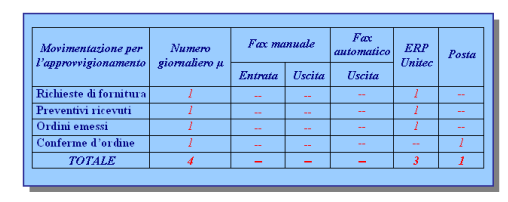
Languette. 16h30 : J'utilise les médias après l'accord de fourniture intégré avec Unitec.
La qualité de l'utilisation des médias, la réduction des procédures, unies à l'exploitation des technologies Internet, permettent à l'entreprise de limiter remarquablement les temps à consacrer à la gestion des approvisionnements. Ici de suite viendront vous analyser les mêmes unités dont l'implication dans les procès d'approvisionnement a été précédemment décrite, en illustrant des différences plus importantes.
4.1. Émissions demandées pour l'approvisionnement.
Les premières micro activités de cette première phase ne changeront pas puisque pour établir les exigences commerciales des unités productives, elles devront être contrôlées et ramenées dans le système à travers lequel l'entreprise est gérée. C'est pourquoi, comme d'habitude, l'entrepôt rédigera et enverra la communication concernant la nécessité au responsable de l'agence, puis il la transmettra à celui qui acquiert la compétence dans le bureau. Et c'est dans cette phase que l'approvisionnement vous apporte des avantages dans la gestion des approvisionnements. Le principal avantage dans cette phase est de ne pas avoir à se soucier de devoir commencer une recherche d'un fournisseur pour une nouvelle pièce parce que les demandes de matériel se confondent et ce sera alors Unitec pour commencer cette recherche et cette prise de contact avec ce nouveau sujet.
4.1.1. Interférences possibles trouvées dans les émissions demandées d'alimentation: 1ª phase.
Dans ce cas également, les interférences qui intéressent ce premier groupe d'activités sont considérablement réduites ; Ce phénomène est dû avant tout à la contraction du nombre d'activités, ce qui expose l'unité à d'éventuelles erreurs, en plus de cela à l'aide de technologies qui permettent de transmettre l'information de manière plus sûre et plus rapide. Naturellement, les inconvénients peuvent être vérifiés. Il peut arriver en effet que les demandes envoyées au prestataire se révèlent peu claires pour lesquelles ce dernier a besoin d'un contact téléphonique pour demander des informations ultérieures sur le mérite. La fréquence de ces contacts peut être estimée à 2 fois par semaine pour un total de 14' 52 ", cependant de loin inférieure à la même typologie d'activité réalisée normalement qui exigeait 3h 09' (-92%).
4.2. La direction a exigé des estimations.
4.2. La direction a exigé des estimations.
Plutôt que d'avoir chaque jour à préparer et à envoyer 10 demandes d'approvisionnement par fax, l'opérateur pourra s'adresser à NetSourcing di Unitec pour exiger un seul devis. Inséré et il vous envoie la marchandise demandée, Unitec se chargera de contacter les fournisseurs. Le temps employé hebdomadaire est de 51' 35", la réduction de temps est égale à 89%. Pour autant qu'il s'agisse des succès que vous accélérez, il n'y aura plus de fournisseurs différents à contacter et à côté desquels demander une offre puisque cet Unitec nous pense que nel.giro.di provvederà un jour à l'expédition du devis pour tous les matériaux que l'entreprise a demandé. Cette phase est donc la plus rapide puisque les estimations à vérifier n’en sont qu’une.
4.2.1. Possibilités d'interférences constatées dans la gestion demandée des devis : 2ª phase.
Les interférences diminuent moins proportionnellement qu'autrement aux activités ; la raison est recherchée dans le fait que ce type d'interférences, même s'ils sont remarquablement réduits, ne sont jamais complètement éliminés, cependant les valeurs de référence sont nombreuses. En premier lieu, on n'enregistre pas davantage d'interférences liées à l'utilisation du fax ; en deuxième lieu la nécessité d'utiliser avec ordre peu d'heures l'ordinateur, afin de diminuer la probabilité de se produire des ralentissements du système ou des problèmes de logiciel (10' 30 ", -75%). Ce sont les erreurs du personnel, unies aux dispersions de temps dans la recherche de documents et d'archivage qui ne se trouvent pas supportées, qui subissent une diminution.
4.3. Gestion des offres.
L'entreprise recevra donc un devis unique, qui sera enregistré et estimé. Évidemment, l'entreprise pourra contacter Unitec pour avoir des éclaircissements sur d'éventuelles conditions de livraison et pourra exiger une réduction du prix en faisant allusion à une réduction de prix. Le prix de la marchandise est en effet refacturé par Unitec, afin de couvrir ses frais, d'un montant assez variable. Cette marge est largement compensée soit par les réductions de prix obtenues grâce aux économies d'échelle sur lesquelles Unitec réussit à faire levier auprès des fournisseurs, soit surtout par les réductions de temps et les plus grandes efficacités que l'entreprise réussit à obtenir de l'offre intégrée. Ce devis suivra évidemment la procédure bureaucratique préalable donc avec passage pour l'approbation des caractéristiques de la part d'une partie des techniciens.
4.3.1. Interférences trouvées dans la gestion des proposées : 3ª phase
Les interférences liées à l'ordinateur ou au fax peuvent être toujours vérifiées et sont dues ou héritées de surcharges momentanées du système qui déterminent des rallentamenti dans l'approche des pages souhaitées. Compris lorsque plus opérationnels ils ont recours au même moment de confinement blindé vous donnent un rendu particulièrement long et complexe. Comme nous l'avons déjà souligné, lorsqu'il s'agit de disposer des différentes offres, il essaie d'améliorer les conditions en interagissant directement avec le fournisseur. Projet pour la plupart à tenter d'obtenir des réductions de prix ultérieures, ou d'anticiper la date de la livraison. D'autres fois le fournisseur vous propose des produits alternés. Généralement, les conversations se déroulent à travers l'utilisation du téléphone. Il s'agit même de négociations qui se produisent assez fréquemment - pour 10 réceptions de devis, dans 6 cas le fournisseur se contacte lui-même -, le temps que vous consacrez chaque semaine est relativement élevé et cependant il interfère avec l'activité commerciale normale en faisant perdre du temps au personnel.
4.4. Gestion des commandes.
Après avoir préparé une seule commande malgré les positions qu'ils sont nombreux et surtout de différents fournisseurs entre eux, celle-ci est envoyée via Web. Le temps hebdomadaire travaillé est de 52' 30", avec un gain de temps de 91%. Grâce au service de NetSourcing l'attaché pourra surveiller et analyser la mouvement relatif aux approvisionnements que de jour en jour viennent vous effectuer et le temps hebdomadaire est de simple 16' 35". La réception de la confirmation de commande se fait toujours par courrier ordinaire, mais étant un document unique, elle est assistée cependant à une réduction du temps, qui devient égale à 30' 25 ", avec une réduction du 51,5%. Le temps que chaque semaine le personnel de l'entreprise emploie pour gérer les opérations liées aux approvisionnements après l'introduction de l'approvisionnement intégré d'Unitec, devient plus petit. Cela signifie que le temps de mise à disposition de l'unité pour les activités d'accueil et de gestion des clients augmente de façon considérable, au bénéfice de la qualité du service offert.
4.4.1. Interférences possibles trouvées dans la gestion des commandes: 4ª phase.
Dans le cas où les marchandises reçues sont louées, il s'agit malheureusement d'un inconvénient lié au transport, donc non négligeable. De toute façon, compte tenu du type de relation qui vient d'établir avec Unitec, les délais pour remédier à telle situation devraient baisser et être égaux à environ 6' 49" hebdomadaires.
4.5. Contrôle à l'arrivée des marchandises.
Suite à l'adoption de l'approvisionnement intégré, les tâches exercées depuis les attachés jusqu'à l'entrepôt ne changent pas. Cette modification est par contre la fréquence avec laquelle ces activités sont réalisées. Vérification en outre d'une réduction substantielle des interférences. En ce qui concerne la réception et le contrôle de la marchandise, le workflow qui la gère reste immuable. Le changement significatif qui est célèbre est la fréquence avec laquelle les opérations individuelles sont effectuées ; cela dérive directement du fait que les 14 cous quotidiens sont livrés une seule fois par jour avec une seule facture et une seule bulle d'accompagnement. Cela signifie qu'ils sont "compattati" les processus de réception de la marchandise, d'enregistrement et d'enregistrement du document d'accompagnement. L'hebdomadaire de temps est en effet réduit à 1h 44' 20" avec une réduction nette de 42,7%.
4.5.1. Interférences possibles constatées dans le contrôle à l'arrivée des marchandises: phase 5ª.
Les interférences qui peuvent être vérifiées dans cette phase souffrent d'une réduction drastique : un contrôle de la liste des fournisseurs en retard de livraison et non plus des serviteurs, donc comme celui-là pour vérifier si les marchandises arrivées sont fausses, dans combien de fonctions qui ont été déléguées à Unitec. Parallèlement les délais de livraison sont plus rares (de 1 fois par jour à 1 toutes les deux semaines). En faisant référence pour les fournitures seulement à Unitec, mais les causes de retard peuvent être circonscrites à deux: le retard de livraison qu'ont dû les fournisseurs d'Unitec; le retard de livraison pour erreurs d'Unitec. Mais les deux résolubles à la hâte, en effet le temps nécessaire est égal à 2' 01 " avec une réduction du 98,8%. Il reste cependant le risque que les marchandises soient endommagées lors du transport d'Unitec à l'entreprise ; ce problème est totalement salarié du transport, pour lequel non licenciable, les procédures de substitution se résolvent de façon rapide et donc le temps hebdomadaire devient 12' 10". Dans le cas où un dommage se produit, le remplacement des marchandises louées se produit sans la préparation de la lettre rendue, ayant déjà informé Unitec et le temps hebdomadaire est réduit à 7' 58 ". Le temps demandé pour faire face aux interférences directes se réduit à seulement 22' 09 "par semaine - comme rapporté dans le tableau 4.3 -, avec une économie de près de 93%. Les interférences transversales, de par leur nature, ne peuvent pas être toutes éliminées ; cependant, ils subissent une réduction nette. Bâti à penser en outre au fait que tous les problèmes dérivant du fax, qu'ils soient manuels ou automatiques, vous sont complètement éliminés, en pouvant compter sur d'autres médias beaucoup plus expresses ; en outre, en diminuant l'activité liée à la gestion des approvisionnements, en proportion les erreurs qui peuvent être vérifiées, ou diminuent les difficultés que l'on peut avoir dans la recherche de documents et d'archives.
4.6. Réception de la facture du fournisseur.
4.6. Réception de la facture du fournisseur.
Même si dans une moindre mesure par rapport aux autres, cependant aussi dans cette phase je l'utilise de l'offre intégrée vous a apporté ses effets positifs ; ceci surtout en tenant compte du fait que la taille du document vous concerne chaque jour pour les fournitures diminue considérablement. Les processus de réception et d'enregistrement des factures, sont sensiblement simplifiés, grâce à la quantité réduite d'informations à traiter. L'estimation du magazine hebdomadaire horaire peut être descendue de 9h 17' 20" à 1h 30' 05" (- 83,8%).
4.6.1. Interférences possibles constatées dans la réception de la facture du fournisseur : 6ª phase.
Les interférences qui peuvent être vérifiées sont très minimes. En référence aux paiements, il est difficile de supposer que des factures non correctes puissent arriver, le temps descend à 8' 34 "(-66,6%). Des activités plus petites relatives aux livraisons impliquent aussi une réduction des interférences : des possibilités plus petites de s'embrouiller dans des problèmes de système ou de logiciel, des erreurs mineures dans le traitement de l'information, des difficultés mineures pour trouver des documents et des classeurs qui peuvent être difficiles à trouver. Cela implique une réduction des temps égaux au 59,1%.
4.7. Paiement de la facture.
Aussi pour ce qui concerne le paiement des factures, il s'avère que tout est beaucoup plus simplifié puisque les factures à payer seront réduites, puisque dans une seule facture elles viennent rapportées diverses positions également de divers fournisseurs. Par conséquent, on pourrait arriver à avoir aussi seulement 12 factures si finalement l'entreprise d'accord avec le fournisseur décide de recevoir la facture une seule fois par mois relatif à tous les matériaux de cette période.
4.7.1. Interférences possibles constatées dans le paiement de la facture : phase 7ª.
Par conséquent aussi le contrôle des paiements s'avère devenir plus simple si des problèmes ne se produisent pas, le temps hebdomadaire nécessaire pour ce type de contrôle est en effet réduit à 31' 30 "(-45,5%). En ce qui concerne les inconvénients liés aux paiements, ceux-ci sont également introduits très rarement et, lorsque cela se produit, leur résolution est facilitée par le moindre nombre d'informations à traiter et surtout parce qu'il y a un seul sujet à traiter et non une myriade de fournisseurs.
4.8. Avant et après la fourniture intégrée : comparaison des délais
4.8. Avant et après la fourniture intégrée : comparaison des délais
Dans ce paragraphe ils vous analysent et vous confrontent aux données recueillies avant et après l'adoption de l'externalisation d'approvisionnements sous la forme de l'approvisionnement intégré d'Unitec, en se basant sur les enquêtes qu'il vous réalise dans l'entreprise et sur l'estime élaborée dans les paragraphes précédents. Les unités impliquées dans le processus d'approvisionnement sont quatre : unité logistique, qui les commercialise, central téléphonique et unité administrative et la première conséquence induite de l'approvisionnement intégré d'Unitec, pour toutes et les quatre unités est sûre la réduction nette du temps que l'entreprise consacre à la gestion des approvisionnements. Le diagramme 4.15 ci-dessous ramené ici représente les temps que vous trouvez dans les unités de l'entreprise championne - en rouge - et ceux que vous estimez pouvoir être rattrapés - en bleu -. On remarquera durablement que l'unité principalement impliquée dans les processus d'approvisionnement reste que l'on les commercialise ; cependant, compte tenu du nombre de personnes affectées à l'unité, ce sont les unités logistiques et administratives qui emploient plus de temps par semaine dans des opérations liées aux approvisionnements. Il s'agit d'un changement radical de direction qui induit à conclure que justement l'unité les commercialise est ce qu'elle a trouvé un plus grand giovamento de l'offre intégrée, permettant une plus grande économie de temps.
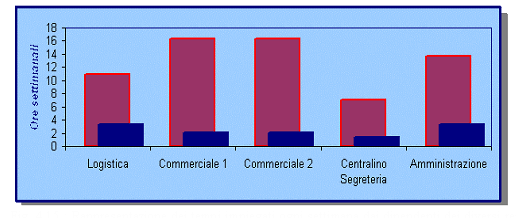
Fig. 4.15 : Présentation des temps qui vous emploie chaque semaine depuis les dépendants des différentes unités pour la gestion des approvisionnements, avant - en rouge - et après - en bleu - l'approvisionnement intégré.
Comme preuve de cela, il suffit de penser que chaque attaché de l'unité commerciale épargne plus de 2 heures et 48 minutes par jour, en réduisant les tâches liées à des approvisionnements non stratégiques moyens du 87,3%. Cela est déterminé conjointement par une forte réduction des activités (- 87%) et des interférences relatives, qui diminuent plus que proportionnellement de très 95,8%. En ce qui concerne le soleil lié aux activités directes aux approvisionnements, il est attaché à l'unité administrative pour gagner plus de temps, cependant si on le considère en relation avec le total des heures de montage, la diminution est égale à près de 80%. il faut remarquer que l'administration, caractérisée aussi déjà en s'éloignant d'interférences directes assez faibles, avec l'offre intégrée a réussi cependant à réduire la mesure des deux tiers. L'unité logistique se présente également puisqu'elle semble en contradiction avec les autres unités d'affaires ; la diminution des activités, en effet, est égale à 42%, nettement moins prononcée par rapport aux autres valeurs qui varient de 79,5% à 87%. La raison réside dans la relation entre activité et interférences de l'agence : contrairement aux autres unités, en effet, la plus grande partie du temps est normalement dépensée pour des interférences directes égales au 47,5% du temps total - tandis que les activités réelles et propres qu'elles occupent, la seconde se trouve directement combien, un temps plus réduit ; telle réduction implique une réduction d'un pourcentage nettement plus grand des interférences concernant les activités. La réduction des interférences transversales, comme on peut le constater, s'avère relativement moins prononcée en ce qui concerne les activités et les interférences directes. Dans presque toutes les agences commerciales celles-ci diminuent étonnamment de façon homogène d'environ une heure moyenne et, à l'exception du secrétariat du central téléphonique de l'unité, qui cependant, n'introduisant pas quelque type d'interférences dirigées, il s'agit d'envisager, sous ce point de vue, un cas à part. Cela est dû, en même temps, au fait que, en départ, les interférences transversales plus basses ont une valeur de temps en ce qui concerne les activités et aux interférences dirigées, soit au fait qu'elles sont liées à des facteurs moins sensibles qui ne viennent pas du tout éliminer la gestion des approvisionnements et cependant au volume de travail diminué. En supposant, deuxièmement, ils vous rapportent, on peut affirmer que dans le cas spécifique de l'entreprise championne, l'introduction de l'approvisionnement intégré d'Unitec entraînerait en moyenne une réduction des interférences directes du 93,8%, des activités du 81% et des interférences transversales du 66,9%, pour une réduction des temps totaux consacrés aux devoirs relatifs aux approvisionnements autour de 81%. En particulier, les agences commerciales qui en tireraient principalement profit seraient, dans l'ordre, l'unité commerciale, l'unité central téléphonique-secrétariat, l'unité administrative et celle logistique. Dans le premier et le trimestre, on a pu constater surtout de fortes réductions des interférences dirigées, dans les deux autres, à la place des activités. Ce comportement différent dépend en grande partie de la nature des tâches exercées : l'unité central téléphonique-secrétariat, donc comme l'administration, s'avère principalement sensible à la variation des volumes d'informations qui vous sont adressées, et en fait, pour ces agences, ce sont les réductions de temps relatives aux activités qui contribuent de manière déterminante à la réduction des délais ; l'unité logistique et celle que l'on commercialise, par contre en moyenne, démontrent surtout trouver un giovamento particulier de la diminution des interférences directes.
4.9. Avant et après l'adoption de l'offre intégrée : évaluation économique.
4.9. Avant et après l'adoption de l'offre intégrée : évaluation économique.
Comme on a pu comprendre du paragraphe précédent, l'approvisionnement se révèle être un instrument optimal de gestion des approvisionnements relatifs au matériel non stratégique, dans la mesure où il permet aux attachés de l'entreprise de consacrer un minimum de temps à la gestion d'un tel processus, pouvant ainsi se consacrer à toutes ces activités liées au Core business qui se révèlent avoir un caractère stratégique et une plus grande valeur ajoutée. Au-delà de telle comparaison, dans ce paragraphe le service de fourniture intégré offert par Unitec a été calculé à combien s'élève l'économie obtenue de l'entreprise utilisatrice et pour faire en sorte que ce besoin soit du coût des heures de travail supportées par l'entrepreneur qui des heures employées pour porter un terminal d'approvisionnement géré à l'intérieur de chez l'attaché. La première valeur regroupe tous les coûts qu'un entrepreneur doit supporter pour le développement de l'activité commerciale normale. On pourrait penser que dans tel chiffre ces coûts relatifs rentrent seulement dans la gestion active du personnel comme les salaires ou traitements et cotisations ; ces coûts directs rentrent par contre tous et indirects qui humides dans le temps permettent aux personnes à charge d'accomplir leur travail, qui louent des locaux, des équipements comme des ordinateurs et des fax, mais aussi des infrastructures dont des machines et des outils. Ce coût a été calculé et s'élève à environ 140 euros par heure. Selon les statistiques de l'Union européenne, cette valeur est cependant en constante augmentation. Pour le premier trimestre de cette année on a déjà enregistré seulement, en Eurolandia, une augmentation de 2,3% par rapport à la même période du 2003. Légère augmentation également par rapport au trimestre précédent, lorsque le coût du travail avait fait enregistrer un + 2,2%. Évidemment, cette valeur varie d'un État à l'autre, comme exemple dans le premier trimestre du 2004 a enregistré un +0,2% pour l'Autriche, un 0,5% pour le Portugal et +1,5% en Allemagne. Dans notre pays, le coût des heures de travail, enregistre une augmentation de +4,1 %, avec une augmentation décidée par rapport à +0,6% du premier trimestre du 2003 et au +2,3% des derniers trois mois de l'an passé. Après tout, ils vous donnent plus de rapport et ne veulent pas que cela confirme que ce coût a tendance à augmenter avec le passage des années. Pour ce qui concerne les heures consacrées par les attachés de l'entreprise pour trouver le manque matériel jusqu'à l'obtention des marchandises et payer les factures relatives tas à environ 7 heures, telles données sont données du récapitulatif des temps rapportés dans le schéma rapporté 2.4 dans le compris le 2. Pour obtenir donc le coût total supporté par l'entreprise pour réaliser l'approvisionnement, il est nécessaire d'effectuer l'opération suivante :
COÛT HEURES DE TRAVAIL X HEURES NÉCESSAIRES
En effectuant ce calcul, il s'avère donc que gérer un tel approvisionnement coûte à l'entreprise environ 1015 euros. De cela il en résulte que pour l'entreprise il est plus commode de faire gérer à Unitec, tous ces approvisionnements non stratégiques, dont la valeur d'achat n'est pas élevée. Faire déplacer toute la machine bureaucratique avant tout côte à l'entreprise en fait un chiffre exorbitant et sproporzionata en ce qui concerne la valeur et l'importance que ce bien couvre pour l'entreprise. L'entreprise qui confie à Unitec ses approvisionnements aura donc un double avantage : d'une part en effet elle devra payer un coût de service plus bas que 1015 Euros (grâce à l'efficacité des processus il est possible d'appliquer en fait des marges réduites.) et en plus elle pourra se consacrer à ces activités stratégiques liées au Core business. Avoir plus de temps, mais surtout plus de ressources en personnel et en argent pour mener à bien ces activités qui seront exécutées de manière meilleure et plus rentable pour la même entreprise. Après tout dans ce centre nous pouvons considérer l'offre intégrée comme un instrument optimal de gestion des approvisionnements qui permet aux entreprises qui l'utilisent de rendre dynamique et surtout flexible l'entreprise, grâce à la transformation des coûts d'approvisionnement, une fois qu'elle se considère fixe en coûts variables adaptables et donc au volume d'affaires.
BIBLIOGRAPHIE
R. Colangelo, "Supply Chain Management : comment améliorer la gestion des approvisionnements et des fournisseurs", Il sole 24 ore, 2001. C. Ferretti, R. Shapiro, "De la logistique à la gestion de la chaîne d'approvisionnement : théories et expériences", Isedi, 2002. L. Ronche, " Introduction à la planification à long terme et aux stratégies commerciales", Franco Angeli éditeur, 1975. L. Fumagalli, P. Di Croccio, "L'externalisation et les nouveaux scénarios de tertiarisation", Franco Angeli Editore, 2002. R. Perrotin, F. Calì, "Marketing d'achat : stratégies et tactiques" Franco Angeli éditeur, 2002. Unitec GmbH. https://www.unitecd.com 2004. G. Remparts, M. Loni, "Comakership : clients et fournisseurs comment faire des affaires ensemble" Isedi, 1997. R. De Maio, E. Maggiore, "S'organiser pour innover : des relations client-fournisseur évoluées", Etaslibri, 1997. A.Landi, "Marketing d'achat : un guide pratique pour les gestionnaires et les responsables des achats", Franco Angeli Editore, 1979. L. Cantone, "Externalisation et création de valeur", Il sole 24 ore, 2000. G. Ferrando, "Sous-traitance et approvisionnement dans l'évolution du système d'entreprise", Milan, 1987. G. Gregari, "L'évolution du processus d'externalisation dans les stratégies de développement des entreprises", G. Giapichelli Editore, 1999. V. Marino, D. Brignone, "Case History - Pour une chaîne de valeur" Soluzioni, 1998. P.Venturini, "Externalisation des achats et intégration des achats dans le cas Unitec", Université "La Sapienza" de Rome, A.Y. 1997-1998 V. Marino, "L'externalisation procédurale des achats" Buy Today, 1998. Conseil de la chaîne d'approvisionnement (SCC), 2004. J. Champy, M. Hammer, "Repenser l'entreprise" Sperling & Kupfer Editori, 1994. Petit Arthur D., http://www.ilsole24ore.com, Il sole 24 ore, 2000. White A. "L'équation de valeur : gestion de la chaîne de valeur, collaboration et Internet" http://www.logility.com, mars 2000.
CURRICULUM VITAE
Données personnelles : Nom : Roberta. Nom de famille : Smaila. Adresse : Turin, Via Pergolesi, 60. Lieu et date de naissance : Turin, 1er avril 1981. État civil : Célibataire. Mobile : 3473644427 - 0049 1738226634 Téléphone : 011 266393
Éducation scolaire :
Diplôme de premier cycle en commerce extérieur à l'Université de Turin. Réalisé le 12 juillet 2004 avec une note de 101/110. Titre de la thèse : « L'offre intégrée dans les achats : le cas Unitec ». Diplôme d'expert commercial et correspondant en langues étrangères. Réalisé c/o I.T.C. "Vera e Libera Arduino" de Turin le 10 juillet 2000 avec la note suivante : 95/100.
Expériences professionnelles :
Mai 2004 - décembre 2004. c/o Unitec G.m.b.H de Gersthofen. Gestion d'un budget client, support commercial et achats avec des contacts quotidiens avec les clients italiens et les fournisseurs étrangers et responsable des activités de secrétariat. Octobre 2002 - mai 2004. c/o E.d.j Promotion de Turin. Activités promotionnelles et hôtesses dans les centres commerciaux.
Langues étrangères :
Italien : locuteur natif. Allemand : bon à l'écrit et à l'oral. Anglais : passable à l’écrit et à l’oral.
Compétences informatiques : Bonne connaissance des systèmes d'exploitation Windows (Word, Excel..).
Disponibilité : Libre de contrat depuis le 1er janvier 2005. Disponible pour de courts voyages en Italie et à l'étranger.
Autres informations :
Stage : Octobre 2003 - Décembre 2003 c/o Unitec G.m.b.H. Rappels quotidiens aux fournisseurs, création de fiches clients, archivage, support au bureau des ventes et des achats. Stage : Juillet 2003 - Septembre 2003 c/o Eaton - Amtec de Rivarolo (To). Saisie des données, activités de secrétariat du bureau technique, création des fiches techniques et cycles de traitement, archivage. Été 2001 - Été 2003 : Commande chez un glacier de Turin.
Je soussignée, Roberta Smaila, autorise l'utilisation de mes données personnelles, conformément à la loi 675/96.
Cette page a été automatiquement traduite avec Google à partir de la langue italienne.


